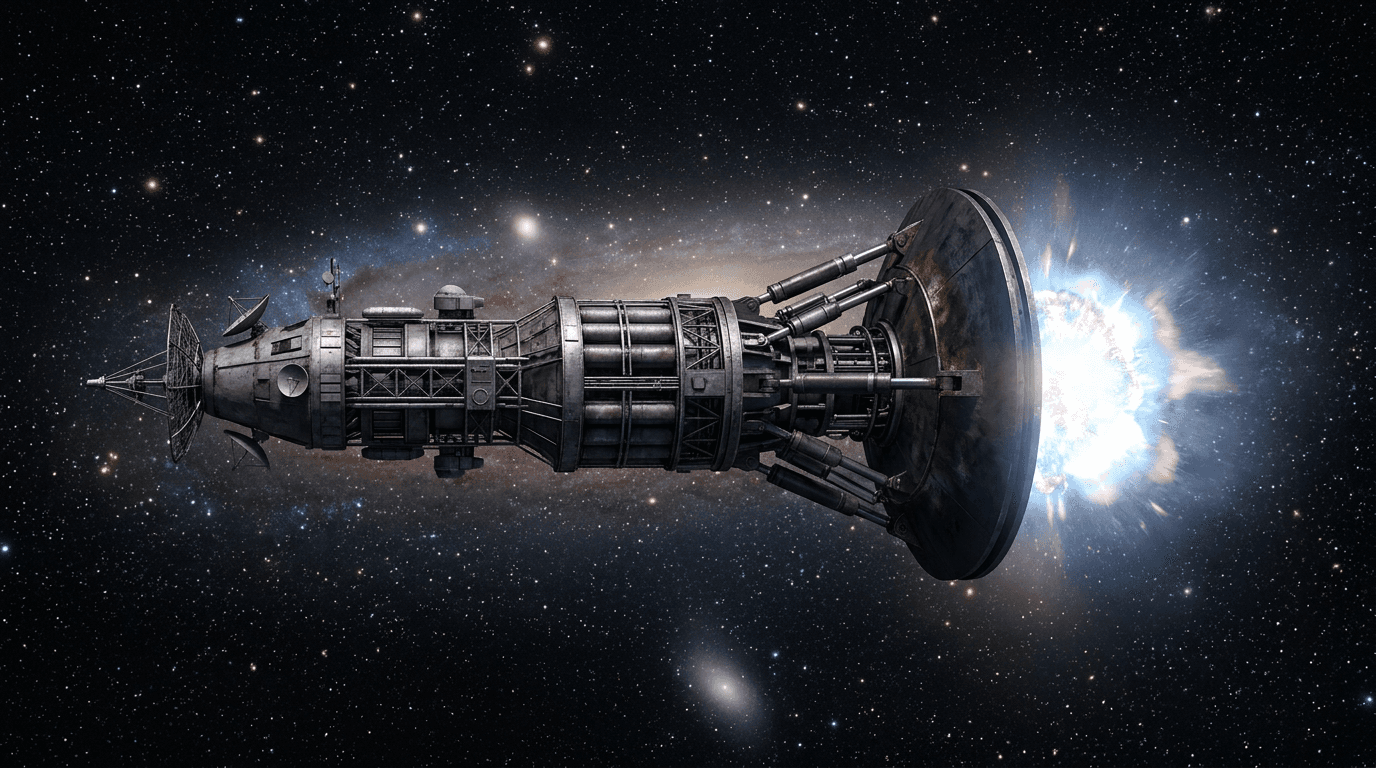
Nuclear Pulse Propulsion
Nuclear pulse propulsion represents one of the most audacious concepts in spacecraft engineering, utilizing controlled nuclear detonations to achieve velocities far beyond conventional chemical rockets. The fundamental mechanism involves ejecting small nuclear devices—either fission or fusion charges—behind a spacecraft at regular intervals, where they detonate and transfer momentum to a massive shock-absorbing "pusher plate" attached to the vehicle. This plate, designed to withstand repeated nuclear blasts through advanced materials and ablative coatings, converts the explosive force into forward thrust through a sophisticated suspension system that dampens the acceleration pulses into manageable loads for the crew and payload. The most thoroughly studied designs, including the U.S. Project Orion in the 1950s-60s and the British Interplanetary Society's Project Daedalus concept from the 1970s, demonstrated through theoretical analysis that such systems could achieve specific impulses orders of magnitude higher than chemical propulsion, potentially enabling crewed missions to the outer planets or even nearby star systems within human lifetimes.
The primary challenge this technology addresses is the fundamental limitation of conventional propulsion for deep-space exploration: the tyranny of the rocket equation, which requires exponentially increasing fuel mass for linear increases in velocity. Chemical and even advanced ion drives face severe constraints when contemplating missions beyond the inner solar system, with transit times measured in years or decades and payload fractions that make crewed missions economically prohibitive. Nuclear pulse propulsion offers a pathway to dramatically reduce transit times—early Orion studies suggested Mars missions in weeks rather than months, and outer planet expeditions in timeframes comparable to historical oceanic voyages. This capability would transform humanity's relationship with the solar system, making resource extraction from asteroids, establishment of permanent outer-system colonies, and rapid-response scientific missions to emerging phenomena feasible for the first time. The technology has also been repeatedly cited in aerospace intelligence assessments, including the French COMETA report, as a theoretically viable explanation for observed unidentified aerial phenomena exhibiting performance characteristics beyond known propulsion systems.
Despite its theoretical promise, nuclear pulse propulsion has never progressed beyond conceptual studies and small-scale component testing, primarily due to the 1963 Partial Nuclear Test Ban Treaty, which prohibits nuclear detonations in the atmosphere and outer space. Contemporary research continues at a theoretical level, with some aerospace organizations exploring miniaturised fusion variants that might comply with international treaties while still delivering transformative performance. The concept remains a touchstone in discussions of breakthrough propulsion, regularly appearing in long-range space exploration roadmaps and speculative engineering literature. As humanity's ambitions extend deeper into the solar system and fusion energy research advances, nuclear pulse propulsion may experience renewed interest as a potential bridge technology between current chemical systems and hypothetical future drives based on antimatter or field propulsion. The persistent gap between this technology's theoretical capabilities and its complete absence from operational spacecraft continues to make it a reference point in discussions of unexplained aerospace phenomena, representing what advanced propulsion could achieve if political, environmental, and engineering barriers were overcome.
Research this in Signals
Signals turns a topic into a sourced research record you can inspect and rerun. Your first scan is free, and this one starts with Nuclear Pulse Propulsion already loaded, so edit it or scan as is.