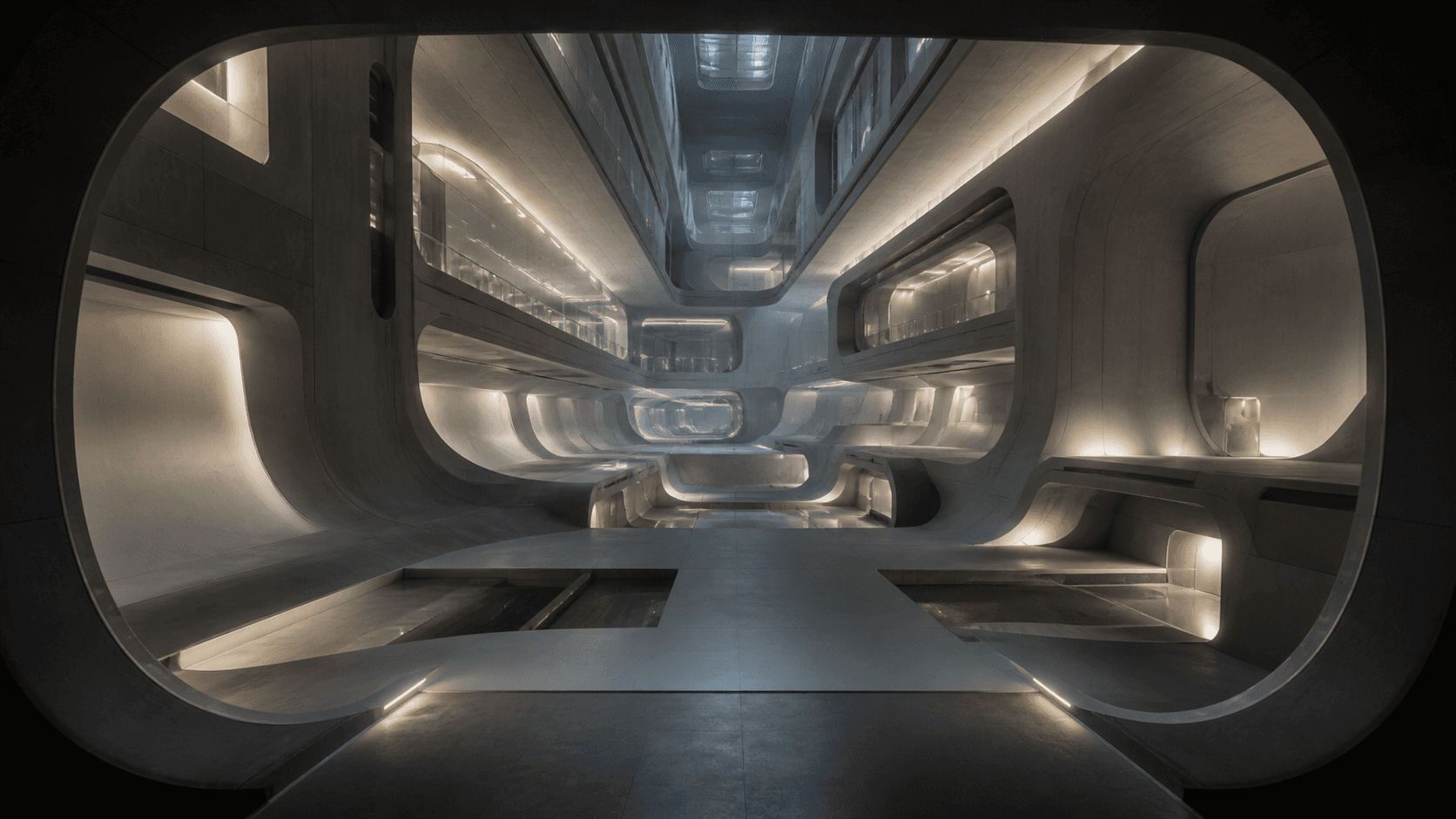
Non-Euclidean Interior
Among the more reality-defying claims in abduction testimony documented by John Mack and others is the 'TARDIS effect'—craft interiors that appear impossibly spacious relative to observed external dimensions. Experiencers describe entering small disc-shaped objects (30-50 feet diameter) and finding themselves in vast chambers with high ceilings, multiple rooms, and corridors extending beyond what external geometry permits. Some accounts include specific estimates: exterior appearing 40 feet across, interior feeling like warehouse scale.
Reported Characteristics
The phenomenon includes curved or domed walls that nevertheless contain large rectilinear spaces, absence of visible support structures in vast open areas, and spatial disorientation where directions feel ambiguous. Some experiencers report the space feeling 'wrong' or 'impossible,' while others accept the expanded interior without questioning inconsistency. A few accounts describe windows or openings in interior walls that shouldn't exist based on exterior observation.
Proposed Explanations
Physically, matter cannot occupy negative space—interior volume cannot exceed exterior volume in three-dimensional Euclidean space. Proposed 'explanations' invoke higher spatial dimensions (craft extending into 4th spatial dimension invisible to 3D observers), localized spacetime curvature (warping space inside like gravitational field effects), or pocket dimensions. However, these require exotic physics (stable higher-dimensional access, massive energy for spacetime manipulation) with no experimental basis. More prosaically, spatial disorientation, dream logic, impaired depth perception during altered states, and memory confabulation explain reported experiences. Humans estimate interior space poorly, especially in novel, symmetrical environments with curved surfaces and unusual lighting. The phenomenon likely reflects perceptual limitations and memory reconstruction rather than exotic spatial manipulation—though it remains one of abduction research's most conceptually fascinating recurring elements.
Research this in Signals
Signals turns a topic into a sourced research record you can inspect and rerun. Your first scan is free, and this one starts with Non-Euclidean Interior already loaded, so edit it or scan as is.