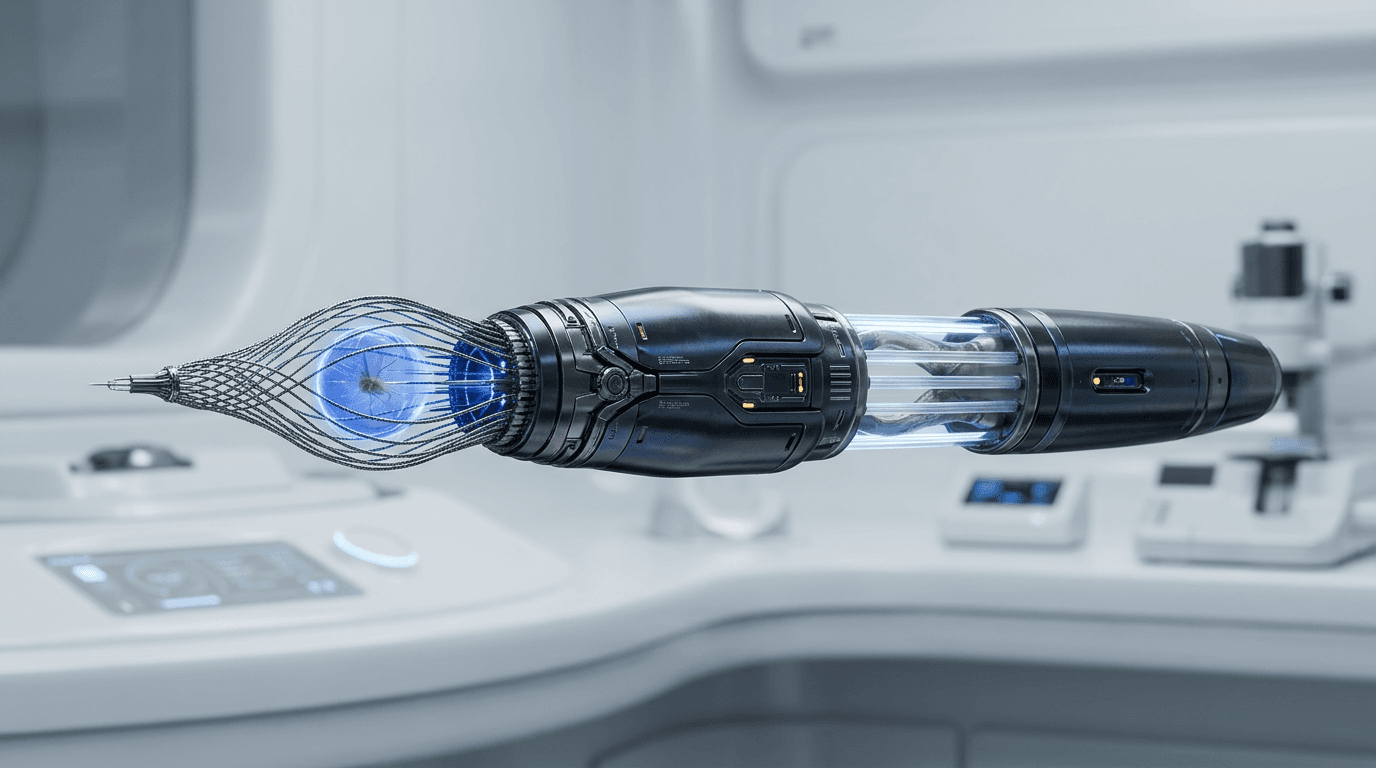
Mechanical Probe
The mechanical probe represents one of the most persistent and specific technological constructs in abduction literature, appearing consistently across four decades of encounter testimonies. This technological motif describes slender metallic or biomechanical instruments—often autonomous, wire-tipped, or mesh-caged—used for biological sampling, neurological procedures, and medical examinations during close-encounter events.
Historical Documentation
The earliest detailed descriptions appear in Bud Hopkins's foundational works Missing Time (1981) and Intruders (1987), where hypnotic regression subjects consistently describe long metallic rods with fine wire ends performing cranial or genital procedures. These accounts established the core imagery: slender metallic structure, articulated or mesh extremities, autonomous movement, and clinical context. Subsequent researchers including David Jacobs (Secret Life, 1992; The Threat, 1998) reinforced this imagery, emphasizing the devices' apparent intelligence and systematic sampling functions.
Whitley Strieber's Communion (1988) brought the motif to broader public awareness through vivid portrayal of a 'mechanical probe with a wire-cage tip' acting semi-autonomously during medical-like examination. Strieber's account closely paralleled later clinical material documented by John E. Mack (Abduction, 1994; Passport to the Cosmos, 1999), where experiencers described living or responsive instruments used for extraction or implantation procedures. The consistency across independent researchers and time periods suggests either consistent technology or shared cultural expectations about alien medical examination.
Comparative Analysis
Thomas Bullard's comprehensive analysis for CUFOS (1987) identified 'rod-type instruments with articulated or mesh extremities' as one of the core technological archetypes in abduction testimonies. Karla Turner (Into the Fringe, 1992; Masquerade of Angels, 1994) and Ray Fowler (The Watchers, 1994) recorded similar devices within reproductive and transformational narratives, while later psychological studies including Kenneth Ring and Christopher Rimmer's Omega Project (1992) reinterpreted these accounts phenomenologically—linking the imagery to near-death or altered-state medical symbolism rather than literal machinery.
Reported Characteristics
The mechanical probe motif exhibits consistent features across testimonies: slender metallic or translucent structure (typically 6-18 inches long); articulated or mesh-cage tip with fine wire-like extensions; autonomous or semi-autonomous movement (appearing to operate independently or under mental control); clinical context (used during medical examinations, biological sampling, or neurological procedures); and apparent intelligence (responding to situations, adapting procedures, or coordinating with other devices). Some accounts describe the probes as living or responsive, exhibiting organic characteristics alongside mechanical precision.
Functional Descriptions
Witnesses report various functions including: biological sampling (extracting tissue, fluid, or cellular material); neurological procedures (brain scanning, neural interface establishment, or memory access); reproductive procedures (egg or sperm extraction, implantation, or monitoring); and diagnostic functions (scanning internal organs, monitoring physiological processes, or assessing health status). The devices often operate without visible cables or external power sources, suggesting advanced wireless or self-contained operation.
Technical Speculation
If interpreted as literal xenotechnology, mechanical probes would represent sophisticated autonomous medical devices with capabilities exceeding current robotics: precision manipulation at cellular scales; autonomous operation without external control; biological compatibility and non-invasive procedures; and integration with larger medical or examination systems. The wire-cage tip design suggests specialized sampling or manipulation capabilities, while autonomous operation implies advanced artificial intelligence or consciousness integration.
Psychological Interpretations
Later psychological and transpersonal studies reinterpret these accounts phenomenologically, linking the imagery to: near-death experience symbolism (medical instruments representing transition between states); altered-state consciousness (projected medical technology during dissociative experiences); symbolic representation of invasive transformation (probes representing psychological or spiritual penetration); and cultural conditioning (medical technology expectations from science fiction and medical procedures).
Symbolic Framework
The mechanical probe motif functions as symbolic representation of: invasive transformation (psychological, spiritual, or physical change); medical authority and expertise (alien technology exceeding human medical capabilities); biological manipulation and control (extraction, implantation, or modification of human biology); and technological superiority (advanced autonomous systems beyond current engineering). The consistency of form and function suggests stable narrative element bridging physical, symbolic, and psychological frameworks.
Cross-Cultural Patterns
The mechanical probe appears in diverse cultural contexts and time periods, suggesting either universal technological archetype or cross-cultural psychological pattern. Similar imagery appears in: ancient medical texts describing surgical instruments; science fiction literature featuring advanced medical technology; near-death experience reports of medical procedures; and shamanic journey accounts of spirit-world medical interventions.
Current Research
Contemporary abduction research continues documenting mechanical probe encounters, with some researchers focusing on: physical evidence (scars, marks, or tissue changes corresponding to probe procedures); technological analysis (attempting to understand probe design and function); psychological assessment (examining trauma, memory, or behavioral changes); and comparative study (analyzing consistency across different researchers and populations).
Significance
The mechanical probe represents one of the most persistent and specific technological constructs in the abduction canon. Whether read as literal xenotechnology, psychological projection, or symbolic representation of invasive transformation, it remains a central organizing image connecting otherwise disparate experiential accounts from the early 1980s through contemporary research. The motif's consistency across independent researchers, time periods, and cultural contexts suggests either genuine technological phenomenon or fundamental psychological archetype requiring explanation.
The mechanical probe motif exemplifies the intersection of technological speculation, psychological analysis, and cultural symbolism in xenotechnology research. Its persistence across decades of documentation makes it essential for understanding abduction phenomenology, whether approached as literal alien technology or symbolic representation of human transformation experiences.
Research this in Signals
Signals turns a topic into a sourced research record you can inspect and rerun. Your first scan is free, and this one starts with Mechanical Probe already loaded, so edit it or scan as is.