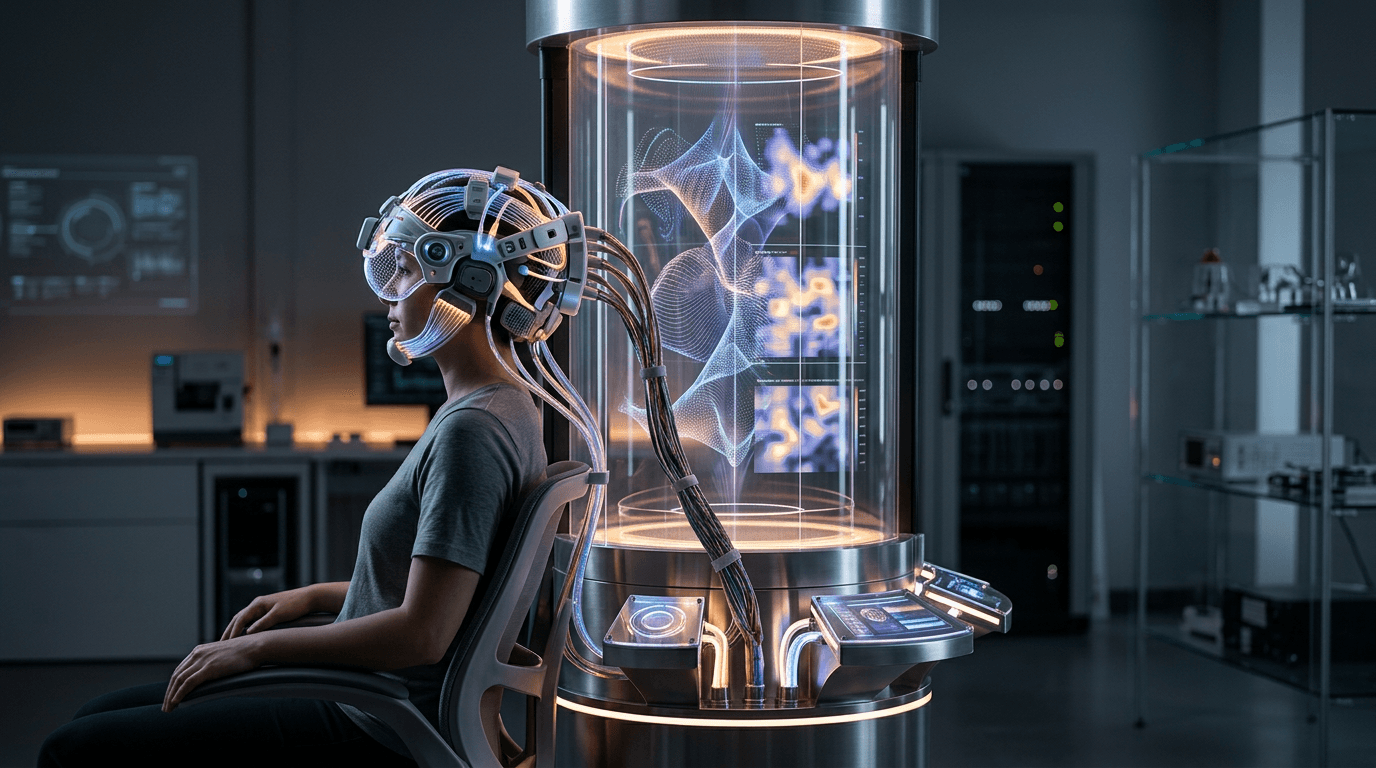
Sensory Modulation
Numerous encounter and contactee testimonies describe technological systems capable of bidirectional sensory interaction—both monitoring human sensory data (reading what an individual perceives) and actively manipulating sensory perception (writing new sensory experiences into awareness). These accounts consistently describe technologies far exceeding known capabilities, suggesting complete sensory control systems about which little is documented regarding mechanisms or implementation.
Sensory Monitoring Capabilities
Testimonies describe systems that can observe what experiencers are seeing, hearing, and feeling in real-time. Descriptions include entities appearing to respond to unspoken thoughts or mental imagery; devices that 'read' emotional states or physical sensations from contactees; and systems that seem to monitor awareness during altered states or unconscious periods. Some accounts describe technology that extracts or records sensory memories—individuals later recalling having their experiences 'downloaded' or scanned by devices during encounters. The consistency of these monitoring claims across independent testimonies suggests either sophisticated neural interface technology or systematic psychological processes not yet understood.
Sensory Manipulation and Injection
More striking are accounts of sensory experiences being actively created or imposed. Witnesses report seeing environments that later prove impossible (rooms larger than exterior dimensions, landscapes that shift location); hearing voices that appear internally rather than through ears; feeling physical sensations without corresponding stimuli (touch, temperature, movement); experiencing scenes with impossible sensory richness (hyperrealistic holographic displays with full sound, scent, and tactile feedback); and having sensations induced that override normal perception (floating during encounters, feeling moved through physical barriers). Multiple witnesses sometimes report identical visual details, suggesting external rather than purely subjective experiences.
Full-Spectrum Sensory Control
Accounts describe technology influencing all sensory modalities simultaneously. Experiencers report being shown complex immersive scenes combining: visual imagery (detailed landscapes, spacecraft interiors, entity appearances); auditory experiences (music, voices, environmental sounds); tactile sensations (soft surfaces, temperature changes, pressure); and occasionally olfactory or gustatory experiences (unusual scents during encounters). The sensory richness and coordination across modalities suggest sophisticated multi-sensory interfaces rather than simple individual channel stimulation.
Time-Locked Sensory Experiences
Many accounts describe sensory experiences with precise temporal synchronization. Witnesses report seeing events that later occur identically in material reality (predictive visual information); experiencing past events as if personally present (sensory playback of memories or historical scenes); and receiving sensory information about locations or events impossible to have witnessed normally. These time-locked experiences suggest either: advance knowledge being transmitted through sensory channels; historical or remote sensory data being projected; or synchronizing predicted future sensory experiences with subsequent reality.
Cooperative Witness Synchronization
Some testimonies describe technology that generates identical or complementary sensory experiences across multiple witnesses simultaneously. Different individuals report seeing the same non-physical objects, hearing the same sounds, or experiencing coordinated sensory sequences. This suggests environmental projection systems rather than individual neural manipulation—unless mechanisms exist for coordinating sensory experiences across multiple brains simultaneously. The phenomenology suggests external technology creating shared perceptual fields rather than independent subjective effects.
Selective Sensory Isolation and Augmentation
Accounts describe technology that can either remove sensory inputs (individuals temporarily losing vision, hearing, or bodily sensation during encounters) or enhance sensory perception (seeing ultraviolet light, hearing frequencies beyond normal range, increased tactile sensitivity). Some describe experiencing sensory information without normal receptor channels (visual imagery appearing without light, spatial awareness while blindfolded, auditory information occurring 'in the head' rather than through ears). These suggest either: bypassing biological sensory pathways; directly stimulating neural sensory processing centers; or creating perceptual experiences that don't correspond to physical stimuli.
Sensory Memory Manipulation
Many testimonies describe technology that appears to access, modify, or replace sensory memories. Accounts include: witnesses recalling both a 'screen memory' (seeing deer or owl) and a suppressed 'actual' memory (entity encounter); having sensory memories inserted that don't correspond to remembered events; or experiencing memory gaps where sensory continuity breaks. This suggests technology capable of interacting with neural memory systems, either modifying how experiences are encoded or creating false sensory memories. The reliability of such testimonies is complicated by normal memory reconstruction processes and the possibility that encounter experiences themselves may be anomalous perceptual events rather than straightforward technological effects.
Technology-Biological Interface Challenges
Accounts describing these systems raise fundamental questions about how technology interfaces with biological sensory processing. Current human research shows: fMRI can detect basic visual imagery from brain activity (limited, requires training); TMS can induce simple perceptual experiences (phosphenes, basic sensations) but not complex scenes; and brain-computer interfaces can read simple motor or cognitive states. The testimonies describe capabilities orders of magnitude beyond current technology: real-time monitoring of rich sensory experiences; complex multi-modal sensory injection; and coordination across multiple subjects. If accurate, these accounts suggest either: revolutionary advances in neural interface technology not publicly known; exotic physics enabling non-invasive interaction with neural processes; or completely unknown mechanisms for sensory modulation beyond current understanding.
Testimonial Consistency and Independence
The consistency of sensory modulation descriptions across independent accounts, spanning decades and multiple countries, suggests either: genuine physical phenomena with repeated characteristics; shared cultural narratives shaping how extraordinary experiences are interpreted; systematic psychological processes producing similar perceptual effects; or coordinated deception or social reinforcement creating aligned testimonies. The phenomenological consistency—detailed descriptions of sensory injection, monitoring, and manipulation—exists alongside lack of physical mechanism explanation, creating challenging evidentiary status: strong testimonial consistency but no documented technology capable of producing described effects.
Scientific Assessment
Sensory modulation systems occupy problematic position—extensive testimony describing specific capabilities, with phenomenological consistency suggesting systematic processes rather than random hallucinations, yet completely beyond known technology or demonstrated physics. The accounts describe: bidirectional sensory interaction (reading and writing); multi-modal coordination across all sensory channels; time-locked and predictive sensory experiences; and technology operating with precision exceeding current neural interface capabilities by orders of magnitude. These either represent: actual sophisticated technology unknown to mainstream science; testimonies systematically misattributing psychological or physical processes to technology; or advanced understanding of consciousness and perception not reflected in current research. Without documentation of underlying technology or mechanisms, the testimonies remain phenomenologically rich but technically unverified—worthy of documentation as claimed experiences while acknowledging inability to validate technological capability or determine underlying processes. The phenomenon represents test case for how to handle extensive testimony describing technology capabilities that, if accurate, would represent revolutionary advances beyond current understanding.
Research this in Signals
Signals turns a topic into a sourced research record you can inspect and rerun. Your first scan is free, and this one starts with Sensory Modulation already loaded, so edit it or scan as is.