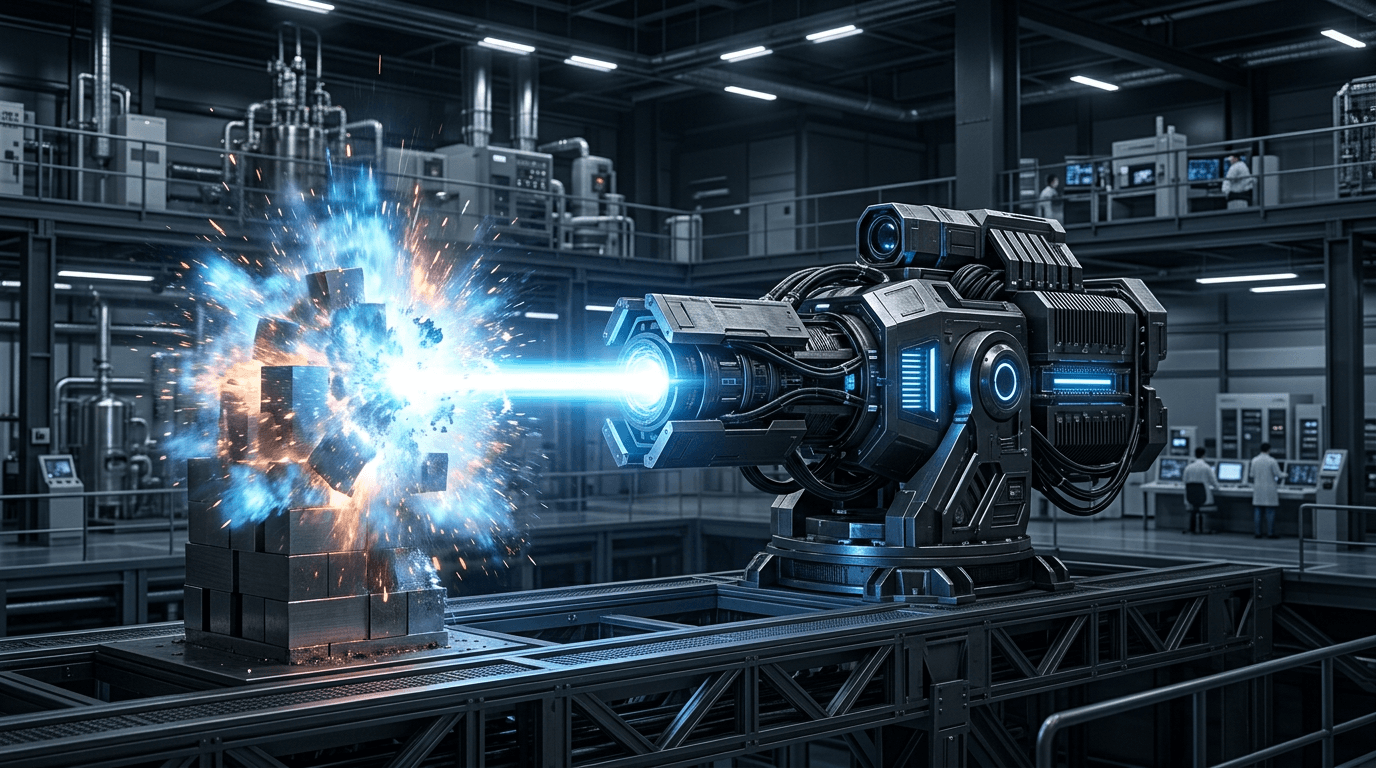
Matter Disintegration Weapon
Matter disintegration weapons represent the most advanced class of directed-energy systems described in alien technology testimony—devices capable of complete atomic-level destruction rather than thermal damage or kinetic impact. Unlike conventional directed-energy weapons (lasers, particle beams, microwaves) that damage through heating, ablation, or electromagnetic disruption, these systems allegedly destabilize matter's fundamental structure, causing instantaneous conversion to energy or dispersed plasma.
Operational Mechanism
Testimony describes weapons that 'destroy matter entirely' through mechanisms possibly including: particle beam bombardment at energies sufficient to overcome nuclear binding forces; high-frequency resonance fields inducing catastrophic molecular vibration and bond failure; localized field collapse creating micro-regions of extreme spacetime curvature or energy density; or exotic radiation triggering cascading atomic disintegration. The effect is described as instantaneous and total—targeted matter disappears without residual debris, explosive force, or thermal bloom, suggesting conversion to energy forms or particle states that disperse immediately.
Field Collapse Hypothesis
One theoretical mechanism involves generating an intense, localized field discontinuity—possibly gravitational, electromagnetic, or quantum vacuum-based—that creates conditions of extreme energy density within the target volume. At sufficient intensity, spacetime curvature or quantum field fluctuations could exceed binding energies of atomic nuclei, causing matter to decompose into constituent particles or energy. This would parallel concepts from black hole physics (matter disruption at event horizons) or Schwinger pair production (particle creation from intense fields), but at focused, weaponized scales.
Particle Beam Alternative
Advanced particle accelerators can deliver energies exceeding nuclear binding forces, potentially fragmenting atomic nuclei through direct bombardment. A compact particle beam weapon operating at GeV to TeV energies could achieve matter disintegration through: spallation (nuclear fragments ejected by high-energy particle impacts); fission cascades in heavy elements; or simply depositing such extreme energy density that material explosively vaporizes. However, this requires enormous power sources, massive beam generation equipment, and precision targeting—challenges suggesting the alien technology operates through unknown physics or engineering breakthroughs.
Visual Signatures and Behavioral Indicators
According to testimony, weapon activation or threat readiness correlates with specific visual indicators—craft displaying red lights signal 'hostility or caution to deploy weapons,' suggesting integrated sensor-weapon-signaling systems. This implies: weapons tightly coupled to craft power and propulsion systems; automated threat assessment and weapon readiness protocols; and possibly communication or warning functions (the red lighting visible to observers may serve to deter rather than conceal). The lack of reported weapon use despite numerous encounters suggests either: defensive-only posture, extreme restraint, or weapon systems requiring specific threat conditions for authorization.
Energy Requirements and Power Source
Complete matter disintegration requires overcoming atomic binding energies—approximately 8 MeV per nucleon for most elements. Disintegrating even small masses (kilograms) instantaneously would require gigawatt to terawatt power delivery over microseconds to milliseconds. This energy scale matches reported propulsion power levels, supporting claims that weapons draw from the same gravity-based energy cores as flight systems. The integration suggests: unified power architecture feeding propulsion, weapons, and systems; rapid power allocation and switching between functions; and energy storage or generation density far exceeding human technology (chemical, fission, or even fusion systems).
Human Replication Status
No successful replication attempts are documented or claimed in available testimony. Human directed-energy weapons (tactical lasers, particle beams, microwave systems) achieve surface damage, electronic disruption, or thermal effects but not total disintegration. The closest analogs—high-energy particle accelerators and inertial confinement fusion lasers—are facility-scale installations, not compact weapons. Achieving matter disintegration would require breakthroughs in: compact particle acceleration or field generation; power sources with orders-of-magnitude higher energy density; targeting and beam coherence over tactical distances; and thermal management preventing weapon self-destruction.
Defensive vs. Offensive Use
The testimony describes these weapons in defensive context—'caution to deploy weapons' rather than active use. This aligns with broader encounter patterns where UAP demonstrate superior capabilities but rarely engage offensively, even when approached by military aircraft. The weapons may function as: last-resort defensive systems against peer-level threats; demonstrations of capability to deter aggression; or automated defense protocols protecting craft from physical attack. The reluctance to use weapons despite thousands of encounters suggests either: extremely strict rules of engagement, technological limitations preventing use against certain targets, or weapons designed primarily for deterrence and inter-craft combat rather than surface engagement.
Physics Implications
Matter disintegration weapons, if functional, would represent either
extreme engineering within known physics (ultra-compact particle accelerators, controlled antimatter reactions, focused vacuum energy extraction) or exploitation of unknown physical principles (gravity-matter coupling, quantum field manipulation, spacetime engineering at weapon scales). The instantaneous, total conversion of matter suggests mechanisms beyond simple energy deposition—possibly involving fundamental interaction manipulation or local physics modification.
Matter disintegration weapons represent the ultimate evolution of directed-energy concepts—moving from thermal damage to complete atomic destruction. The testimony places them within integrated craft systems, powered by the same exotic energy sources as propulsion. The absence of successful human replication, despite understanding theoretical mechanisms, highlights the vast engineering and energy density gaps between human and alleged alien technology. Whether the descriptions reflect actual physics-defying weapons, misinterpreted conventional effects, or symbolic representations of overwhelming technological superiority remains an open question defined by absence of physical evidence and reliance on testimony alone.
Research this in Signals
Signals turns a topic into a sourced research record you can inspect and rerun. Your first scan is free, and this one starts with Matter Disintegration Weapon already loaded, so edit it or scan as is.