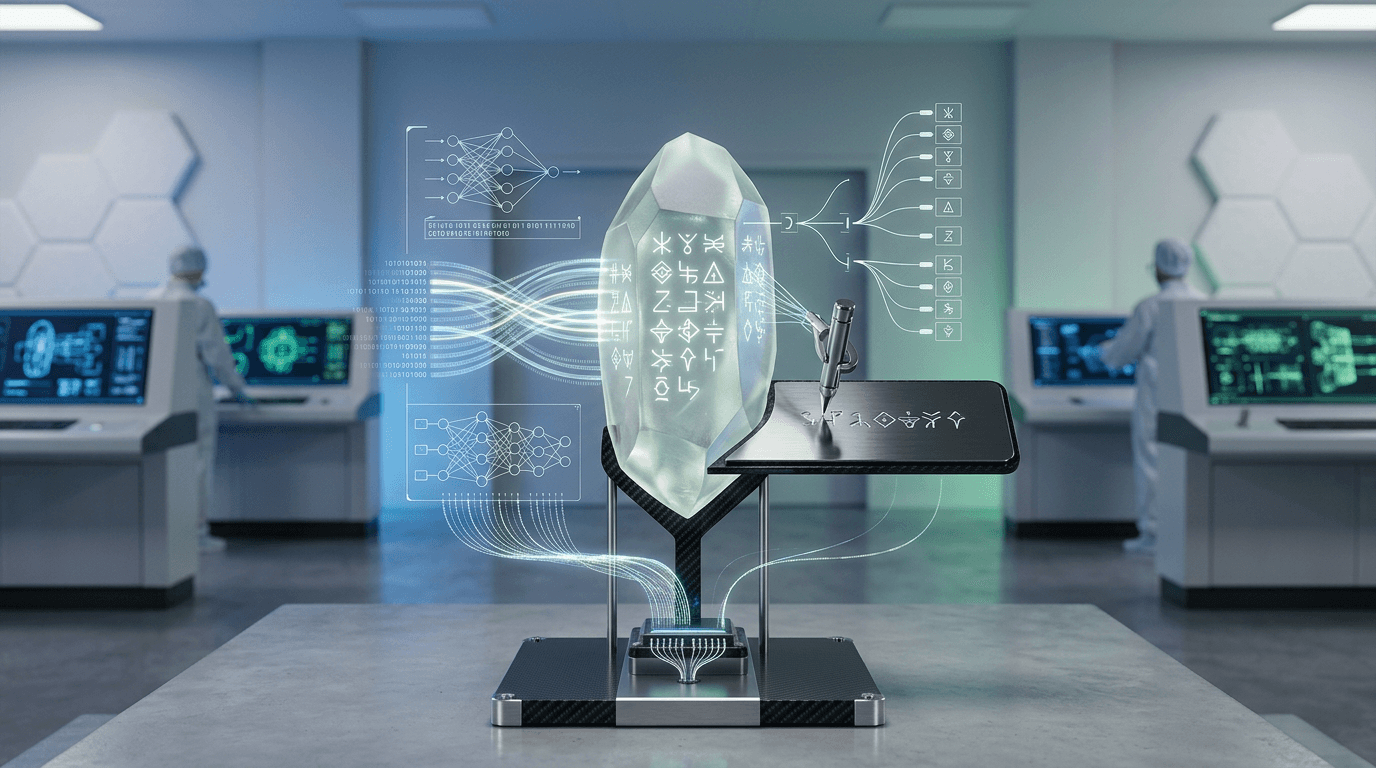
Symbol Decoding
Recent testimony describes alleged government-sponsored machine learning projects using advanced language models to decode symbolic systems from recovered non-human technology and artifacts. Specifically mentioned are 'byte-latent transformer' architectures—AI models processing information at the byte level rather than token level—applied to exotic inscriptions, mathematical notations, and interface symbols from alleged UAP craft.
Approach and Methodology
The approach treats alien symbolic systems as cryptographic problems solvable through pattern recognition, statistical analysis, and multi-modal learning (correlating symbols with craft functions, material properties, or operational contexts). Claims suggest European intelligence agencies have developed specialized large language models for this purpose, distinct from commercial AI systems.
Assessment and Context
While byte-latent transformers are real emerging AI architecture (2024-25) showing promise in multilingual and code tasks, their application to alleged alien languages is purely speculative. Decoding unknown languages typically requires either a Rosetta Stone (parallel texts), substantial corpus data, or understanding of the underlying conceptual framework—none verified to exist for purported non-human artifacts. The concept represents interesting intersection of legitimate AI advancement (models handling non-linguistic symbol systems) with disclosure mythology. It updates ancient astronaut 'decoding' narratives for the machine learning era, assuming both artifact existence and that alien cognition produces pattern structures recognizable to transformer architectures trained on human data.
Research this in Signals
Signals turns a topic into a sourced research record you can inspect and rerun. Your first scan is free, and this one starts with Symbol Decoding already loaded, so edit it or scan as is.