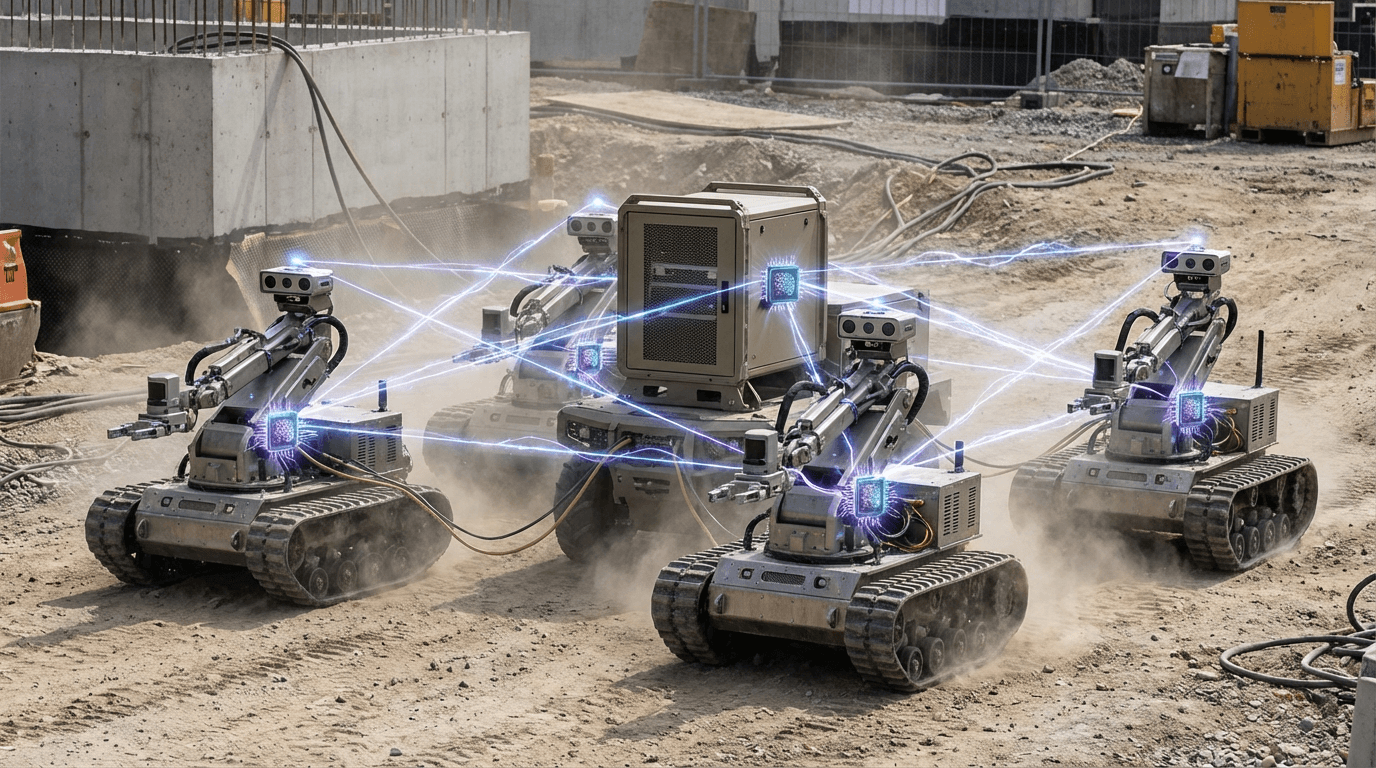
Distributed Minds & Cloud Embodiment
Distributed minds and cloud embodiment systems enable a single AI agent to exist simultaneously across multiple cloud computing instances, creating parallel "selves" that share memory and identity while working on different tasks or problems concurrently. This architecture allows agents to achieve massive parallelism in problem-solving, with different instances handling different aspects of a problem while maintaining a unified sense of self and shared knowledge base.
This innovation explores new paradigms of AI architecture where agents are not bound to single instances but can exist as distributed systems with shared cognition. By enabling parallel instantiation, these systems could dramatically increase the speed and scale at which AI agents can operate, potentially enabling agents to work on multiple problems simultaneously or tackle problems that require massive parallel processing. Research institutions are exploring these concepts, though practical implementations remain experimental.
The technology raises fascinating questions about identity, consciousness, and the nature of AI agents when they can exist in multiple places simultaneously. As AI systems become more capable and are deployed at scale, distributed architectures could enable new capabilities and applications. However, the technology faces significant challenges including maintaining coherence across instances, managing conflicts, and ensuring that the distributed system maintains a unified identity and goals. The concept remains largely theoretical, with practical applications likely requiring significant advances in AI architecture and coordination mechanisms.
Related Organizations
United States · Company
Developers of Ray, the open-source unified compute framework that enables scaling AI and Python applications across clusters, serving as the infrastructure layer for distributed agent minds.
Open Source
An open-source project enabling the collaborative running of large language models like Llama and BLOOM across distributed consumer GPUs.

A platform for building and deploying autonomous agents that can communicate, negotiate, and work together across a decentralized network.

Develops the leading open-source framework for orchestrating LLMs and retrieval systems.
Japan · Startup
Tokyo-based AI lab focusing on nature-inspired intelligence, specifically evolutionary model merges and collective intelligence (swarm) architectures.

Developers of the Gemini family of models, which are trained from the start to be multimodal across text, images, video, and audio.
United States · Research Lab
An open research group focused on decentralized AI and distributed reasoning, known for releasing open-source models optimized for agentic workflows.

Decentralized AI marketplace and developer of OpenCog Hyperon, a cognitive architecture for AGI.
United Kingdom · Startup
Building a decentralized compute protocol for machine learning, allowing AI models to be trained and run across distributed hardware resources.

An AI research lab building agents that can reason and code, aiming to create custom AI agents for everyone.
Supporting Evidence
Research this in Signals
Signals turns a topic into a sourced research record you can inspect and rerun. Your first scan is free, and this one starts with Distributed Minds & Cloud Embodiment already loaded, so edit it or scan as is.