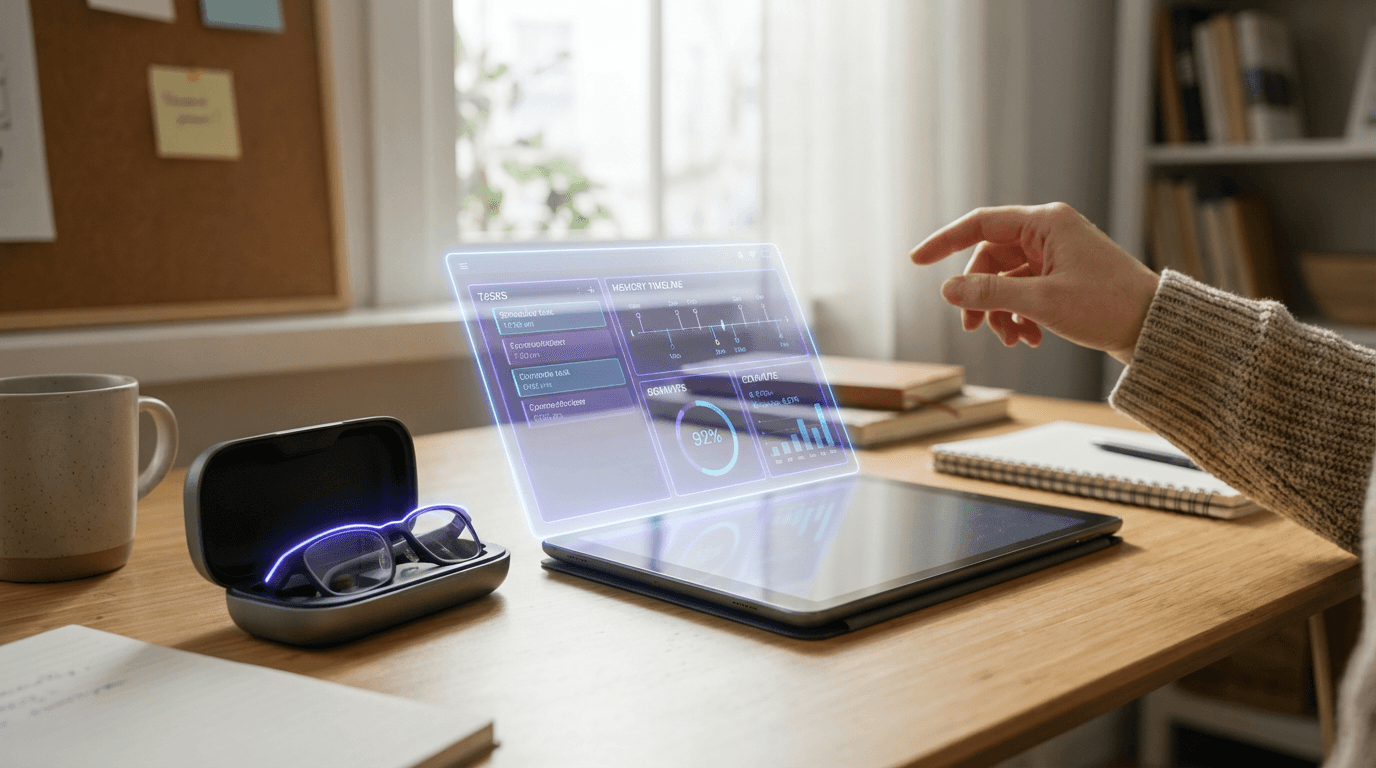
Personal Cognitive Operating Systems
Personal cognitive operating systems are persistent AI agent platforms that act as intelligent intermediaries between individuals and their digital environments, managing information flow, coordinating tasks, maintaining personal memory, and proactively assisting with work and life management. These systems learn user preferences, goals, and values over time, functioning as personalized cognitive assistants that understand context and can act autonomously within defined parameters.
This innovation addresses information overload and the complexity of managing modern digital lives, where individuals must coordinate across multiple tools, platforms, and information sources. By providing a unified AI layer that understands user needs and can coordinate across systems, personal cognitive operating systems could dramatically simplify digital life and increase productivity. Companies and research institutions are developing these capabilities, with some early implementations already available.
The technology represents a vision of AI as a personal cognitive extension, where AI systems become deeply integrated into how individuals work, think, and live. As AI becomes more capable and trustworthy, personal cognitive operating systems could become essential infrastructure for managing complexity and maximizing human potential. However, the technology raises profound questions about privacy, agency, and the relationship between humans and AI. Ensuring that these systems serve user interests, maintain privacy, and enhance rather than replace human agency will be crucial for responsible development and deployment.
Related Organizations

Developing 'Apple Intelligence', a personal intelligence system integrated into iOS/macOS that uses on-device context to mediate tasks and information.
Developers of the Limitless Pendant and software (formerly Rewind AI) that records, transcribes, and summarizes user interactions to create a personalized memory stack.

Through Copilot and the 'Recall' feature in Windows, Microsoft is integrating persistent memory and agentic capabilities directly into the operating system.
United States · Startup
Creators of the r1 device and the Large Action Model (LAM), designed to operate apps and perform tasks on behalf of the user via a natural language interface.

An AI-powered workspace that self-organizes notes and information, using a personal knowledge graph to surface relevant memories and tasks automatically.

Builds autonomous browser agents that can navigate the web to perform tasks like booking flights or ordering food.
United States · Startup
Developers of the Ai Pin, a wearable device intended to replace the smartphone interface with an ambient, voice-forward AI operating system.
United States · Startup
Creators of a personal AI assistant capable of operating a web browser to complete tasks like booking flights or organizing research.

Develops the leading open-source framework for orchestrating LLMs and retrieval systems.
Supporting Evidence
Research this in Signals
Signals turns a topic into a sourced research record you can inspect and rerun. Your first scan is free, and this one starts with Personal Cognitive Operating Systems already loaded, so edit it or scan as is.