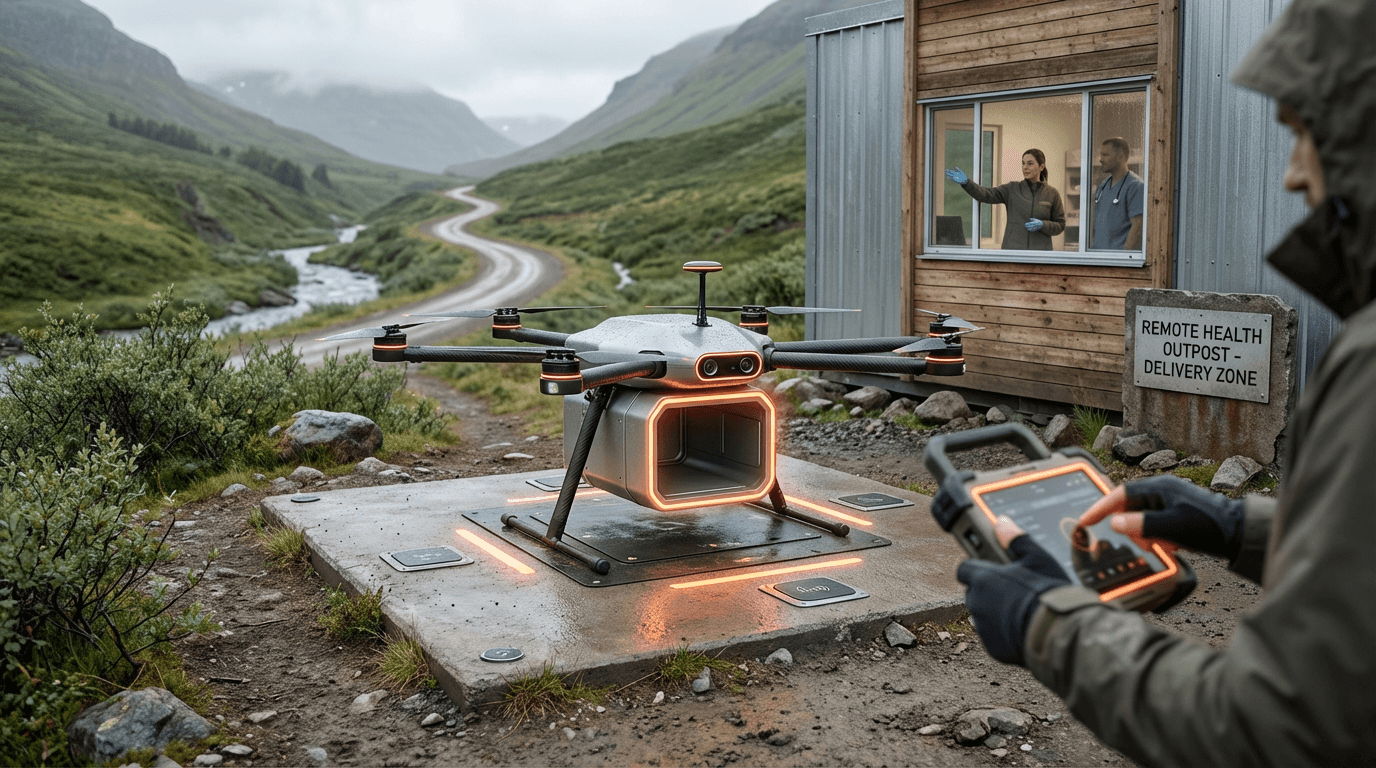
Autonomous Medical Delivery Drones
Healthcare systems worldwide face a persistent challenge: the timely delivery of critical medical supplies to locations where traditional ground transportation is either too slow, too expensive, or entirely impractical. In remote rural areas, mountainous terrain, island communities, and regions with underdeveloped road networks, patients often wait hours or even days for essential medications, blood products, or diagnostic services. Even in well-developed urban centers, traffic congestion can delay ambulances and courier services during critical moments when minutes determine survival. Autonomous medical delivery drones address this fundamental gap by creating aerial supply chains that operate independently of ground infrastructure. These unmanned aerial vehicles (UAVs) employ GPS navigation, obstacle-avoidance sensors, and automated flight control systems to transport payloads ranging from single-dose medications to multi-unit blood bags. Equipped with temperature-controlled compartments, shock-absorbing packaging, and parachute or precision-landing mechanisms, these drones maintain the integrity of fragile biological materials throughout flight. The systems typically operate within established air corridors, communicating with ground control stations and integrating with existing air traffic management protocols to ensure safe operations.
The introduction of autonomous medical drones fundamentally reshapes healthcare logistics by decoupling delivery speed from road quality and distance. In emergency medicine, the ability to deliver blood products to accident scenes or remote surgical centers within minutes rather than hours directly improves trauma survival rates. For chronic disease management, drones enable regular medication deliveries to patients in isolated communities, reducing the need for long, costly journeys to urban pharmacies. Public health programs benefit significantly as well—vaccine distribution campaigns can reach previously inaccessible populations, while diagnostic sample collection becomes feasible in areas lacking laboratory infrastructure. This technology also introduces new operational models: on-demand delivery networks replace costly inventory stockpiling at remote facilities, and hub-and-spoke distribution systems allow centralized medical centers to serve wider catchment areas. The economic implications extend beyond healthcare, as successful medical drone networks demonstrate viability for broader logistics applications, potentially catalyzing investment in drone infrastructure and regulatory frameworks.
Real-world deployments have moved well beyond pilot programs into sustained operational service. In Rwanda and Ghana, commercial drone networks have completed hundreds of thousands of medical deliveries since the mid-2010s, serving rural health centers across entire nations with routine blood and vaccine shipments. Similar programs have emerged in remote regions of the United States, delivering medications to island communities and rural clinics in states with challenging geography. These established networks demonstrate reliability rates exceeding traditional ground transport while reducing delivery times from hours to an average of 15-30 minutes. Regulatory bodies in multiple countries have developed specific frameworks for medical drone operations, creating pathways for expanded deployment. Looking forward, integration with hospital inventory management systems, expansion into urban environments for inter-facility transfers, and the development of larger payload capacities suggest that autonomous medical drones will become standard components of healthcare infrastructure. As climate change increases the frequency of natural disasters that disrupt ground transportation, and as healthcare systems worldwide prioritize equitable access, drone-based delivery networks represent a scalable solution aligned with broader trends toward resilient, technology-enabled healthcare systems.
Related Organizations

Operates the world's largest autonomous drone delivery network, specializing in medical supplies and e-commerce delivery.

Healthcare logistics company connecting healthcare providers with drone operators.

Developer of autonomous drone logistics systems for healthcare and e-commerce, with FAA Type Certification.

Global health partnership increasing access to immunization in poor countries.

Australian drone logistics company focused on essential health supplies.


Provider of drone delivery services and vertiport infrastructure.

Drone delivery service operating in Ireland and expanding to the US.

Alphabet subsidiary developing an autonomous delivery drone service and an unmanned traffic management (UTM) platform.
Supporting Evidence
Research this in Signals
Signals turns a topic into a sourced research record you can inspect and rerun. Your first scan is free, and this one starts with Autonomous Medical Delivery Drones already loaded, so edit it or scan as is.