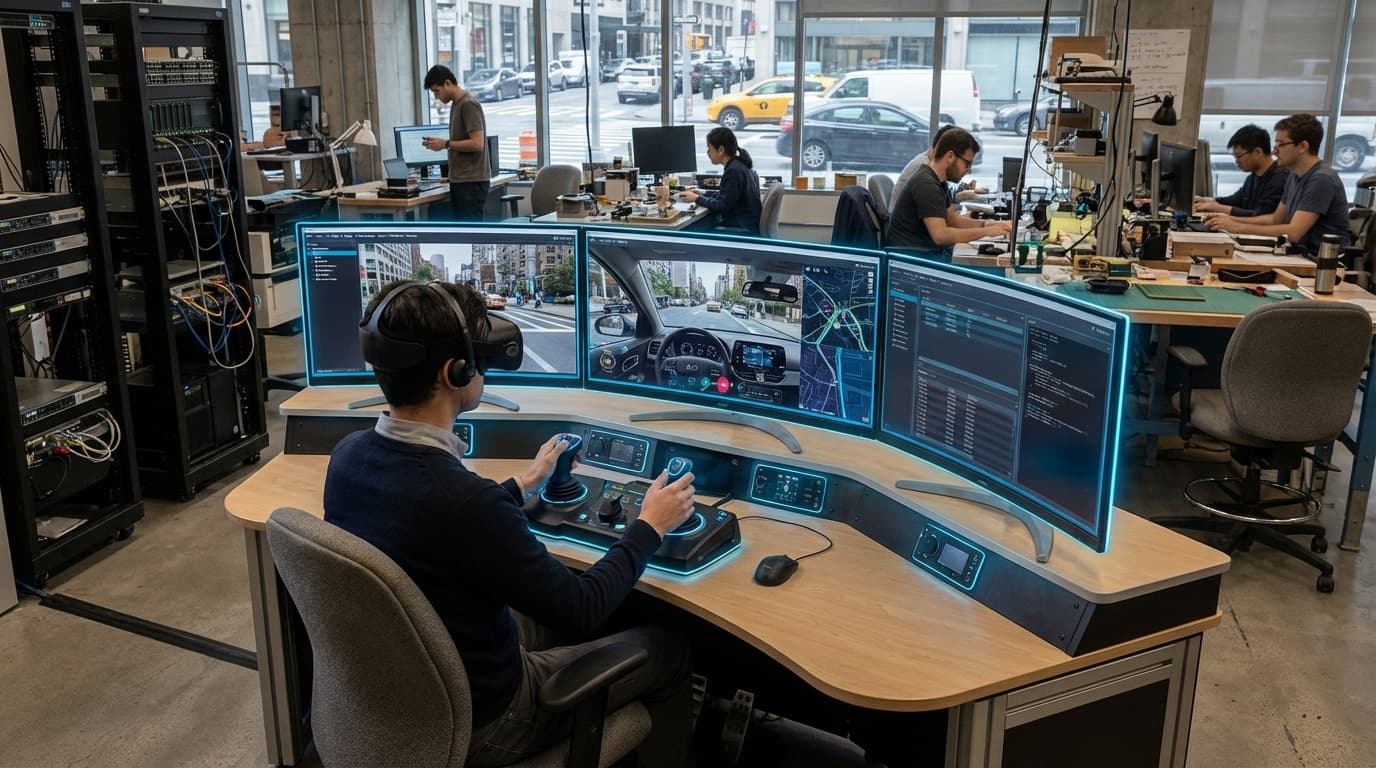
Teleoperation Control Centers
Teleoperation control centers represent a critical infrastructure layer in the deployment of autonomous vehicle fleets, serving as remote command hubs where human operators provide real-time oversight and intervention capabilities. These facilities function as safety nets for autonomous systems, enabling trained personnel to monitor multiple vehicles simultaneously and take control when algorithms encounter scenarios beyond their operational design domain. The technical architecture relies on ultra-low-latency communication networks, typically leveraging 5G and emerging 6G infrastructure, to transmit high-definition video feeds, sensor data, and vehicle telemetry in near real-time. Operators utilize sophisticated interfaces that combine multiple camera angles, LIDAR visualizations, and predictive path displays to maintain situational awareness. The systems employ redundant communication channels and edge computing to minimize latency, ensuring that remote interventions can be executed within milliseconds when necessary. Advanced implementations incorporate haptic feedback systems and immersive displays that replicate the driving environment, allowing operators to make informed decisions despite physical distance from the vehicle.
The emergence of teleoperation centers addresses one of the most significant barriers to widespread autonomous vehicle deployment: the inability of current AI systems to handle every conceivable driving scenario with complete reliability. While autonomous technology has advanced considerably, edge cases involving construction zones, unusual weather conditions, ambiguous traffic situations, or infrastructure failures continue to challenge even sophisticated algorithms. Rather than waiting for perfect autonomy, teleoperation centers enable commercial deployment by providing human judgment as a fallback mechanism. This hybrid approach allows fleet operators to expand service areas and operating hours while maintaining safety standards that would be impossible with fully autonomous systems alone. The model also creates new operational efficiencies, as a single operator can typically oversee multiple vehicles, intervening only when necessary rather than continuously controlling individual units. Industry analysts note that this approach has proven particularly valuable for autonomous delivery services, robotaxi operations, and logistics applications where service reliability directly impacts business viability.
Early deployments of teleoperation infrastructure have already begun appearing in pilot programs across North America, Europe, and Asia, with several autonomous vehicle companies establishing dedicated control facilities. These centers typically operate around the clock, staffed by personnel with backgrounds in professional driving, aviation, or emergency response. The technology has demonstrated particular promise in urban environments where complex traffic patterns and unpredictable human behavior create frequent edge cases. Research suggests that as autonomous systems continue to improve through machine learning, the frequency of required interventions decreases over time, allowing operators to oversee larger fleets with the same staffing levels. Looking forward, teleoperation centers are expected to evolve beyond simple intervention points into sophisticated fleet management hubs that optimize routing, coordinate vehicle maintenance, and provide customer support. This infrastructure represents a pragmatic bridge between today's assisted autonomy and tomorrow's fully independent systems, enabling the autonomous vehicle industry to scale commercially while continuing to refine the underlying technology. As regulatory frameworks mature and public acceptance grows, these control centers will likely become standard components of transportation infrastructure, much like air traffic control towers serve aviation today.
Related Organizations

Provides a human-assisted autonomy platform for yard trucking, integrating teleoperation centers to handle edge cases in logistics hubs.

Develops a software platform for remote teleoperation of autonomous vehicles, focusing on low-latency video compression and network bonding.

Operates a teledriving service where remote drivers in a control center deliver cars to customers or drive them remotely.

Provides a connectivity platform optimized for teleoperation, ensuring consistent high-quality video transmission over cellular networks.

Offers a car rental service where the vehicle is delivered to the customer via remote piloting from a central hub.

Freight technology company developing autonomous electric trucks, with signed MOUs for deployment in UAE logistics.

Develops video streaming software optimized for VR teleoperation, providing low latency 360-degree views for remote operators.

A global cross-industry organization of automotive, technology, and telecommunications companies working to develop end-to-end solutions for future mobility.

Non-profit research institute with a long history in AI, currently working on hybrid neuro-symbolic systems for DARPA and commercial use.
Supporting Evidence
Research this in Signals
Signals turns a topic into a sourced research record you can inspect and rerun. Your first scan is free, and this one starts with Teleoperation Control Centers already loaded, so edit it or scan as is.