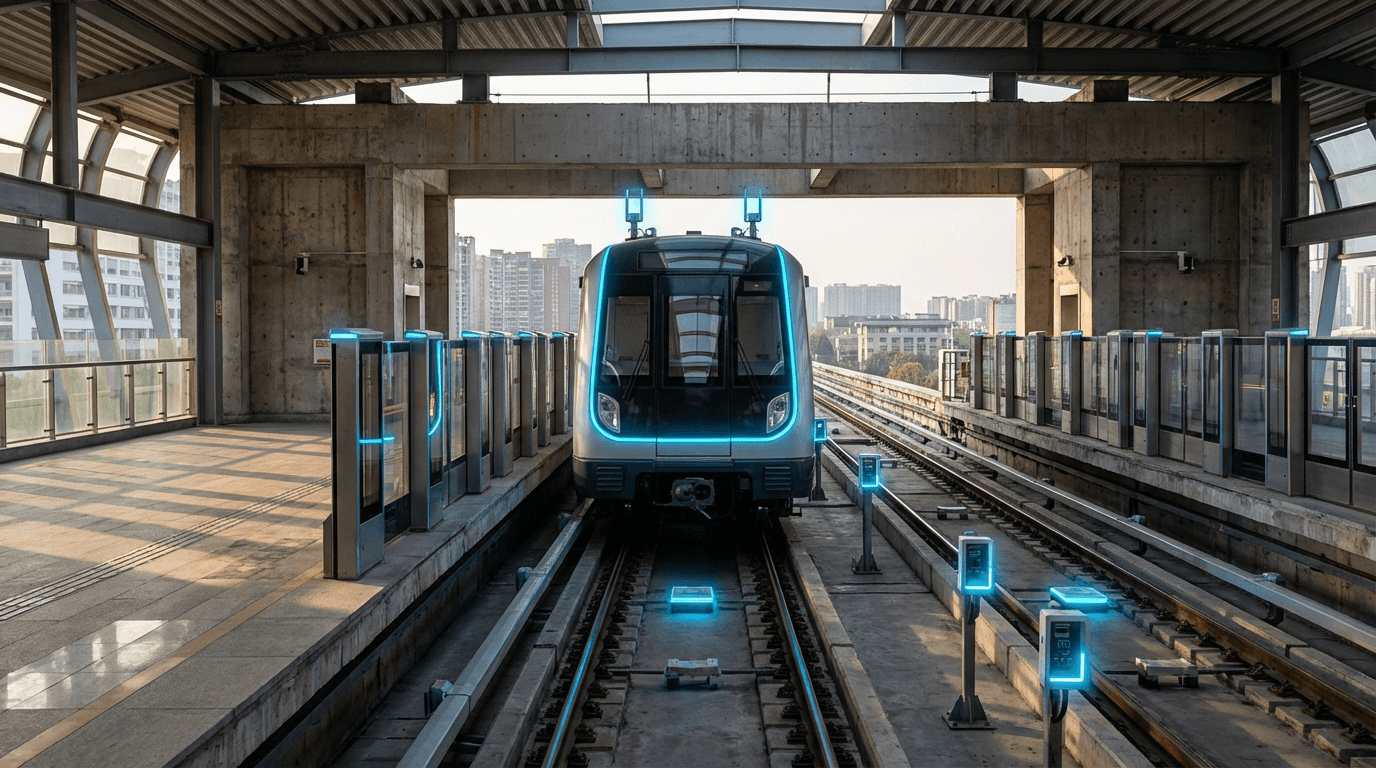
Autonomous Rail Operations (ATO)
Autonomous Train Operation at Grade of Automation 4 represents the highest level of railway automation, where mainline trains operate entirely without human intervention, including no onboard staff for driving or supervision. This capability builds upon advanced signaling and control systems such as the European Train Control System (ETCS) Level 3, which enables continuous communication between trains and trackside infrastructure. The technology relies on sophisticated sensor arrays, real-time positioning systems, and artificial intelligence algorithms that monitor track conditions, detect obstacles, and make split-second decisions about speed, braking, and route optimization. Unlike metro systems where driverless operation has become relatively common in controlled environments, GoA4 for mainline railways must contend with far more complex variables including mixed traffic patterns, varying weather conditions, level crossings, and the need to share infrastructure with conventional trains. The system employs 'moving block' signaling, which replaces traditional fixed track sections with dynamic safety zones that move with each train, calculated based on real-time speed, braking capacity, and separation requirements.
The railway industry faces mounting pressure to increase capacity on existing infrastructure while simultaneously reducing operational costs and improving energy efficiency. Traditional signaling systems create significant inefficiencies by maintaining large fixed safety margins between trains, limiting how many services can operate on a given route. GoA4 addresses these challenges by enabling trains to run closer together safely, potentially increasing line capacity by 20-40 percent without laying new track. The technology also tackles the persistent issue of driver shortages affecting many rail networks globally, while eliminating human error as a factor in railway incidents. By optimizing acceleration and braking curves based on precise real-time calculations, autonomous systems can reduce energy consumption by 10-15 percent compared to human-operated services, contributing to sustainability goals. Furthermore, the consistency of automated operations improves punctuality and allows for more precise timetabling, creating opportunities for new service patterns and business models in both passenger and freight rail.
Several railway operators have begun piloting GoA4 systems on mainline networks, though full commercial deployment remains limited compared to urban metro applications. Early trials in Europe and Asia have demonstrated the technical feasibility of the approach, with test programs focusing on freight corridors and specific passenger routes where conditions can be more carefully controlled. The technology aligns with broader industry trends toward digitalization and the development of smart transportation networks, where different modes of transport communicate and coordinate seamlessly. However, significant regulatory, safety certification, and public acceptance hurdles remain before widespread adoption can occur. As rail networks seek to compete more effectively with road and air transport while meeting climate commitments, the trajectory points toward gradual expansion of autonomous operations, likely beginning with dedicated freight lines and specific passenger corridors before extending to mixed-traffic mainline networks. The integration of GoA4 with emerging technologies such as predictive maintenance systems and dynamic capacity management platforms suggests a future where railways can offer unprecedented levels of efficiency, reliability, and service flexibility.
Related Organizations

Mining giant that operates 'AutoHaul', the world's first fully autonomous, heavy-haul, long-distance railway system.
French multinational rolling stock manufacturer, maker of the TGV.
Industrial giant offering intermodal transport solutions and MaaS platforms for transit agencies.

Global rail solutions provider delivering ATO systems, recently acquiring Thales' Ground Transportation Systems to bolster autonomy capabilities.
European rail initiative (now Europe's Rail) coordinating research and innovation to integrate ATO up to GoA4 across European networks.
SNCF
France · Company
France's national state-owned railway company, leading the 'Tech4Rail' program to develop autonomous freight and passenger trains.
German railway operator running the 'Digital Rail Germany' initiative to automate rail operations nationwide.

Startup developing AI-based vision systems and sensors specifically for autonomous rail operations in complex environments.

Swiss train manufacturer developing rolling stock equipped with ATO capabilities, including successful GoA4 tests.

Offers a large-scale automotive simulation platform using computer vision and deep learning to create realistic digital twins.
Supporting Evidence
Research this in Signals
Signals turns a topic into a sourced research record you can inspect and rerun. Your first scan is free, and this one starts with Autonomous Rail Operations (ATO) already loaded, so edit it or scan as is.