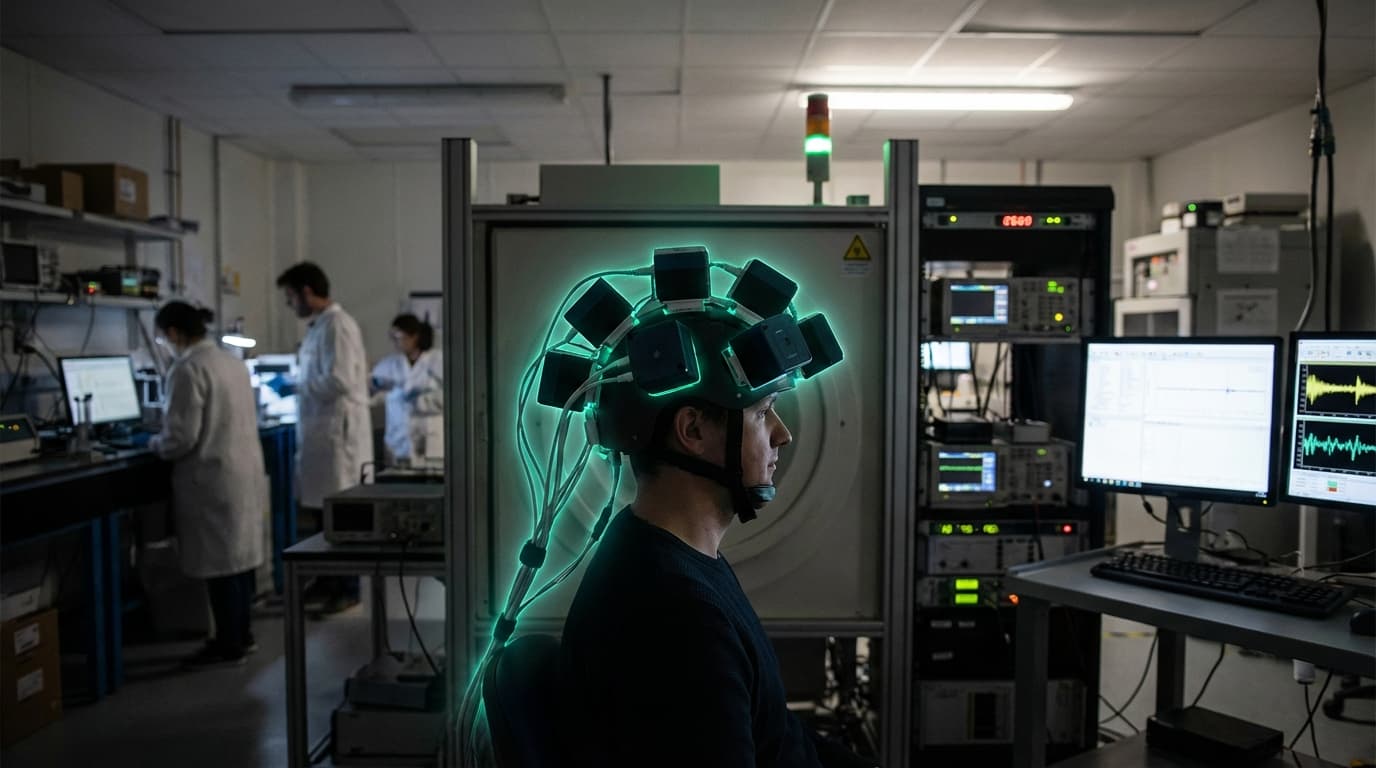
Quantum Magnetometry for Brain Imaging
Quantum magnetometry for brain imaging uses room-temperature magnetometer arrays (arrays of magnetic field sensors) leveraging quantum defects (quantum systems like NV centers in diamond) and optically pumped magnetometers (sensors that use laser light to measure magnetic fields) to deliver high-resolution brain activity maps (detailed images of brain function) without cryogenic shielding (cooling and magnetic shielding required by traditional MEG systems), creating wearable MEG (magnetoencephalography) alternatives that can operate in normal environments. Hospitals explore them for portable neurology suites (mobile brain imaging systems), enabling cognition studies (research on how the brain works) and epilepsy monitoring (tracking brain activity in epilepsy patients) outside specialized facilities (without needing expensive, fixed MEG systems), making brain imaging more accessible and practical for clinical use.
This innovation addresses the limitations of traditional MEG, which requires expensive, fixed facilities. By operating at room temperature, quantum magnetometers can be more portable and accessible. Companies and research institutions are developing these systems.
The technology is particularly significant for making brain imaging more accessible, where portable systems could enable new applications. As the technology improves, it could become standard for brain imaging. However, ensuring sensitivity, managing complexity, and achieving clinical validation remain challenges. The technology represents an important evolution in brain imaging, but requires continued development to achieve widespread clinical use. Success could make brain imaging more accessible, but the technology must prove its clinical value. Quantum magnetometry for brain imaging is an active area of research with some commercial systems being developed.
Related Organizations
United Kingdom · Startup
Develops and commercializes the world's first wearable OPM-MEG brain scanner system.
United States · Company
Manufactures the Zero-Field Magnetometers (OPMs) that power most current wearable MEG research and commercial systems.
United Kingdom · University
Home to the Sir Peter Mansfield Imaging Centre, a global leader in OPM-MEG research and the birthplace of Cerca Magnetics.
United States · Company
Develops the HEDscan system, a non-invasive brain imaging device using quantum sensor arrays.
United Kingdom · University
Conducts pioneering clinical trials and neuroscience research using OPM-MEG systems.

A French technology research institute focusing on micro- and nanotechnologies.
Germany · Government Agency
Germany's national metrology institute, conducting advanced research on biomagnetism and OPM sensor calibration.
United States · Company
Produces precision magnetic sensors, including OPMs suitable for biological magnetic sensing.
Sweden · Company
A major manufacturer of traditional MEG systems that collaborates with researchers on next-gen OPM technology.

A US Department of Energy lab actively researching adiabatic logic circuits and reversible computing to overcome thermodynamic limits in microelectronics.
Supporting Evidence
Research this in Signals
Signals turns a topic into a sourced research record you can inspect and rerun. Your first scan is free, and this one starts with Quantum Magnetometry for Brain Imaging already loaded, so edit it or scan as is.