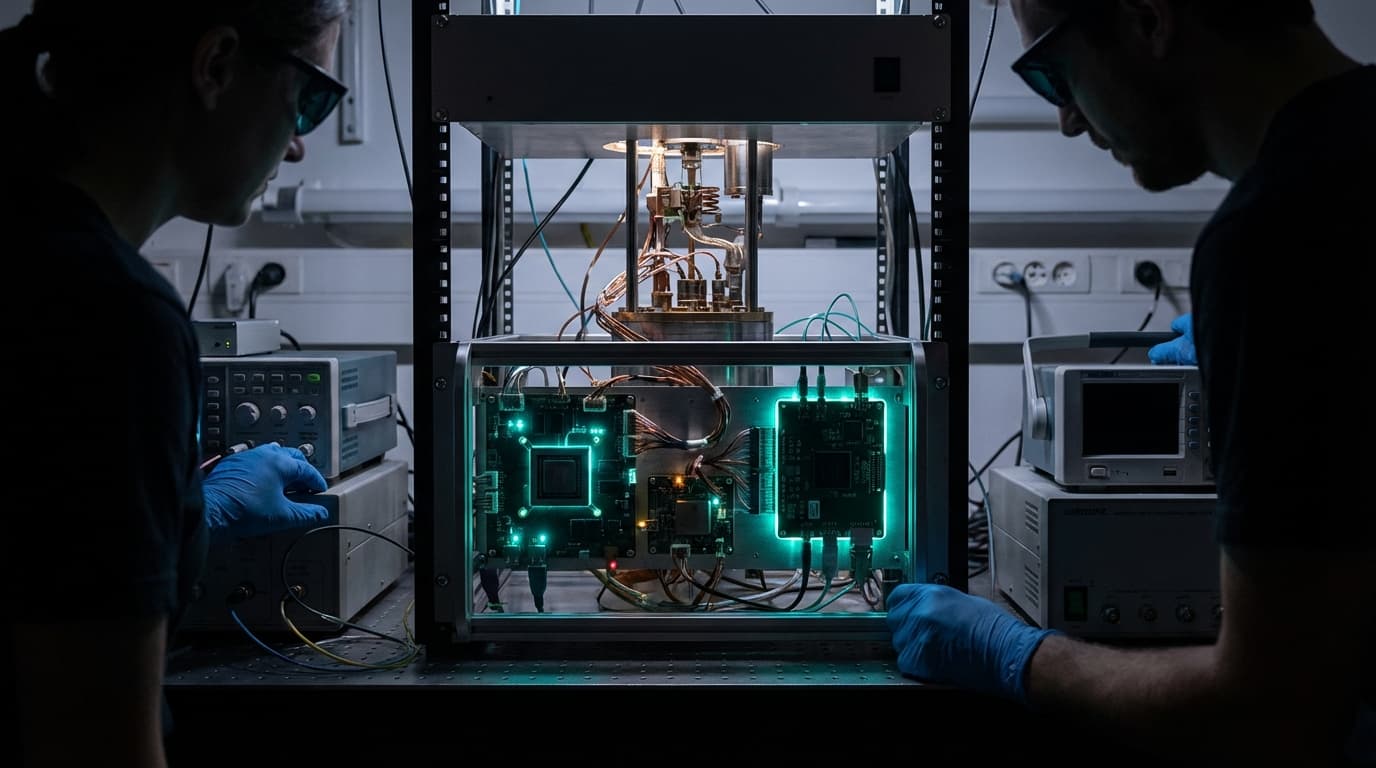
Quantum Error Correction Decoders
Quantum error correction decoders are real-time algorithms (algorithms that run quickly enough to keep up with quantum operations) that identify and correct errors from syndrome measurements (measurements that detect errors without destroying quantum information) in quantum error correction codes. As quantum hardware scales to larger systems, fast and accurate decoders are critical for fault tolerance (the ability to compute correctly despite errors), where these software components process syndrome data (error detection information) from quantum chips in real-time to identify which errors occurred, enabling error correction that prevents logical qubit failure (failure of the encoded quantum information). Techniques include matching decoders (algorithms that match error patterns) and belief propagation (algorithms that infer errors probabilistically), making decoders essential software infrastructure for fault-tolerant quantum computing.
This innovation addresses the challenge of error correction in quantum computing, where errors are common and must be corrected quickly. By providing fast decoders, these algorithms enable fault-tolerant quantum computing. Research institutions and companies are developing these decoders.
The technology is essential for fault-tolerant quantum computing, where fast error correction is necessary for reliable computation. As quantum systems scale, decoder performance becomes increasingly critical. However, ensuring speed, managing complexity, and achieving accuracy remain challenges. The technology represents an important area of research, but requires continued development to support larger systems. Success could enable fault-tolerant quantum computing, but the technology must continue to improve. Quantum error correction decoders are an active area of research with significant progress being made.
Related Organizations
France · Startup
Developing 'cat qubits' which are inherently protected against bit-flip errors, accelerating the path to fault tolerance.
United States · Company
Building a utility-scale quantum computer using silicon photonics and fusion-based architecture.

Through Copilot and the 'Recall' feature in Windows, Microsoft is integrating persistent memory and agentic capabilities directly into the operating system.
Canada · Startup
Uses bosonic codes in superconducting circuits to achieve error correction at the individual qubit level.

Develops neutral-atom quantum computers and has published a roadmap specifically targeting logical qubits.

The Duke Quantum Center (Kenneth Brown) focuses heavily on fault-tolerant architectures and error correction decoding.

Provides infrastructure software for quantum control to suppress errors and improve hardware performance.
Australia · University
Hosts a Microsoft Quantum Laboratory focused on the interface between quantum systems and control electronics.
Germany · Startup
Building neutral atom quantum computers with a focus on high-speed repetition rates to enable effective error correction cycles.
Supporting Evidence
Research this in Signals
Signals turns a topic into a sourced research record you can inspect and rerun. Your first scan is free, and this one starts with Quantum Error Correction Decoders already loaded, so edit it or scan as is.