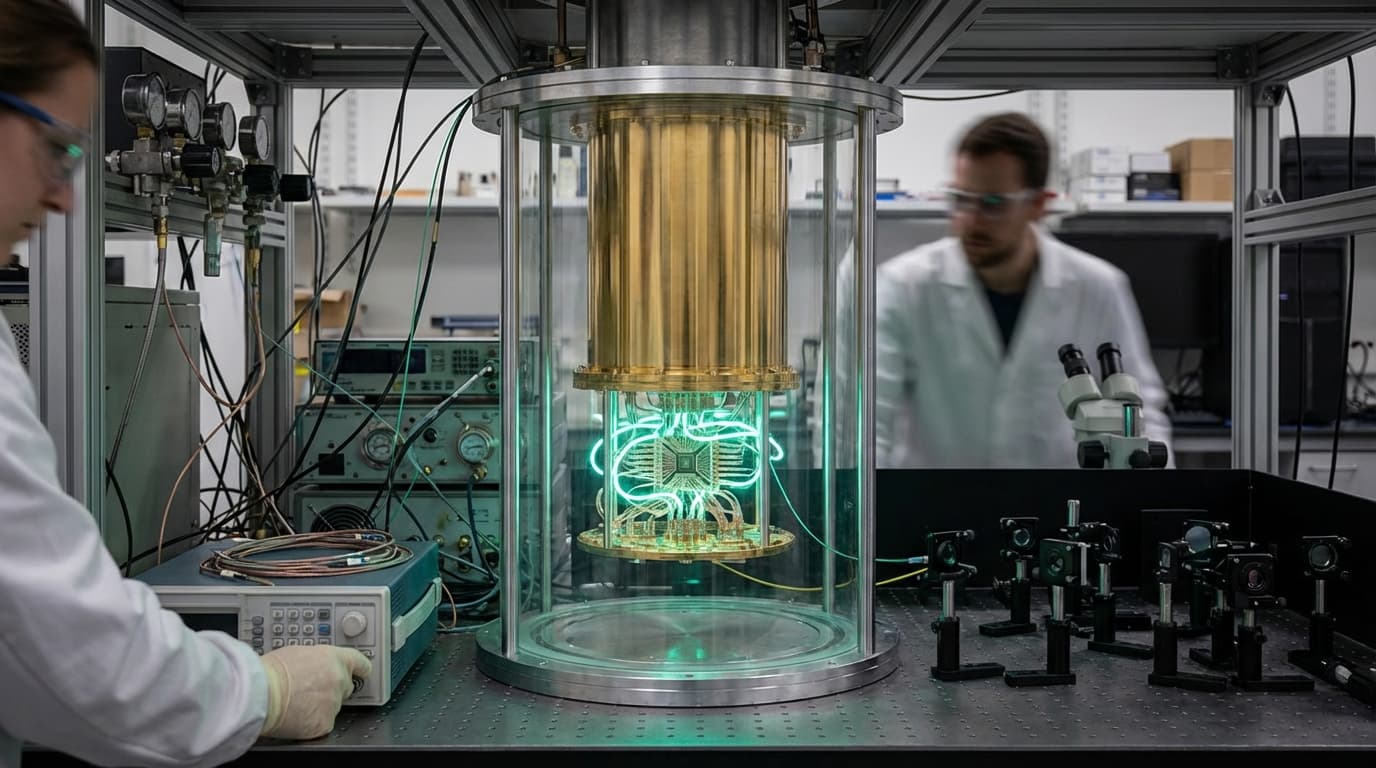
Topological Qubits
Topological qubits are quantum bits (qubits) that exploit the mathematical properties of topological phases of matter (exotic states of matter with topological properties, like Majorana fermions which are particles that are their own antiparticles) to create quantum states that are inherently protected from local perturbations (small disturbances that would normally cause errors in quantum systems). This offers the promise of fault-tolerant quantum computation without the massive error correction overhead required by other qubit types, where topological protection provides natural error resistance, though experimental realization remains a significant challenge because creating and maintaining topological states requires extremely precise control and exotic materials that are difficult to work with.
This innovation addresses the fundamental challenge of quantum error correction, where quantum states are extremely fragile and errors accumulate rapidly. By using topological protection, these qubits could enable practical quantum computers. Research institutions and companies like Microsoft are developing these technologies.
The technology is particularly significant for enabling fault-tolerant quantum computing, where topological protection could dramatically reduce the overhead needed for error correction. As research progresses, topological qubits could become a key technology for practical quantum computers. However, creating and maintaining topological states, managing materials challenges, and achieving experimental realization remain significant challenges. The technology represents an important direction for quantum computing, but requires extensive research to achieve practicality. Success could enable fault-tolerant quantum computing with much lower overhead, but the technology must overcome substantial experimental challenges. Topological qubits remain largely theoretical, with experimental progress being slow and challenging.
Related Organizations

Through Copilot and the 'Recall' feature in Windows, Microsoft is integrating persistent memory and agentic capabilities directly into the operating system.
Denmark · University
Part of the University of Copenhagen, hosting the Center for Quantum Devices which partners with Microsoft.

Collaboration between TU Delft and TNO, a world leader in Majorana fermion research.

Home to the Manfra Group, which grows the ultra-pure semiconductor nanowires needed for topological qubits.

Integrated quantum computing company formed by Honeywell and CQC.
Australia · University
Hosts a Microsoft Quantum Laboratory focused on the interface between quantum systems and control electronics.

Industrial research lab with a history of fundamental research in condensed matter physics relevant to topological phases.

A major hub for quantum materials research, including topological insulators and superconductors.

Renowned for research into fractional quantum Hall effect and topological states of matter.
United States · Company
Maintains Cirq and publishes extensive research on the resource costs of surface codes and specific algorithms like Shor's.
Supporting Evidence
Research this in Signals
Signals turns a topic into a sourced research record you can inspect and rerun. Your first scan is free, and this one starts with Topological Qubits already loaded, so edit it or scan as is.