Quantum Compilation Tools
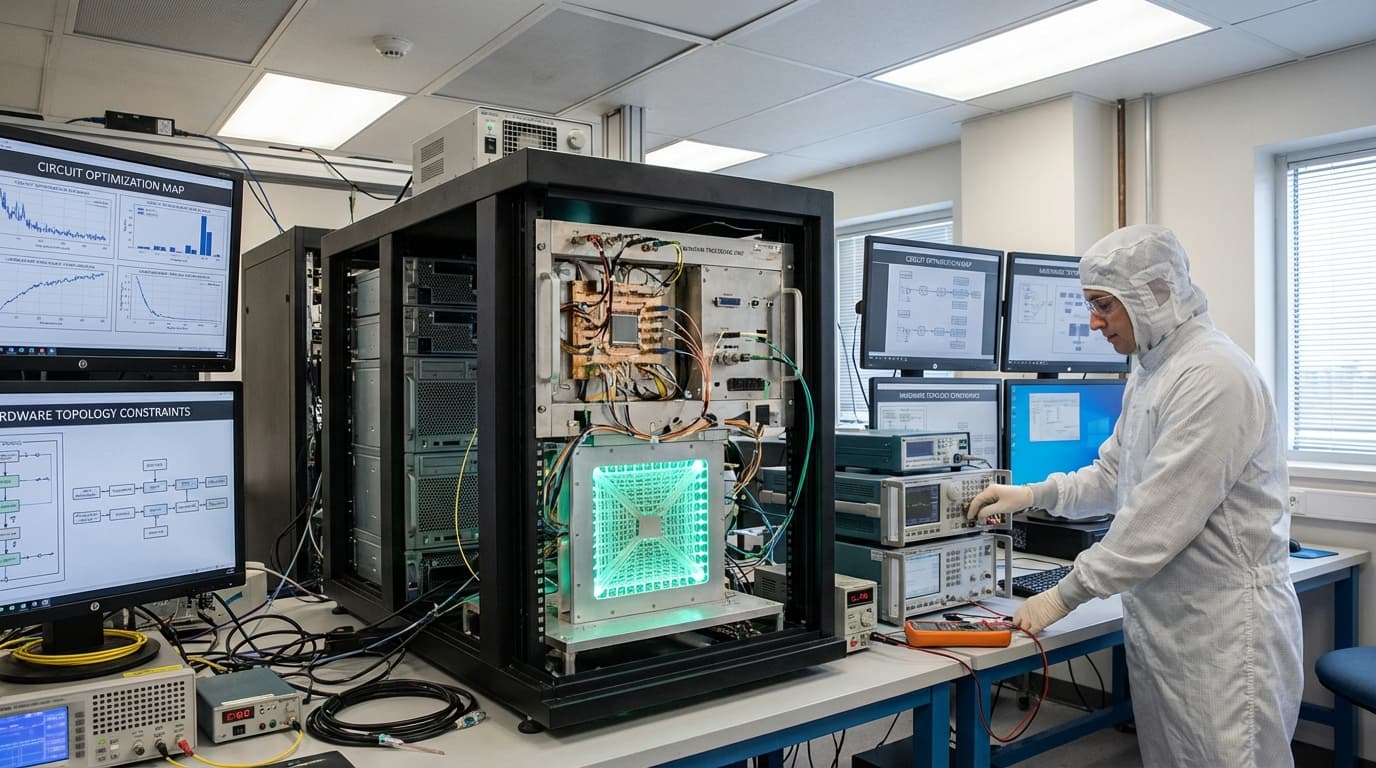
Quantum compilation tools are software optimizers that map abstract quantum circuits (high-level quantum algorithms) to physical hardware topology (the actual layout and connections of qubits on quantum chips) and constraints (limitations like which qubits can interact, which gates are available, and gate fidelities), handling the complex task of transpiling (converting) logical circuits to physical gates (actual quantum operations that can be performed on hardware). They optimize for specific hardware constraints like connectivity (which qubits can interact), gate fidelity (accuracy of gates), and native gate sets (gates that the hardware can perform directly), significantly reducing circuit depth (number of operations) and error accumulation (build-up of errors), making quantum algorithms more efficient and reliable on real hardware.
This innovation addresses the challenge of running quantum algorithms on real hardware, where hardware constraints must be considered. By optimizing circuits for hardware, these tools make quantum computing more practical. Companies like IBM, Google, and compiler developers are developing these tools.
The technology is essential for practical quantum computing, where compilation is necessary to run algorithms on hardware. As quantum hardware evolves, compilers must adapt. However, ensuring optimal compilation, managing complexity, and supporting diverse hardware remain challenges. The technology represents mature infrastructure for quantum computing, with many compilers available. Success is already being achieved, with compilers widely used in quantum computing. Quantum compilers are mature tools that are essential for quantum computing development.
Related Organizations

Provides a platform that automates the synthesis of quantum circuits from high-level functional models.

Integrated quantum computing company formed by Honeywell and CQC.
Singapore · Startup
Building tools to automatically compile classical code (like C or MATLAB) into quantum circuits.
Austria · Startup
Develops a specific architecture (ParityQC Architecture) designed to simplify error correction codes.
United States · Company
Develops cold atom hardware and sensors, including inertial sensors based on atom interferometry.

Home to the EPiQC (Enabling Practical-scale Quantum Computing) collaboration, focusing on full-stack optimization and compilation.

Develops various quantum software tools and compilers within its Advanced Quantum Testbed (AQT) and computer science divisions.
United States · Nonprofit
Maintains Mitiq, an open-source Python toolkit for implementing error mitigation techniques via circuit compilation.
Canada · Startup
Creators of 'Covalent', a workflow orchestration tool designed to manage the iterative loops of hybrid variational quantum algorithms.
Supporting Evidence
Research this in Signals
Signals turns a topic into a sourced research record you can inspect and rerun. Your first scan is free, and this one starts with Quantum Compilation Tools already loaded, so edit it or scan as is.