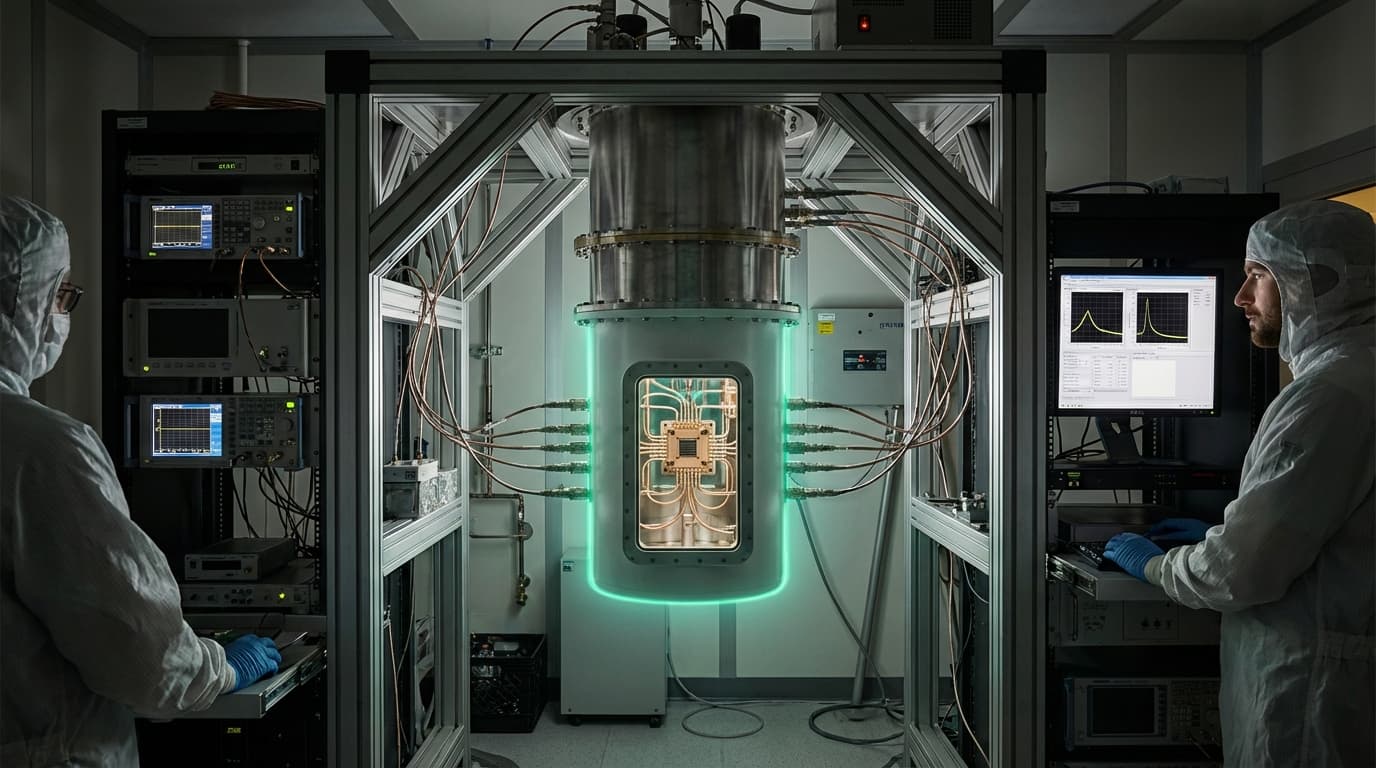
Fault-Tolerant Quantum Computing
Fault-tolerant quantum computing is a pivotal advancement in quantum technology that seeks to ensure the accuracy of computations despite the presence of errors. Quantum bits, or qubits, are inherently sensitive to their environment, making them susceptible to various types of errors such as decoherence and noise. To harness the full potential of quantum computers for solving complex problems, it is essential to develop systems that can operate correctly even in the face of these challenges.
The concept of fault tolerance involves the implementation of quantum error correction codes that can detect and correct errors as they occur. This process is analogous to classical error correction techniques, but with the added complexity of preserving the delicate quantum states. Pioneering work in this field has led to the development of several quantum error-correcting codes, including the 9-qubit Shor code and the toric code, each offering different levels of error tolerance and efficiency.
Achieving fault tolerance on a large scale is not merely about increasing the number of qubits in a quantum processor; it requires sophisticated strategies to manage error rates effectively. Currently, claims of existing fault-tolerant quantum computers have been limited in scale, underscoring the need for further research and practical implementations that can support hundreds or thousands of qubits operating with high levels of logical operations.
As the field progresses, fault-tolerant quantum computing holds the promise of transforming industries by enabling robust quantum algorithms that can tackle problems currently considered infeasible for classical computers. This technology could revolutionize areas such as cryptography, optimization, and complex system simulations, paving the way for significant advancements in various scientific and practical applications.
Related Organizations
France · Startup
Developing 'cat qubits' which are inherently protected against bit-flip errors, accelerating the path to fault tolerance.
United States · Company
Maintains Cirq and publishes extensive research on the resource costs of surface codes and specific algorithms like Shor's.
Provides watsonx.governance for managing AI risk and compliance.
Canada · Startup
Uses bosonic codes in superconducting circuits to achieve error correction at the individual qubit level.
Provides infrastructure software for quantum control to suppress errors and improve hardware performance.

Develops neutral-atom quantum computers and has published a roadmap specifically targeting logical qubits.
Austria · Startup
Develops a specific architecture (ParityQC Architecture) designed to simplify error correction codes.
United Kingdom · Startup
Develops quantum algorithms optimized for the constraints of early fault-tolerant hardware.
Supporting Evidence
Research this in Signals
Signals turns a topic into a sourced research record you can inspect and rerun. Your first scan is free, and this one starts with Fault-Tolerant Quantum Computing already loaded, so edit it or scan as is.