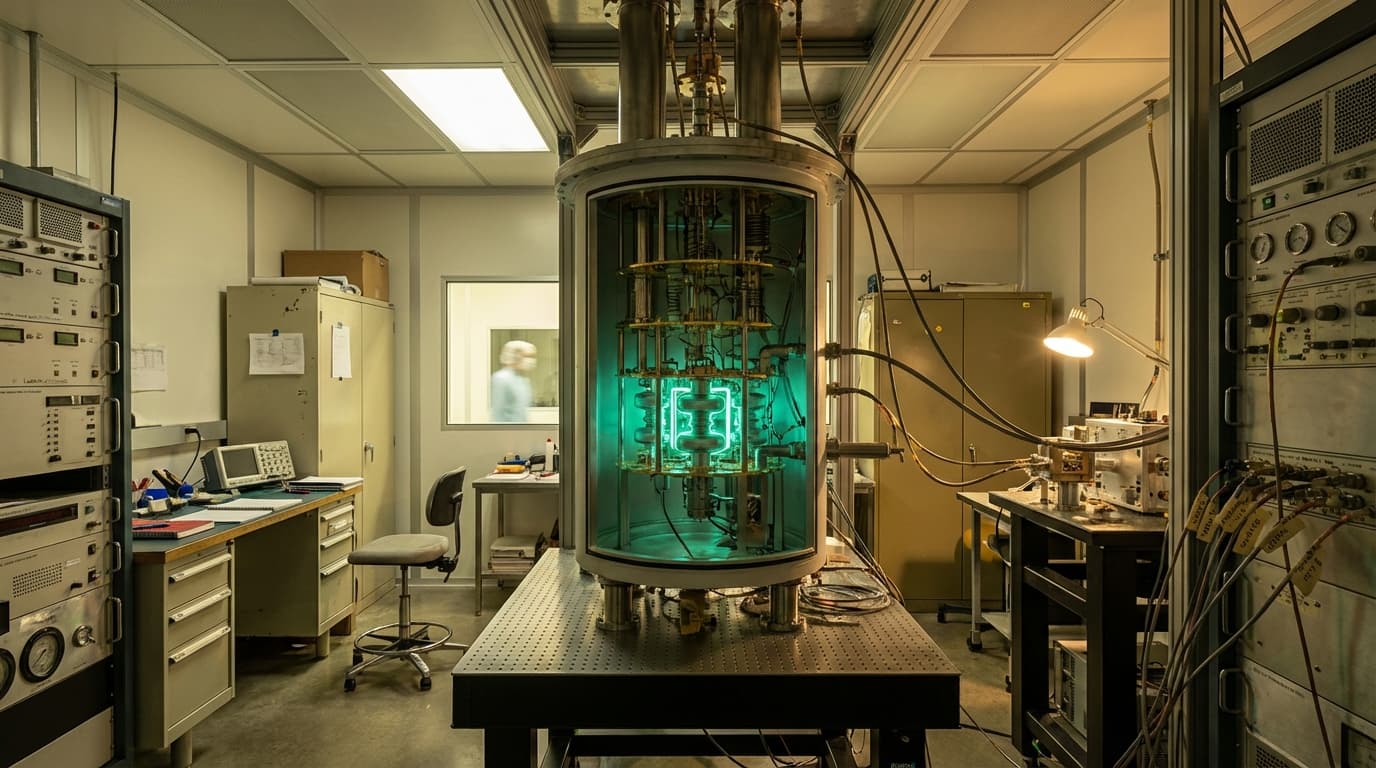
Cat Qubits
Cat qubits are a type of bosonic qubit (qubits encoded in the quantum states of bosonic particles like photons) that encode quantum information in the superposition of coherent states (specific quantum states of light) in a harmonic oscillator (a system that oscillates, like a quantum version of a spring), typically implemented in superconducting microwave cavities (resonant structures that store microwave photons). They feature a biased noise structure where bit-flip errors (errors that flip a qubit from 0 to 1 or vice versa) are exponentially suppressed (reduced dramatically) compared to phase-flip errors, simplifying the requirements for quantum error correction because only one type of error needs to be corrected, making error correction more efficient and potentially enabling fault-tolerant quantum computing with lower overhead.
This innovation addresses the challenge of quantum error correction, where correcting all types of errors is complex and resource-intensive. By suppressing one type of error, cat qubits simplify error correction. Research institutions and companies are developing these technologies.
The technology is particularly significant for reducing the overhead of quantum error correction, where biased noise could make fault-tolerant quantum computing more practical. As the technology improves, it could enable more efficient quantum computers. However, ensuring high fidelity, managing phase-flip errors, and achieving scalability remain challenges. The technology represents an important direction for quantum computing, but requires continued development to achieve practical use. Success could enable more efficient fault-tolerant quantum computing, but the technology must overcome technical challenges. Cat qubits are an active area of research with promising potential for error correction.
Research this in Signals
Signals turns a topic into a sourced research record you can inspect and rerun. Your first scan is free, and this one starts with Cat Qubits already loaded, so edit it or scan as is.