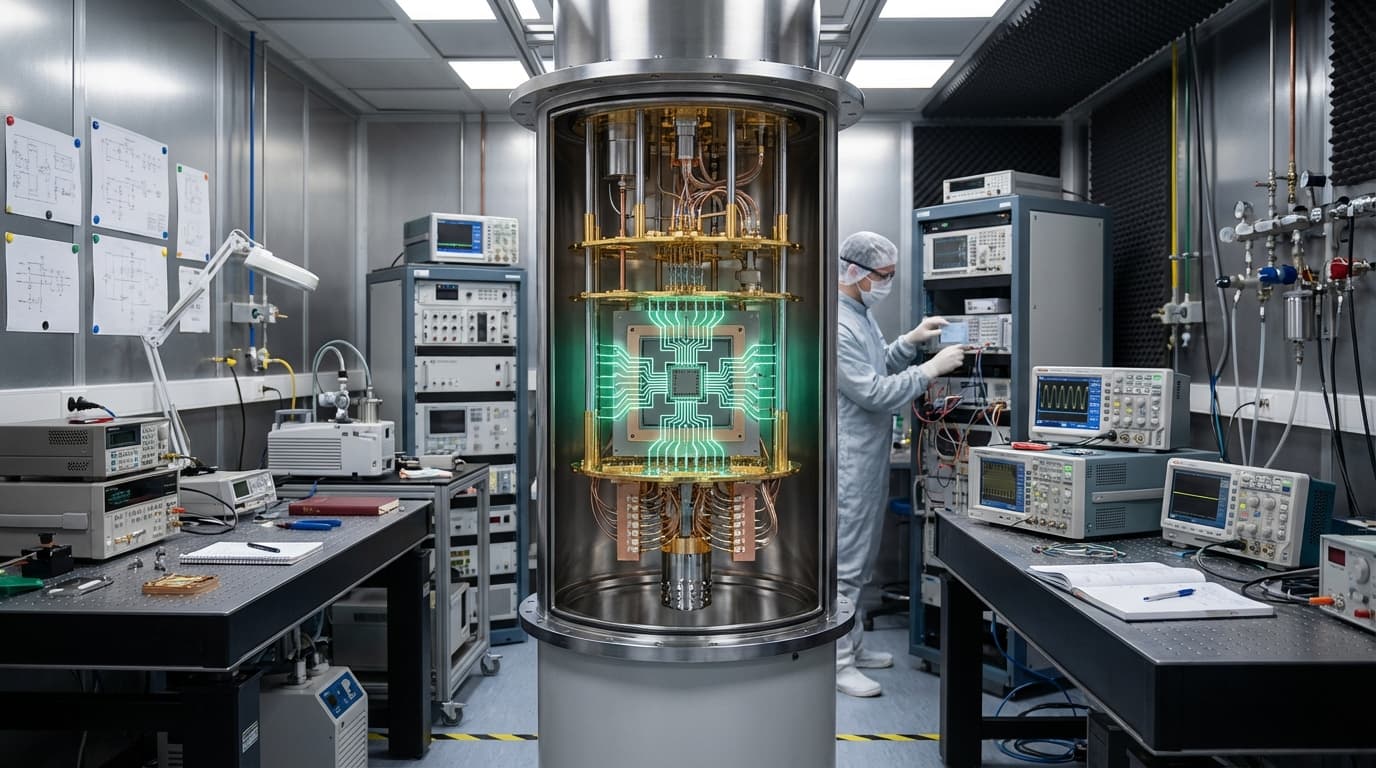
Fluxonium Qubits
Fluxonium qubits are a type of superconducting qubit (quantum bits made from superconducting circuits) that are emerging as a powerful alternative to standard transmons (the most common type of superconducting qubit). By operating at lower frequencies with a large inductor (a circuit component that stores energy in a magnetic field), they achieve significant anharmonicity (non-linear energy levels that prevent unwanted transitions), which suppresses charge noise (electrical noise that causes errors) and leakage to non-computational states (transitions to states that aren't part of the qubit's computational basis), providing better error protection. Recent experiments have shown coherence times (how long quantum states remain stable) rivalling the best transmons, positioning them as a strong candidate for next-generation superconducting quantum processors that could have better performance than current systems.
This innovation addresses the limitations of current superconducting qubits, where charge noise and leakage limit performance. By improving anharmonicity, fluxonium qubits could provide better performance. Research institutions and companies are developing these technologies.
The technology is particularly significant for improving superconducting quantum computing, where better qubits could enable more powerful quantum computers. As the technology improves, it could become a standard for superconducting quantum processors. However, ensuring manufacturability, managing complexity, and achieving consistent performance remain challenges. The technology represents an important evolution in superconducting qubits, but requires continued development to achieve widespread use. Success could enable better superconducting quantum computers, but the technology must prove its advantages in practice. Fluxonium qubits are an active area of research with promising results.
Research this in Signals
Signals turns a topic into a sourced research record you can inspect and rerun. Your first scan is free, and this one starts with Fluxonium Qubits already loaded, so edit it or scan as is.