









Virtual Power Plants
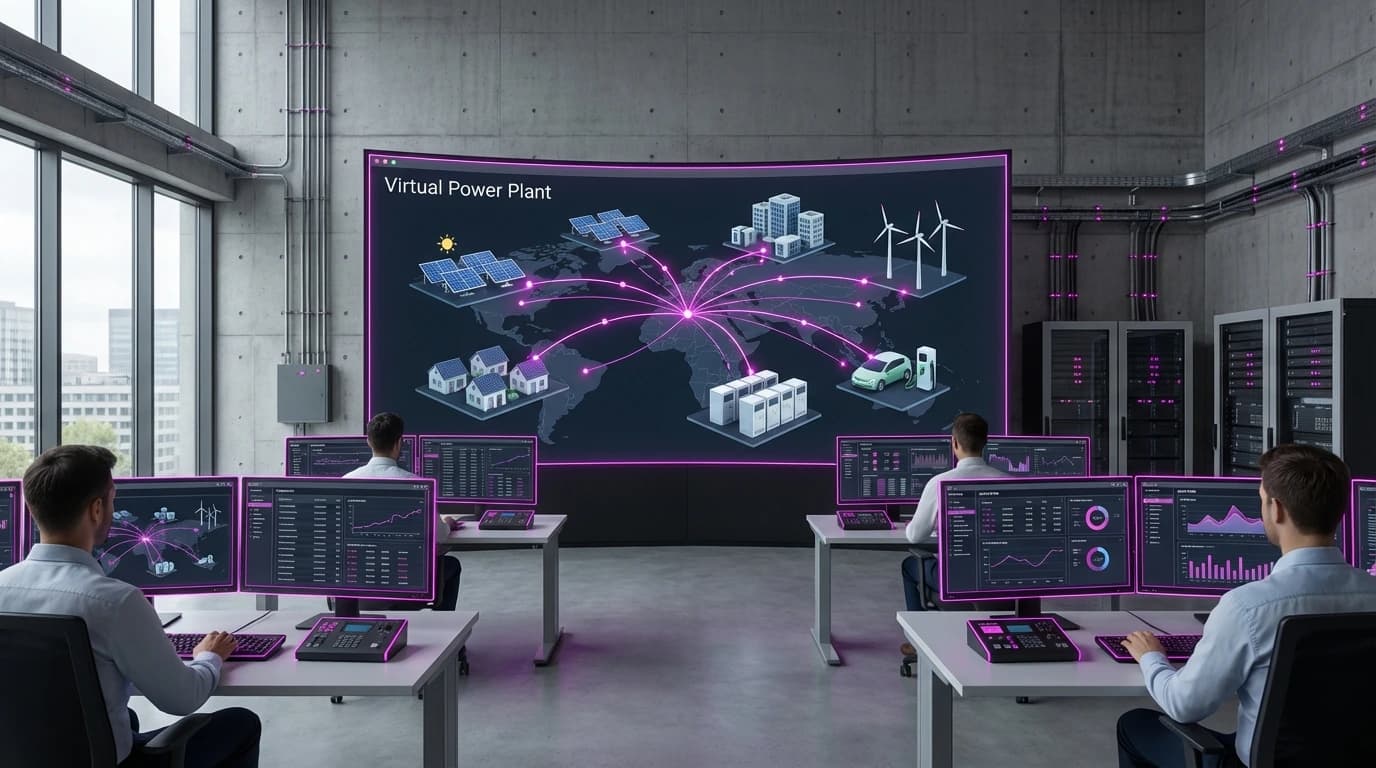
Virtual Power Plants (VPPs)
Software that coordinates distributed energy assets like solar, batteries, and EVs as a unified grid resource
Virtual Power Plants represent a fundamental shift in how electricity grids can be managed and optimized, moving away from centralized generation toward distributed coordination. At their core, VPPs are software platforms that aggregate thousands or even millions of small-scale energy assets—residential solar installations, home battery systems, electric vehicle chargers, smart thermostats, and commercial backup generators—into a unified network that can be controlled as if it were a single large power plant. This aggregation is achieved through cloud-based control systems that communicate with each distributed energy resource (DER) via internet connectivity, sending signals to charge, discharge, or modulate power consumption based on grid conditions. Advanced forecasting algorithms analyze weather patterns, historical consumption data, electricity prices, and grid frequency to predict when and where power will be needed, while machine learning models continuously optimize dispatch decisions across the entire portfolio of connected assets. The result is a dynamic, responsive energy resource that can ramp up or down within seconds, providing services traditionally delivered only by conventional power plants.
The electricity grid faces mounting challenges as renewable energy penetration increases and extreme weather events become more frequent. Traditional grids rely on large fossil fuel peaker plants that sit idle most of the year but activate during periods of maximum demand, representing enormous capital investments with poor utilization rates. VPPs address this inefficiency by transforming assets that consumers already own into grid resources, effectively creating capacity without building new infrastructure. They solve the intermittency problem inherent in solar and wind generation by coordinating battery storage to absorb excess renewable energy when production exceeds demand and release it during peak hours or when generation drops. For utilities, VPPs offer a cost-effective alternative to infrastructure upgrades, deferring or eliminating the need for expensive transmission line expansions or substation reinforcements. They also enable new business models where homeowners and businesses can monetize their energy assets by participating in demand response programs, earning payments for allowing their batteries or controllable loads to support grid stability during critical periods.
Pilot programs and commercial deployments have demonstrated VPP viability across multiple markets, with some regions already integrating hundreds of megawatts of virtual capacity into grid operations. In Australia, several utilities have enrolled tens of thousands of residential solar-plus-storage systems into coordinated networks that provide frequency regulation and emergency reserves. California's grid operator has begun procuring capacity from VPP aggregators to address summer peak demand, while European markets are leveraging VPPs to balance increasing wind and solar generation. The technology is particularly valuable in areas with high renewable penetration or constrained transmission infrastructure, where traditional solutions would require years of planning and construction. As battery costs continue declining and electric vehicle adoption accelerates, the potential scale of VPP resources will expand dramatically—millions of EVs could collectively provide gigawatts of flexible capacity simply by coordinating when they charge. This trajectory positions VPPs as essential infrastructure for the energy transition, enabling grids to accommodate higher renewable shares while maintaining reliability and reducing the need for fossil fuel backup generation.
TRL
7/9Operational
Impact
5/5
Investment
4/5
Category
Software
Related Organizations
Operates one of Europe's largest Virtual Power Plants, networking thousands of medium-and small-scale power-producing and consuming units.
Developer
Develops enterprise software that unlocks the value of distributed energy resources (DERs) through Virtual Power Plants (VPPs).
Developer
The advanced energy services arm of Enel Group, focusing on demand response and flexibility.
Deployer
Energy technology company and supplier, developer of the Kraken platform.
Deployer
The largest residential solar installer in the US, actively networking home batteries into VPPs to support grid reliability.
Deployer
Provides a universal API for energy markets, allowing DER partners to automate bids and dispatch assets into wholesale markets.
Developer
Develops residential VPPs by financing and installing solar+storage systems and networking them for grid services.
Developer
A flexibility aggregator that connects industrial processes to the grid for balancing services.
Developer
A digital electricity supplier that uses smart algorithms to charge EVs and heat homes when prices (and grid load) are low.
Deployer
Offers an integrated energy system and VPP software (via its acquisition of Moixa) to manage home batteries.
Developer
What was expected
Published forecasts about this technology, graded against what happened in Hindsight.
Supporting Evidence
Evidence data is not available for this technology yet.
Research this in Signals
Scan Virtual Power Plants (VPPs) for yourself.
Signals turns a topic into a sourced research record you can inspect and rerun. Your first scan is free, and this one starts with Virtual Power Plants (VPPs) already loaded, so edit it or scan as is.