Hollow-Core Fiber Networks
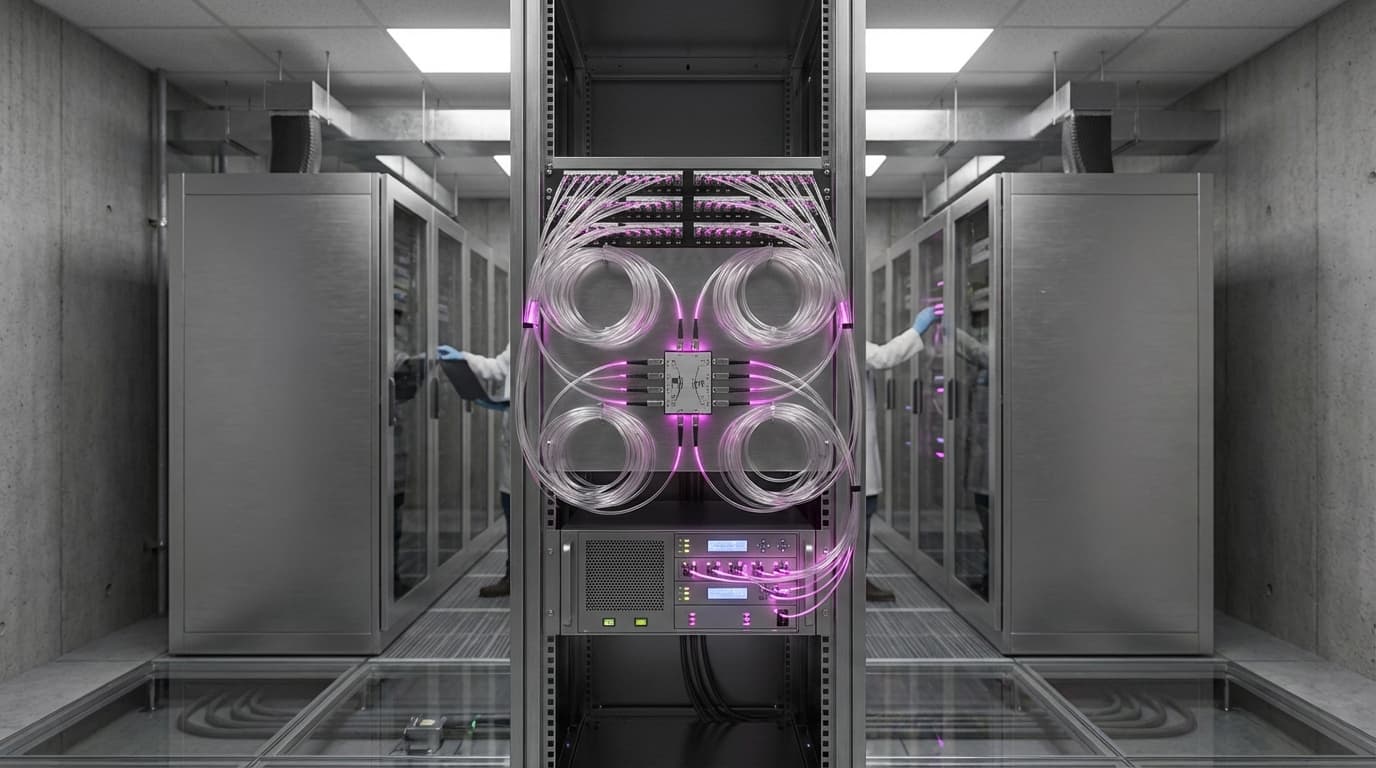
Hollow-core fiber networks represent a fundamental reimagining of optical transmission infrastructure, addressing the physical limitations that have constrained data transmission speeds in conventional fiber optic systems. Traditional fiber optic cables guide light through solid glass cores, where the refractive properties of the material slow photons to approximately two-thirds the speed of light in a vacuum. Hollow-core fibers, by contrast, confine light within air-filled or vacuum channels surrounded by specially engineered microstructured cladding. This photonic bandgap structure uses periodic patterns of air holes or other materials to create a "cage" that prevents light from escaping while allowing it to propagate through the hollow center at speeds approaching 299,792 kilometers per second. The result is a latency reduction of roughly 30-50% compared to solid-core alternatives, with light traveling at approximately 99.7% of its maximum velocity rather than the 67% achieved in conventional glass fibers.
The telecommunications and data center industries face mounting pressure to reduce signal propagation delays as applications become increasingly latency-sensitive. For high-frequency trading operations, where microseconds can translate to millions in competitive advantage, even marginal reductions in transmission time between exchanges can prove decisive. Similarly, emerging applications in distributed artificial intelligence training require synchronisation across geographically dispersed computing clusters, where cumulative latency across thousands of parameter updates can significantly impact model convergence times. Remote surgical procedures and autonomous vehicle coordination systems demand near-instantaneous communication to ensure safety and precision. Beyond raw speed advantages, hollow-core fibers also exhibit reduced signal distortion and lower power loss over long distances, as light interacts minimally with the transmission medium. This characteristic addresses the challenge of maintaining signal integrity across transcontinental or submarine cable routes without requiring as many amplification stations.
Research deployments have demonstrated hollow-core fiber performance in laboratory settings and limited field trials, with several telecommunications providers exploring integration into existing network infrastructure. Early commercial installations have focused on short-haul, high-value routes where latency reduction justifies the current cost premium over conventional fiber. The technology aligns with broader infrastructure trends toward edge computing architectures and real-time data processing, where physical proximity alone cannot eliminate all transmission delays. As manufacturing techniques mature and production scales increase, industry analysts note potential applications extending beyond premium network segments to general backbone infrastructure. The development trajectory suggests that hollow-core networks may become integral to next-generation telecommunications systems, particularly as quantum communication networks and other latency-critical applications emerge, fundamentally reshaping expectations for what constitutes acceptable signal propagation time in planetary-scale infrastructure.
Related Organizations

Enterprise technology platform providing low-latency edge computing solutions via its fiber network.

Through Copilot and the 'Recall' feature in Windows, Microsoft is integrating persistent memory and agentic capabilities directly into the operating system.

A Furukawa Electric subsidiary that manufactures AccuCore HCF, a commercial hollow-core fiber cable.

British multinational telecommunications holding company conducting extensive QKD trials and commercial pilots.

Industrial research lab with a history of fundamental research in condensed matter physics relevant to topological phases.

Home to the Optoelectronics Research Centre (ORC), a pioneer in photonic crystal fibers and hollow-core technology.

Networking systems, services, and software company specializing in optical networking.

Tested hollow-core fiber to achieve ultra-low latency and high speeds for edge compute applications.
Glophotonics
France · Startup
Develops and manufactures hollow-core photonic crystal fibers for laser beam delivery and gas photonics.

Innovator in materials science, specifically glass and ceramics.
Supporting Evidence
Research this in Signals
Signals turns a topic into a sourced research record you can inspect and rerun. Your first scan is free, and this one starts with Hollow-Core Fiber Networks already loaded, so edit it or scan as is.