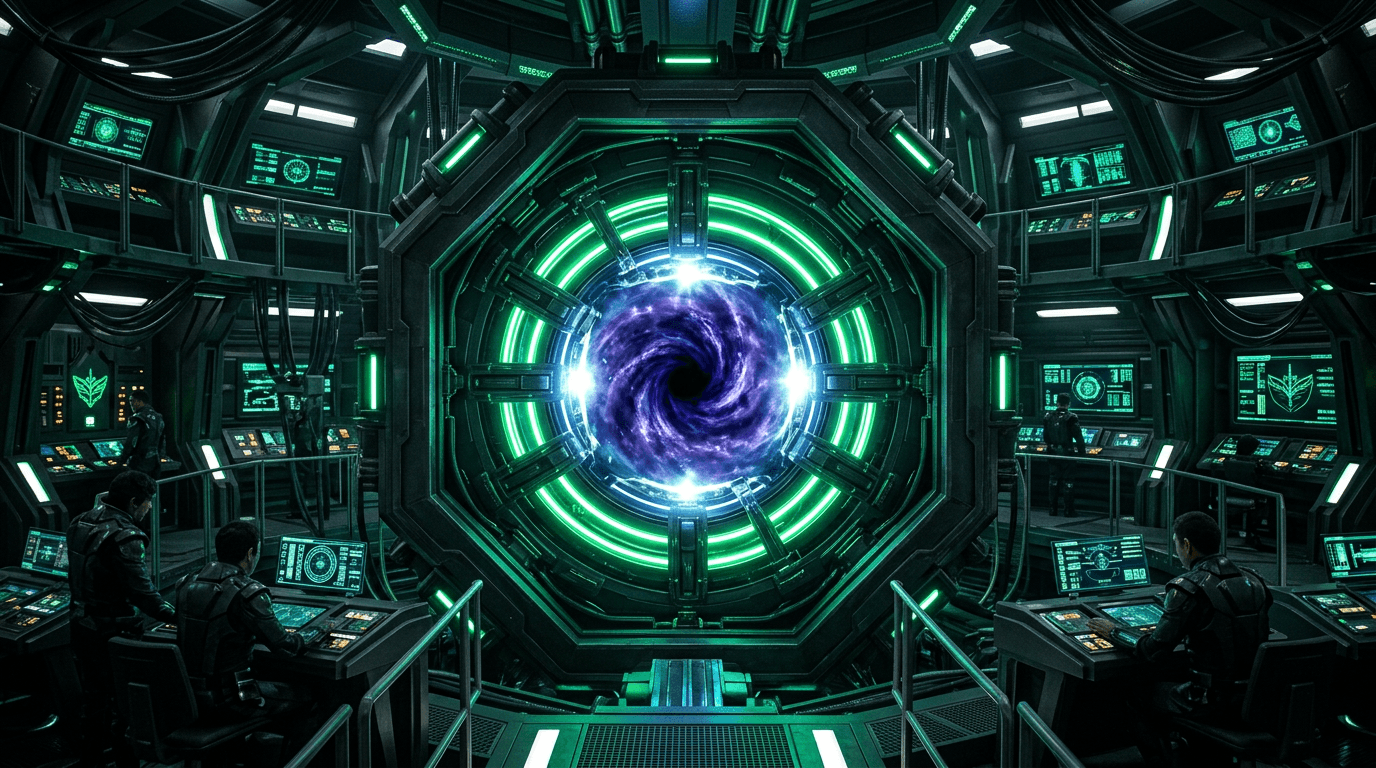
Quantum Singularity Power Core
The quantum singularity power core represents one of science fiction's most audacious energy concepts: harnessing an artificial microscopic black hole as a starship reactor. In the Star Trek universe, this technology distinguishes Romulan vessels from Federation ships, which rely on matter-antimatter annihilation. The imagined mechanics involve creating and stabilizing a quantum-scale singularity—a region of space-time with such extreme gravitational curvature that it forms an event horizon. Romulan engineers theoretically extract energy through multiple quantum phenomena: Hawking radiation (the theoretical particle emission from black holes), rotational frame-dragging effects that could theoretically be tapped through the Penrose process, and possibly quantum vacuum fluctuations amplified by the extreme curvature. Sophisticated containment fields would need to precisely regulate the singularity's mass, preventing both evaporation (which accelerates as black holes shrink) and uncontrolled growth from matter accretion. This concept draws from real theoretical physics but extends far beyond current scientific capabilities, imagining engineering control over phenomena that remain purely mathematical in our understanding.
Within Star Trek's narrative framework, the quantum singularity serves multiple storytelling functions beyond mere power generation. It creates a technological identity for the Romulan Star Empire, distinguishing their engineering philosophy from Federation approaches and reinforcing their portrayal as a civilization willing to embrace dangerous, exotic technologies. The singularity's unavoidable gravitational signature provides plot-relevant limitations—even cloaked Romulan vessels can sometimes be detected through spatial distortions, creating tactical vulnerabilities that balance their stealth advantages. The catastrophic failure potential adds dramatic tension, with containment breaches threatening to create expanding black holes that could consume entire star systems. This narrative device explores themes of technological hubris and the risks of wielding forces beyond complete control. In real-world scientific discourse, the concept occasionally appears in speculative discussions about advanced propulsion or energy systems, though always firmly in the realm of far-future speculation rather than near-term engineering.
From a physics perspective, the quantum singularity core faces formidable theoretical and practical obstacles that separate it from plausible near-term technology. Creating artificial black holes would require compressing matter to densities achievable only in stellar collapse or the early universe—energies far beyond any conceivable human technology. Microscopic black holes, if created, would evaporate almost instantaneously through Hawking radiation unless continuously fed matter, creating a net energy loss rather than gain. The containment challenge is equally daunting: no known force could physically restrain a singularity, as gravity dominates all other interactions at such scales. Any containment would need to work through exotic mechanisms like negative energy densities or manipulated space-time geometry—concepts that remain purely theoretical and may violate fundamental physics. The technology would require breakthroughs not just in engineering but in our understanding of quantum gravity, a theory that remains incomplete despite decades of research. While the concept brilliantly extrapolates from real physics—Hawking radiation, frame-dragging, and singularity thermodynamics are all legitimate theoretical constructs—the engineering leap from mathematical description to controlled power generation represents speculation several centuries beyond current capabilities, making quantum singularity cores a compelling thought experiment rather than a development pathway for future energy systems.
Research this in Signals
Signals turns a topic into a sourced research record you can inspect and rerun. Your first scan is free, and this one starts with Quantum Singularity Power Core already loaded, so edit it or scan as is.