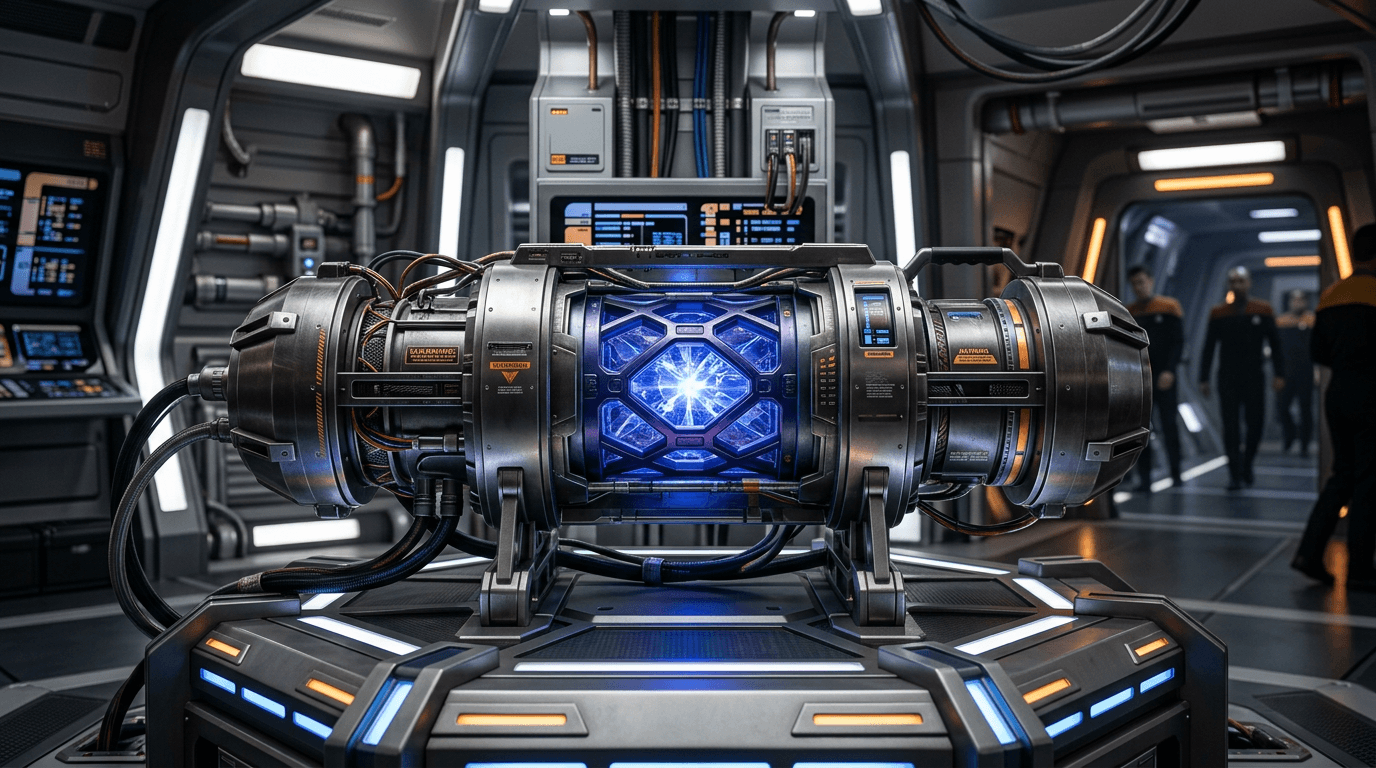
Tricobalt Device
Tricobalt devices represent a class of high-yield explosive ordnance that appears primarily in speculative military scenarios and science fiction narratives, distinguished by their theoretical ability to generate spatial distortions rather than relying solely on conventional explosive force. The conceptual mechanism involves a fictional explosive compound—tricobalt—that when detonated produces cascading gravimetric effects, creating shockwaves that propagate through both normal space and the theoretical substrate of spacetime itself. Unlike traditional explosives that release energy through chemical reactions or even matter-antimatter annihilation, tricobalt devices are imagined to interact with the geometric properties of space, producing distortions that amplify destructive potential far beyond their physical mass. This speculative technology draws loosely from real physics concepts like gravitational waves and spacetime curvature, though the actual mechanisms described remain firmly in the realm of narrative invention. The devices serve as a narrative shorthand for weapons that can affect reality at a fundamental level, representing a tier of destructive capability beyond conventional armaments.
Within strategic fiction and scenario planning contexts, tricobalt devices fulfill a specific narrative role as tools for addressing problems that conventional weapons cannot solve. They appear in situations requiring the destruction of reinforced installations, the collapse of exotic spatial phenomena, or the disruption of advanced transportation infrastructure like theoretical wormholes or faster-than-light transit corridors. This positions them as weapons of last resort in speculative military doctrine, reserved for circumstances where standard ordnance proves insufficient and where collateral effects on the fabric of space itself become acceptable risks. The concept also serves to explore ethical boundaries in warfare, raising questions about weapons that could potentially cause lasting damage to spacetime geometry. In defense and futures studies, such speculative weapons help analysts think through the implications of technologies that might manipulate fundamental physical properties, even if current science offers no pathway to their development.
From a plausibility standpoint, tricobalt devices remain entirely fictional, with no corresponding research program or theoretical foundation in contemporary physics. While gravitational wave astronomy has confirmed that massive cosmic events can create ripples in spacetime, and while research into exotic matter and negative energy densities continues in theoretical physics, nothing suggests the possibility of compact explosive devices that could controllably distort space on tactically relevant scales. The energy requirements alone would likely exceed anything achievable with portable weapons, and our current understanding of general relativity provides no mechanism by which chemical or nuclear explosives could directly affect spacetime geometry in the manner described. For such devices to transition from fiction to plausibility would require revolutionary breakthroughs in our understanding of gravity, the development of exotic matter with properties never observed in nature, and energy generation technologies orders of magnitude beyond current capabilities. Until such foundational discoveries emerge, tricobalt devices remain valuable primarily as thought experiments for exploring the strategic implications of reality-warping weapons rather than as near-term technological possibilities.
Research this in Signals
Signals turns a topic into a sourced research record you can inspect and rerun. Your first scan is free, and this one starts with Tricobalt Device already loaded, so edit it or scan as is.