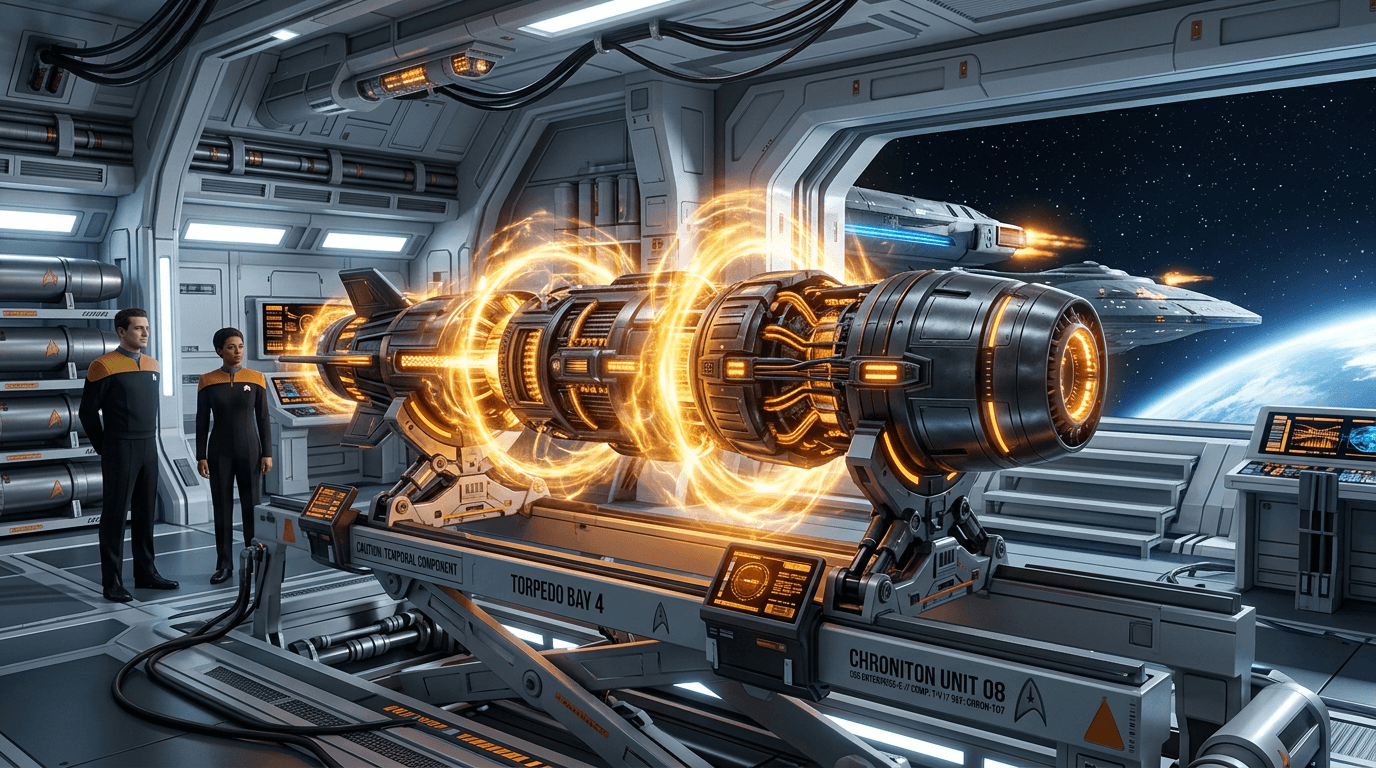
Chroniton Torpedo
The chroniton torpedo represents a speculative weapons concept that appears primarily in science fiction narratives, particularly within the Star Trek universe. The theoretical mechanism involves weaponizing hypothetical chroniton particles—subatomic units proposed to exist in temporal physics frameworks but not observed in real-world experimentation. According to fictional depictions, these particles enable the torpedo to oscillate between temporal phases, creating a state where the weapon exists fractionally ahead or behind the present moment. This temporal displacement would theoretically allow the projectile to bypass spatial barriers like deflector shields, which operate within conventional spacetime. The weapon's detonation is imagined to release both conventional explosive energy and temporal disruption effects, creating localized chronological anomalies at the impact site. While chroniton particles remain purely speculative constructs, the concept draws loose inspiration from quantum mechanics principles like superposition and phase relationships, though it extends far beyond established physics into narrative territory.
Within science fiction storytelling, chroniton torpedoes serve as plot devices that challenge conventional military superiority and force characters to develop countermeasures beyond standard defensive systems. The weapon embodies recurring themes in speculative fiction about technological arms races and the strategic implications of manipulating fundamental forces. In defense and strategic studies contexts, temporal weapons occasionally appear in theoretical discussions about asymmetric warfare and breakthrough technologies, though strictly as thought experiments rather than development priorities. The concept intersects tangentially with real-world research in quantum entanglement, relativistic physics, and theoretical investigations into closed timelike curves, though none of these fields suggest practical weaponization is feasible. The fictional technology also raises narrative questions about temporal paradoxes, causality protection, and whether physical laws would permit such devices to function without creating logical contradictions.
From a scientific plausibility standpoint, chroniton torpedoes face insurmountable obstacles under current physics understanding. No experimental evidence supports the existence of chroniton particles, and temporal manipulation at macroscopic scales contradicts thermodynamic principles and causality constraints embedded in relativity theory. The concept assumes time can be treated as a navigable dimension comparable to spatial coordinates, which remains undemonstrated and theoretically problematic. Any pathway toward such technology would require revolutionary discoveries in temporal mechanics, verification of exotic particles with temporal properties, and resolution of causality paradoxes that currently appear mathematically intractable. While quantum physics demonstrates counterintuitive phenomena like entanglement and tunneling, these effects operate at subatomic scales under strict limitations that don't extrapolate to torpedo-sized objects phasing through barriers. The chroniton torpedo remains firmly in the realm of narrative speculation, useful for exploring conceptual boundaries of physics within fictional frameworks but disconnected from foreseeable technological development trajectories.
Research this in Signals
Signals turns a topic into a sourced research record you can inspect and rerun. Your first scan is free, and this one starts with Chroniton Torpedo already loaded, so edit it or scan as is.