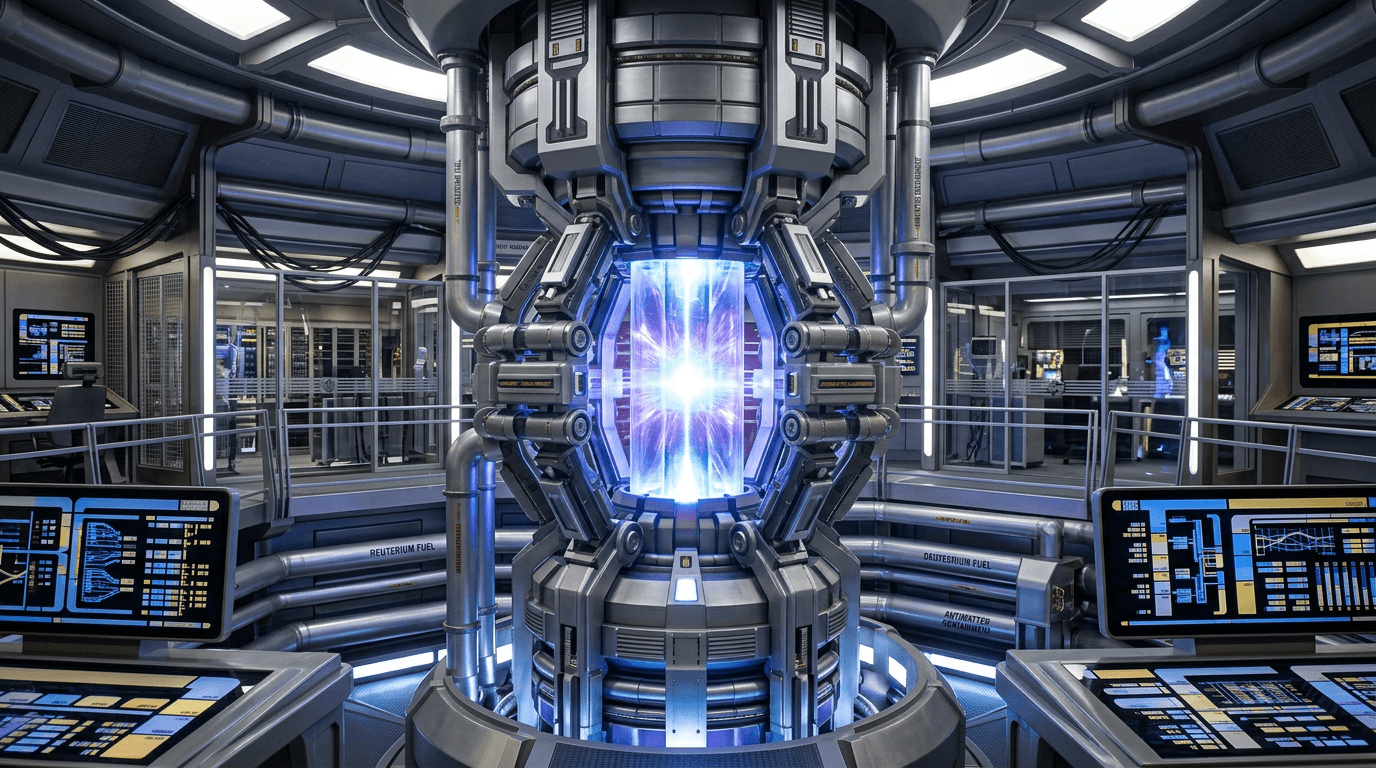
Matter-Antimatter Reactor
Matter-antimatter reactors represent one of the most theoretically powerful energy generation concepts in speculative physics, predicated on the complete conversion of mass into energy according to Einstein's mass-energy equivalence principle. In fictional frameworks like Star Trek's warp core, these systems achieve controlled annihilation by bringing matter and antimatter into contact within a heavily shielded reaction chamber. The fundamental appeal lies in the theoretical efficiency: whereas nuclear fission converts roughly 0.1% of mass to energy and fusion achieves around 0.7%, matter-antimatter annihilation would convert 100% of the reactant mass into energy. Real-world physics confirms that when a particle meets its antiparticle, they annihilate completely, producing gamma rays and other high-energy particles. The engineering challenge centers on containment—antimatter cannot touch conventional matter before the controlled reaction point, requiring magnetic bottles or other exotic confinement methods. Fictional implementations often invoke crystalline regulators or plasma conduits to manage energy output, translating the raw annihilation into forms compatible with propulsion systems and shipboard power grids.
Within science fiction narratives, matter-antimatter reactors serve as the enabling technology for faster-than-light travel and deep-space exploration, providing power densities that conventional nuclear systems cannot match. The dramatic potential of catastrophic containment failure—an uncontrolled matter-antimatter explosion—creates narrative tension while illustrating the extreme energies involved. In strategic defense and space exploration discourse, antimatter propulsion occasionally surfaces as a distant-horizon concept for interstellar missions, where the mass-efficiency advantages could theoretically reduce fuel requirements for long-duration voyages. Research institutions have explored antimatter physics primarily through particle accelerators, where antiprotons and positrons are created in minute quantities. These investigations focus on fundamental physics rather than power generation, as current production methods consume vastly more energy than the antimatter could ever release.
The primary constraint separating fictional reactors from real-world feasibility is antimatter production and storage. Producing even nanograms of antimatter requires enormous particle accelerator facilities and astronomical energy inputs—CERN's antiproton production, for instance, yields quantities measured in trillionths of a gram. Storage presents equally formidable challenges, as antimatter must remain suspended without contacting container walls, requiring sophisticated magnetic confinement systems that themselves consume significant power. No known materials could serve as the "dilithium crystals" of fiction to regulate such reactions. For matter-antimatter reactors to transition from speculative concept to engineering reality would require revolutionary breakthroughs in antimatter production efficiency, room-temperature magnetic confinement, and energy conversion systems capable of handling the intense gamma radiation produced during annihilation. While the physics underlying annihilation is well-established, the engineering pathway to practical reactors remains entirely theoretical, positioning these systems firmly in the realm of far-future speculation rather than near-term development.
Research this in Signals
Signals turns a topic into a sourced research record you can inspect and rerun. Your first scan is free, and this one starts with Matter-Antimatter Reactor already loaded, so edit it or scan as is.