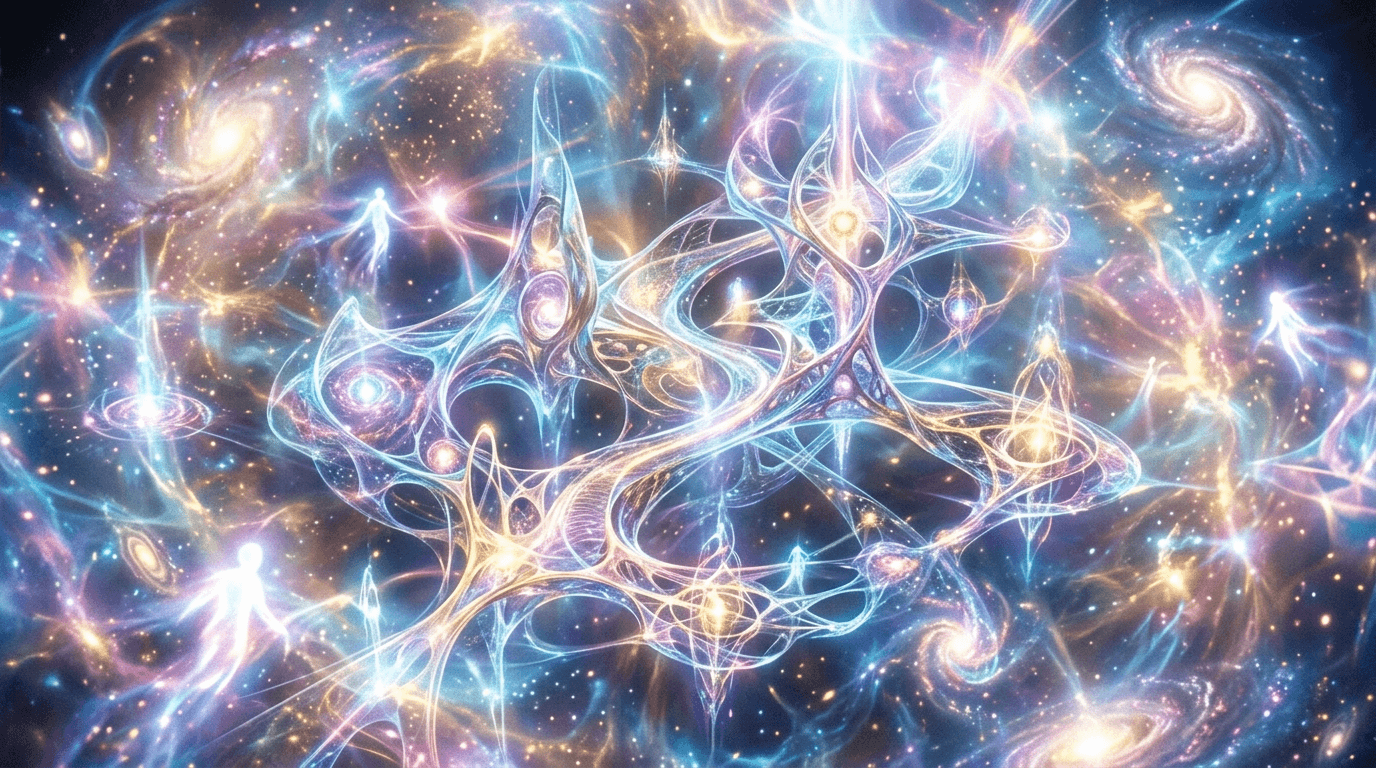
Q Continuum Spatial Constructs
The Q Continuum represents a conceptual framework from science fiction that explores the possibility of realms existing entirely outside conventional space-time physics. In narrative contexts, particularly within the Star Trek universe, these extradimensional constructs are portrayed as spaces where omnipotent beings exist beyond the constraints of causality, entropy, and the fundamental forces governing our observable universe. The concept draws loosely from theoretical physics discussions about higher-dimensional spaces, brane cosmology, and the mathematical possibility of additional spatial dimensions beyond the three we experience. While purely speculative, the Q Continuum serves as a narrative device to explore questions about the ultimate nature of reality, consciousness divorced from physical substrate, and what existence might mean in domains where conventional physics breaks down entirely. The constructs are imagined as accessible only through quantum states or dimensional transitions that transcend known technology, representing a boundary between science and metaphysics.
Within speculative fiction and philosophical discourse, the Q Continuum functions as a thought experiment about the limits of physical law and the possibility of post-physical existence. The concept appears in discussions about consciousness studies, simulation theory, and the long-term trajectory of intelligence in the universe. Some futurists and transhumanist thinkers reference similar ideas when contemplating substrate-independent minds or civilizations that might eventually transcend physical constraints entirely. The narrative role of such constructs is to challenge anthropocentric assumptions about the nature of existence and to provide a framework for exploring what advanced intelligence might become given sufficient time and capability. In defense and strategic foresight contexts, extradimensional concepts occasionally surface in speculative scenarios about breakthrough physics or adversarial capabilities that might operate beyond conventional detection frameworks, though these remain firmly in the realm of scenario planning rather than operational concern.
From a scientific plausibility standpoint, the Q Continuum remains entirely fictional, with no empirical evidence supporting the existence of accessible higher-dimensional spaces or beings operating outside physical law. Theoretical physics does explore concepts like extra dimensions in string theory and M-theory, but these mathematical frameworks describe microscopic compactified dimensions rather than accessible realms of existence. The fundamental constraint is that any phenomenon we can observe or interact with must, by definition, operate within some physical framework subject to consistent laws, even if those laws differ from our current understanding. For such constructs to gain plausibility would require revolutionary discoveries in quantum gravity, verification of higher-dimensional physics, and evidence that consciousness or information can exist independently of physical substrate—developments that remain speculative at best. The Q Continuum thus serves primarily as a narrative tool for exploring philosophical questions about the nature of reality, rather than as a serious technological or scientific prospect.
Research this in Signals
Signals turns a topic into a sourced research record you can inspect and rerun. Your first scan is free, and this one starts with Q Continuum Spatial Constructs already loaded, so edit it or scan as is.