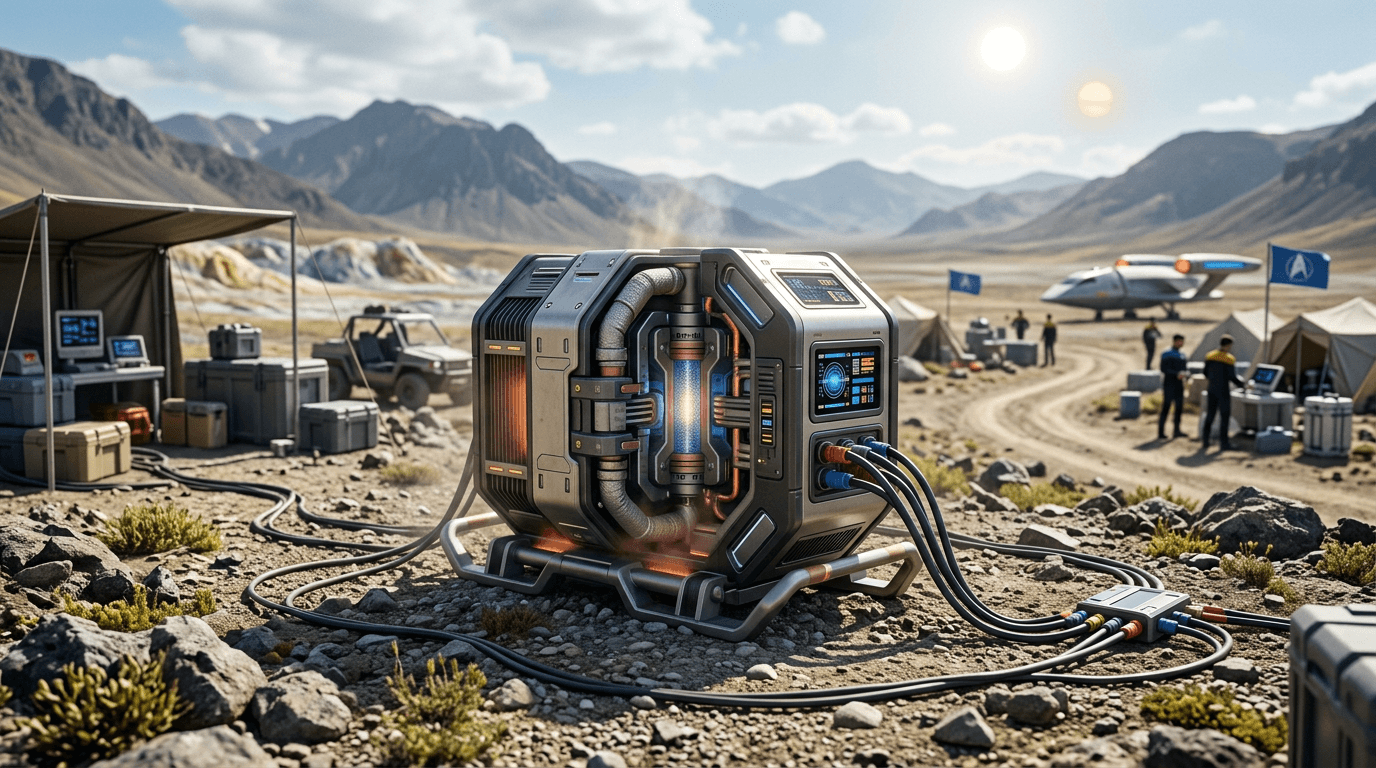
Portable Fusion Generator
The portable fusion generator represents a speculative advancement in mobile energy infrastructure, envisioned as a self-contained power system capable of delivering megawatt-scale electricity in remote or crisis environments. Unlike conventional diesel generators or solar arrays that dominate current field deployment scenarios, this concept imagines a compact fusion reactor small enough for transport yet powerful enough to sustain an entire forward operating base, research station, or disaster relief operation. The theoretical mechanism centers on deuterium-deuterium or deuterium-tritium fusion reactions contained within a miniaturized magnetic confinement chamber, with integrated neutron shielding to protect operators from radiation exposure. The "auto-SCRAM" feature refers to automatic emergency shutdown protocols borrowed from fission reactor safety systems, designed to halt fusion reactions if containment parameters drift outside safe thresholds. In narrative contexts, these generators often interface with broader energy distribution networks through standardized connection protocols, allowing rapid grid extension without extensive infrastructure preparation.
This technology appears prominently in military science fiction, space colonization scenarios, and speculative disaster response frameworks because it addresses a fundamental constraint of remote operations: reliable, high-density power without vulnerable supply chains. Current field operations depend on fuel convoys, which create logistical bottlenecks and security vulnerabilities, or renewable systems that struggle with intermittency and energy density limitations. A portable fusion system would theoretically eliminate fuel resupply requirements for months or years, operating on relatively small quantities of deuterium extractable from seawater. Defense strategists have long recognized that energy independence determines operational tempo in contested environments, making fusion-powered forward bases an attractive concept for future force projection. Similarly, planetary settlement narratives rely on portable fusion to explain how outposts establish themselves before permanent infrastructure arrives, providing a narrative solution to the "bootstrapping problem" of building industrial capacity without existing industrial capacity.
The gap between this vision and present capabilities remains substantial. While experimental fusion reactors like ITER and the National Ignition Facility have achieved fusion ignition milestones, these facilities occupy building-sized footprints and consume more energy than they produce when accounting for total system requirements. Miniaturization faces compounding challenges: magnetic confinement requires superconducting magnets and cryogenic cooling systems, neutron radiation necessitates heavy shielding that conflicts with portability goals, and plasma stability becomes more difficult at smaller scales. Recent progress in high-temperature superconductors and computational plasma control offers potential pathways toward more compact designs, but engineering a truck-transportable system delivering net-positive megawatt output likely requires breakthroughs in materials science, plasma physics, and thermal management that remain decades away. The concept's plausibility would increase substantially with demonstration of sustained fusion gain in progressively smaller experimental reactors, development of advanced neutron-resistant materials, and novel confinement geometries that reduce magnet mass. Until then, portable fusion generators remain a narrative device for exploring energy-abundant futures rather than an imminent deployment technology.
Research this in Signals
Signals turns a topic into a sourced research record you can inspect and rerun. Your first scan is free, and this one starts with Portable Fusion Generator already loaded, so edit it or scan as is.