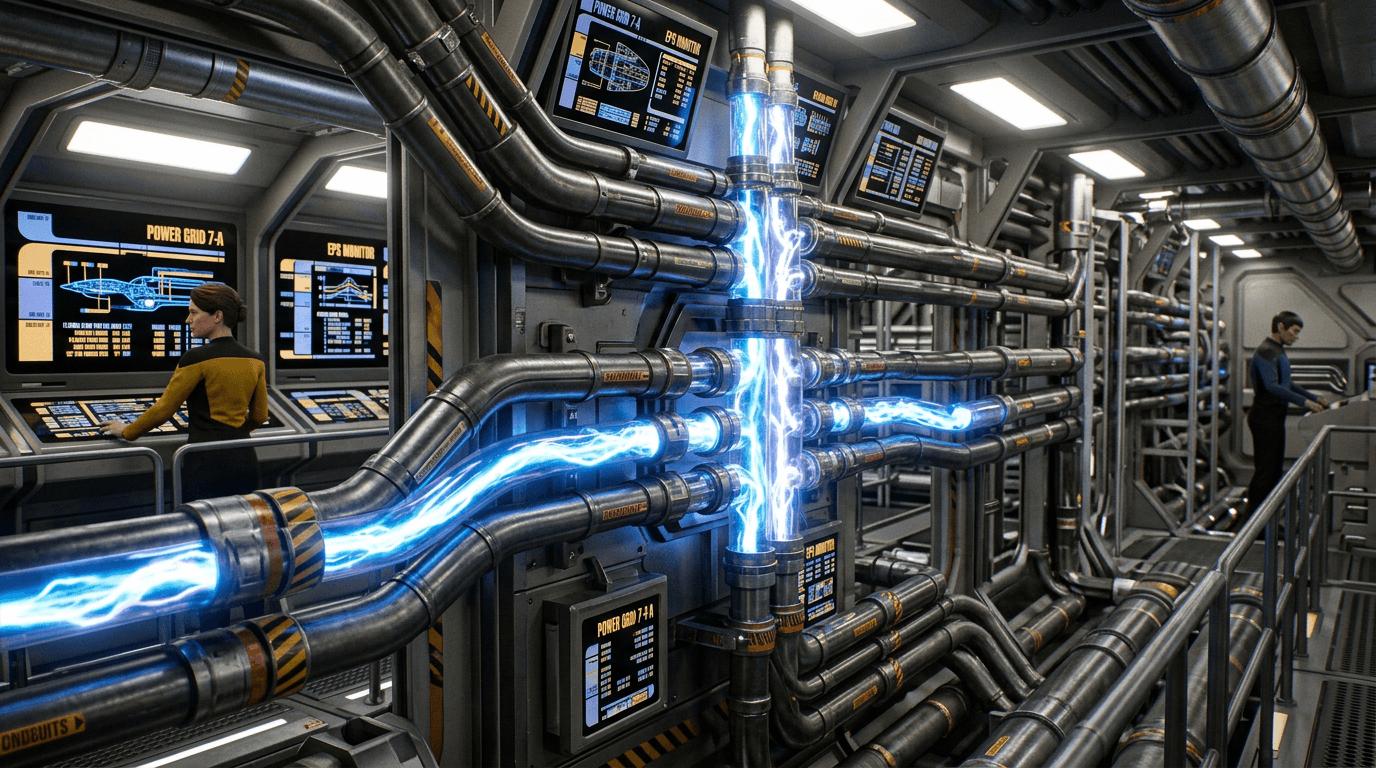
EPS Conduits
The Electro-Plasma System represents a speculative approach to power distribution in large-scale spacecraft, imagined primarily within science fiction narratives as a solution to the enormous energy requirements of faster-than-light propulsion and shipboard systems. In this conceptual framework, matter-antimatter reactions or advanced fusion processes generate superheated plasma that serves as both an energy carrier and a direct power source. This plasma—theorized to exist at temperatures exceeding several million degrees and under extreme pressure—flows through a network of reinforced conduits constructed from materials with properties far beyond current metallurgical capabilities. The system architecture assumes the existence of magnetic containment fields or exotic materials capable of preventing direct contact between the plasma and conduit walls, a requirement that remains firmly in the realm of speculation given that no known substance can withstand such conditions through physical contact alone. The EPS concept also incorporates intelligent routing systems that dynamically adjust power distribution based on operational demands, redirecting energy to weapons, shields, propulsion, or life support as tactical situations evolve.
Within narrative contexts, EPS conduits serve as both a technological backbone and a dramatic device, providing opportunities for tension through system failures, sabotage scenarios, and emergency repairs under crisis conditions. The vulnerability of these conduits to battle damage or overload creates stakes in conflict situations, while their maintenance requirements justify the presence of engineering personnel and technical problem-solving within storytelling frameworks. From a strategic analysis perspective, the EPS concept reflects broader questions about energy density, transmission efficiency, and failure mode management in future large-scale systems. Real-world research into plasma confinement for fusion reactors, high-temperature superconductors, and advanced power management systems explores adjacent problem spaces, though at vastly different scales and energy levels. The notion of using plasma as a direct power transmission medium does find limited parallel in experimental plasma window technology and certain industrial plasma applications, yet these operate at orders of magnitude lower energy densities than fictional depictions suggest.
The fundamental challenge separating EPS conduits from plausible near-term technology lies in materials science and containment physics. Current fusion research struggles to maintain plasma stability for seconds under controlled laboratory conditions; the concept of routing such plasma throughout a structure spanning hundreds of meters requires breakthroughs not yet visible on scientific horizons. Magnetic confinement systems powerful enough to contain the described plasma would themselves require enormous energy inputs, potentially negating efficiency gains. The safety systems mentioned—including automated isolation protocols and cascade failure prevention—would need to operate at response times measured in microseconds to prevent catastrophic hull breaches, demanding computational and mechanical capabilities beyond present engineering. While the EPS concept remains firmly speculative, it does highlight genuine questions about how future high-energy systems might manage power distribution, thermal loads, and failure containment. Any movement toward plausibility would require revolutionary advances in plasma physics, materials capable of functioning in extreme radiation and thermal environments, and fundamentally new approaches to energy transmission that currently exist only in theoretical discussions.
Research this in Signals
Signals turns a topic into a sourced research record you can inspect and rerun. Your first scan is free, and this one starts with EPS Conduits already loaded, so edit it or scan as is.