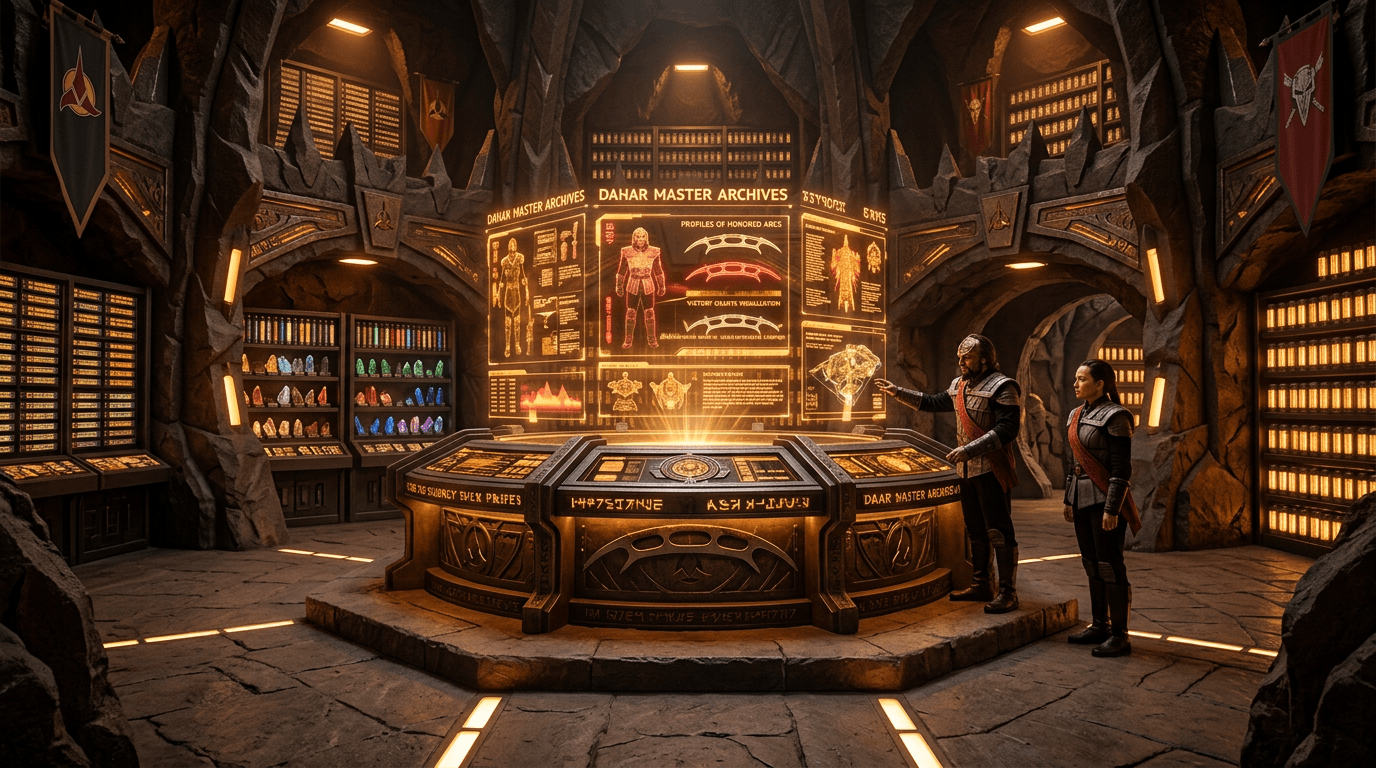
Dahar Master Archives
The Dahar Master Archives represent a conceptual fusion of cultural memory preservation and advanced data storage, imagined as repositories that chronicle the achievements of legendary warriors within Klingon society. In speculative narratives, these archives function as more than mere databases—they serve as living monuments to martial excellence, encoding biographical data, tactical innovations, and combat achievements in formats that blend traditional cultural symbolism with sophisticated information architecture. The archives are envisioned to employ layered authentication protocols rooted in ritual practice, where access requires not just technical credentials but cultural knowledge and ceremonial authorization. This design philosophy reflects broader questions in information science about how societies might preserve culturally significant knowledge while maintaining both accessibility for authorized users and protection against unauthorized access or degradation over time.
Within narrative frameworks, the Dahar Master Archives fulfill a crucial role in maintaining cultural continuity and legitimizing martial authority. They serve as reference systems for evaluating contemporary warriors against historical standards, providing precedents for tactical decisions, and preserving strategic knowledge across generations. This concept resonates with real-world discussions about digital heritage preservation, particularly how military organizations and cultural institutions balance the need to maintain historical records with evolving storage technologies and access paradigms. The archives also raise questions about data sovereignty and cultural ownership—who controls access to culturally significant information, how is authenticity verified across technological transitions, and what mechanisms prevent historical revisionism or unauthorized alterations. These concerns parallel contemporary debates about blockchain-based authentication systems, distributed ledger technologies for historical records, and the challenges of maintaining data integrity across centuries-spanning timescales.
From a plausibility perspective, the core challenge lies in creating storage systems that remain accessible and authentic across generational timescales while incorporating cultural authentication mechanisms. Current research in archival science explores quantum-resistant encryption, DNA-based data storage for extreme longevity, and multi-modal authentication systems that could theoretically incorporate cultural knowledge as access credentials. However, the concept of ritual passwords as security mechanisms faces practical constraints—cultural knowledge evolves, transmission can be disrupted, and purely ceremonial access controls may prove vulnerable to social engineering or cultural discontinuity. The archives' viability would depend on developing hybrid systems that combine robust technical security with cultural authentication layers, perhaps through biometric systems linked to genealogical databases or AI systems trained to verify cultural competency. As discussions around digital sovereignty and indigenous data governance intensify, the underlying questions about culturally-embedded information systems become increasingly relevant to real-world heritage preservation challenges.
Research this in Signals
Signals turns a topic into a sourced research record you can inspect and rerun. Your first scan is free, and this one starts with Dahar Master Archives already loaded, so edit it or scan as is.