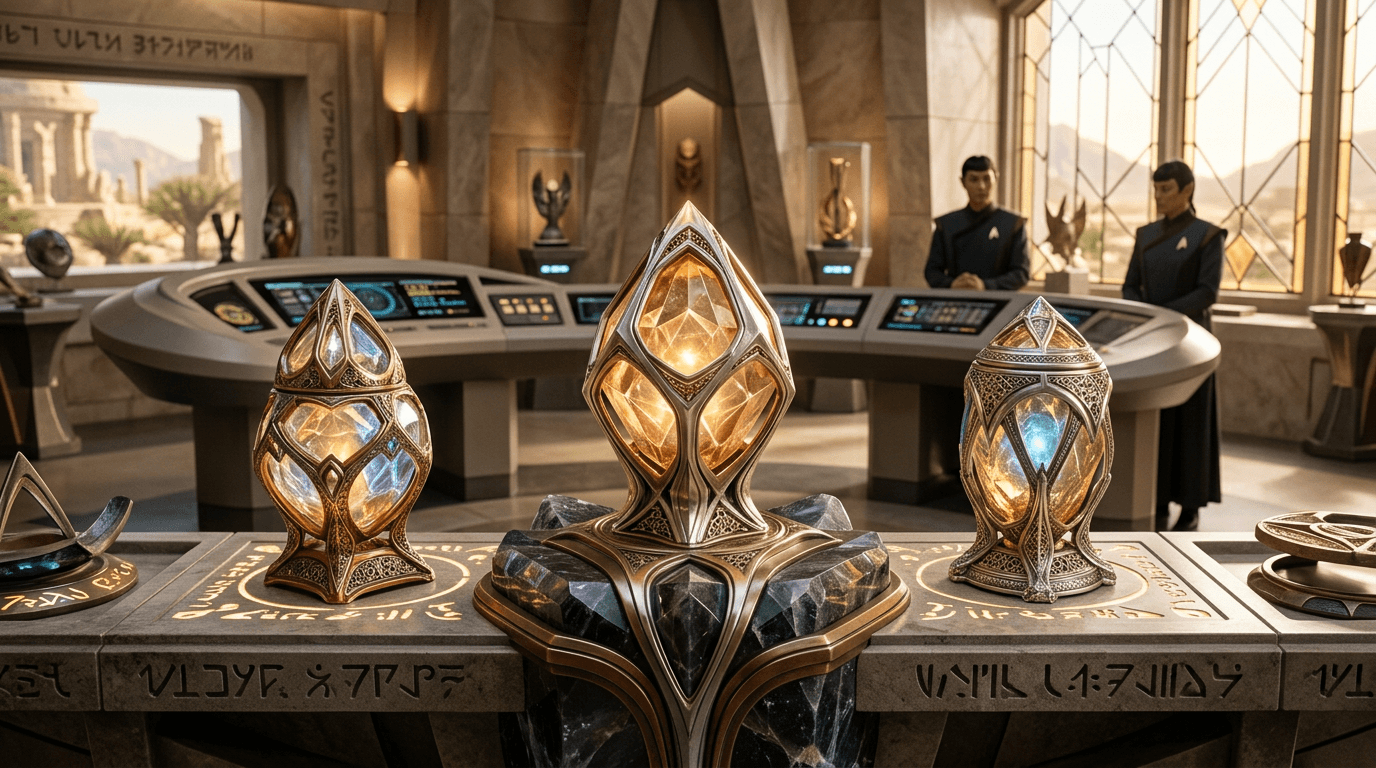
Katric Arks (Katra Containers)
Katric Arks represent a speculative technology rooted in Vulcan philosophy from the Star Trek universe, designed to preserve an individual's katra—the living essence encompassing consciousness, memory, and identity—when biological death is imminent or the body becomes uninhabitable. The concept imagines consciousness as a transferable phenomenon, distinct from neural activity yet intimately connected to it, capable of existing temporarily outside biological substrate. In the fictional framework, this transfer occurs through a ritualized mind-meld, where a dying individual's mental patterns are extracted and stored within crystalline or metallic matrices specifically engineered to maintain coherent thought-structures. The vessels themselves are portrayed as precision-crafted artifacts, their internal lattices designed to preserve the delicate quantum or electromagnetic signatures theorized to encode subjective experience. This technology assumes consciousness operates on principles beyond current neuroscience, requiring exotic materials or field geometries to maintain stability outside living neural tissue.
Within speculative fiction and philosophical discourse, Katric Arks serve as narrative vehicles for exploring questions of identity persistence, the nature of consciousness, and what constitutes continuity of self. The concept appears in discussions of mind uploading, consciousness transfer, and digital immortality—areas where real neuroscience intersects with transhumanist speculation. While no scientific evidence supports consciousness existing independently of biological processes, research in connectomics, neural mapping, and brain-computer interfaces explores related questions about information patterns that define individual identity. The fictional technology also reflects cultural anxieties about death, preservation of legacy, and whether subjective experience can be reduced to transferable data. In strategic foresight contexts, similar concepts appear when examining long-duration space travel, where crew consciousness might theoretically be preserved during suspended animation failures, or in military applications exploring backup systems for critical personnel knowledge.
The fundamental constraint facing any real-world analog is the hard problem of consciousness—the unbridged gap between objective brain states and subjective experience. Current neuroscience can map neural correlates of consciousness and increasingly detailed connectomes, but cannot demonstrate that copying these patterns would preserve phenomenal experience rather than creating a functionally identical but experientially distinct copy. Quantum theories of consciousness remain highly speculative and lack experimental validation. For Katric Ark-like technology to become plausible, breakthroughs would require demonstrating consciousness as substrate-independent information, developing materials capable of maintaining coherent quantum states at biological temperatures, and solving the philosophical puzzle of whether transferred patterns constitute the same individual or a replica. Until such developments emerge, the concept remains valuable primarily as a thought experiment highlighting the profound mysteries still surrounding consciousness, identity, and the possibility of existence beyond biological embodiment.
Research this in Signals
Signals turns a topic into a sourced research record you can inspect and rerun. Your first scan is free, and this one starts with Katric Arks (Katra Containers) already loaded, so edit it or scan as is.