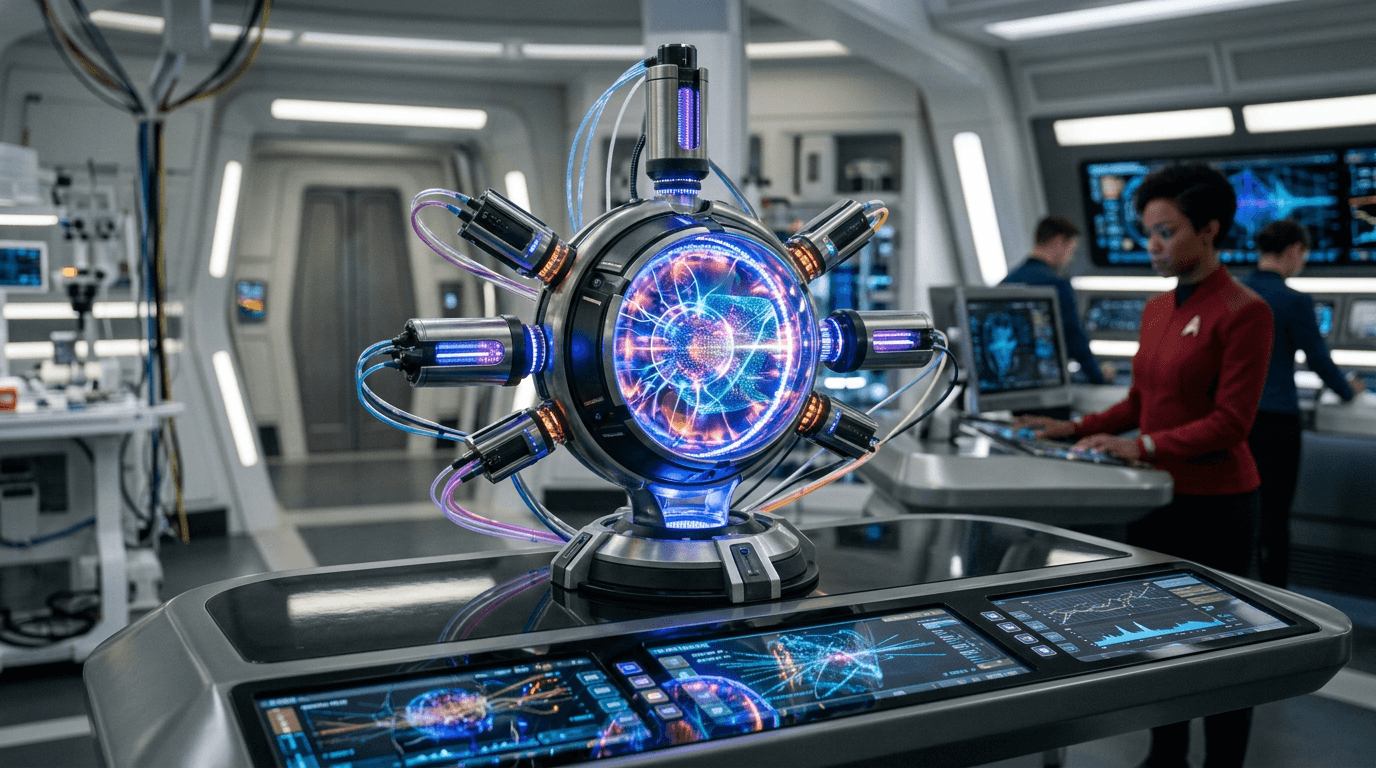
Chroniton Detector
Chroniton detectors represent a speculative class of instrumentation designed to identify and measure hypothetical particles associated with temporal disturbances. In science fiction narratives, particularly within Star Trek and similar franchises, chronitons are conceived as quantum particles that either enable or result from disruptions in the normal flow of time. The detector itself is imagined as a sophisticated sensor array capable of registering the unique energy signatures these particles emit when temporal boundaries are crossed or manipulated. The underlying premise assumes that time travel or temporal anomalies would leave measurable traces in spacetime—analogous to how particle detectors in real physics identify subatomic particles through their decay products or interaction signatures. This fictional technology typically incorporates elements borrowed from real quantum physics terminology while extrapolating far beyond current scientific understanding of temporal mechanics.
Within speculative scenarios and narrative frameworks, chroniton detectors serve multiple strategic functions that reflect broader concerns about causality, historical integrity, and the potential consequences of temporal interference. In fictional universes where time travel is possible, such sensors become essential tools for temporal law enforcement agencies tasked with preventing paradoxes or unauthorized alterations to historical events. The technology appears in stories as both a defensive measure—alerting authorities to temporal incursions—and an investigative instrument that can analyze the characteristics of time distortions, potentially revealing when and where temporal manipulation occurred. This narrative role mirrors real-world concerns in fields like cybersecurity and nuclear nonproliferation, where detection systems attempt to identify unauthorized activities that could have catastrophic consequences. The concept also connects tangentially to legitimate physics research into time symmetry, closed timelike curves, and quantum entanglement, though these areas remain firmly in the realm of theoretical exploration rather than practical application.
From a scientific plausibility standpoint, chroniton detectors face fundamental obstacles rooted in our current understanding of physics. General relativity permits certain theoretical solutions involving closed timelike curves, but these require exotic matter with negative energy density—something never observed and possibly prohibited by quantum field theory. No experimental evidence supports the existence of chroniton particles, and the Standard Model of particle physics includes no mechanism for their production or detection. For such technology to become remotely feasible, physics would require revolutionary breakthroughs: confirmation that macroscopic time travel is possible, identification of particles specifically associated with temporal processes, and development of sensors capable of distinguishing temporal signatures from conventional quantum phenomena. The concept remains valuable primarily as a narrative device for exploring causality questions and as a thought experiment for considering how civilizations might regulate technologies with reality-altering potential, should such capabilities ever emerge from currently unknown physics.
Research this in Signals
Signals turns a topic into a sourced research record you can inspect and rerun. Your first scan is free, and this one starts with Chroniton Detector already loaded, so edit it or scan as is.