Bussard Ramscoop Collectors
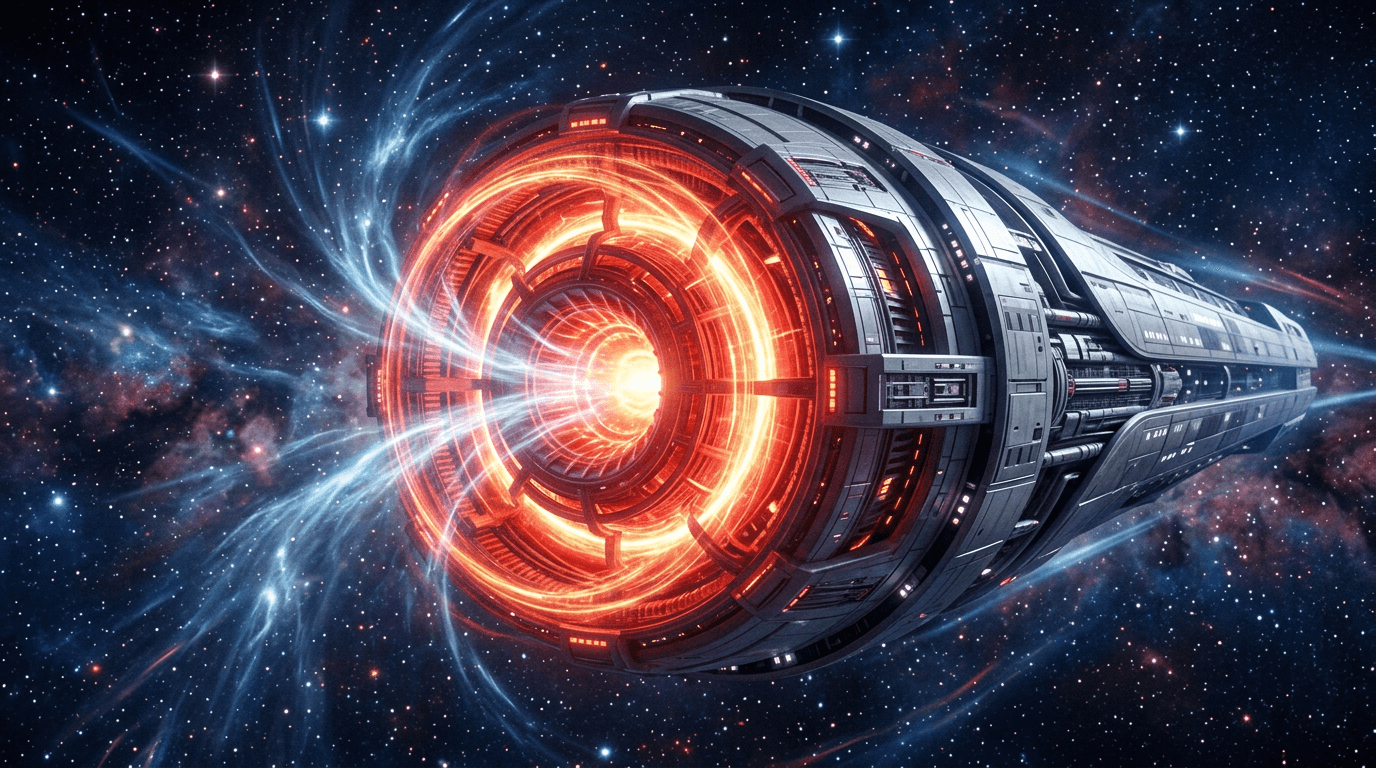
The Bussard ramscoop represents one of the most enduring concepts in speculative propulsion engineering—a forward-mounted electromagnetic funnel designed to collect interstellar hydrogen during high-velocity flight. First proposed by physicist Robert Bussard in 1960, the concept envisions enormous magnetic fields extending thousands of kilometers ahead of a spacecraft, gathering the sparse hydrogen atoms that drift through interstellar space. These particles would theoretically be compressed, ionized, and either fused for energy or processed into fuel reserves, creating a self-sustaining propulsion system that eliminates the tyranny of carrying all fuel onboard. In science fiction narratives, particularly within the Star Trek universe, these collectors appear as the distinctive glowing caps on warp nacelles, continuously harvesting hydrogen to replenish deuterium stocks during extended voyages. The elegance of the concept lies in its promise: a starship that feeds on the very medium through which it travels, transforming the interstellar void from obstacle into resource.
The strategic appeal of ramscoop technology in speculative scenarios centers on solving the fundamental constraint of interstellar travel—the mass fraction problem. Conventional rockets must carry all their propellant, meaning that longer journeys require exponentially more fuel, which in turn requires more fuel to accelerate that fuel, creating a vicious cycle that makes interstellar missions prohibitively expensive. Ramscoop collectors appear in future-oriented thinking as a potential solution to this barrier, enabling vessels to extend their operational range indefinitely by harvesting fuel en route. In fictional contexts, this technology supports narrative requirements for long-duration exploration missions without constant returns to starbases. Real-world research into magnetic confinement fusion and plasma physics explores adjacent concepts, though primarily for terrestrial energy generation rather than propulsion applications. The ramscoop concept also appears in discussions of generation ships and interstellar probe designs, where even modest fuel supplementation could dramatically alter mission profiles.
The fundamental challenge confronting ramscoop feasibility lies in the extreme sparseness of interstellar hydrogen—roughly one atom per cubic centimeter in typical regions—and the enormous energy required to generate and maintain collection fields of sufficient size. Early analyses suggested that the drag created by the magnetic field interacting with the interstellar medium might exceed the thrust gained from collected fuel, particularly at sub-relativistic speeds. Additionally, the fusion of collected hydrogen presents formidable technical hurdles, as most proposed fusion systems require specific isotopes like deuterium rather than common hydrogen-1. For the concept to approach plausibility, breakthroughs would be needed in superconducting magnet technology capable of generating fields across thousands of kilometers, efficient fusion systems that can operate on unprocessed interstellar material, and perhaps most critically, propulsion systems that already achieve significant fractions of light speed through other means. While ramscoop collectors remain firmly in the speculative realm, they continue to inspire research into magnetic field manipulation, fusion propulsion, and the physics of high-velocity flight through interstellar media—domains where incremental progress may eventually illuminate whether this elegant concept could ever transition from fiction to engineering reality.
Research this in Signals
Signals turns a topic into a sourced research record you can inspect and rerun. Your first scan is free, and this one starts with Bussard Ramscoop Collectors already loaded, so edit it or scan as is.