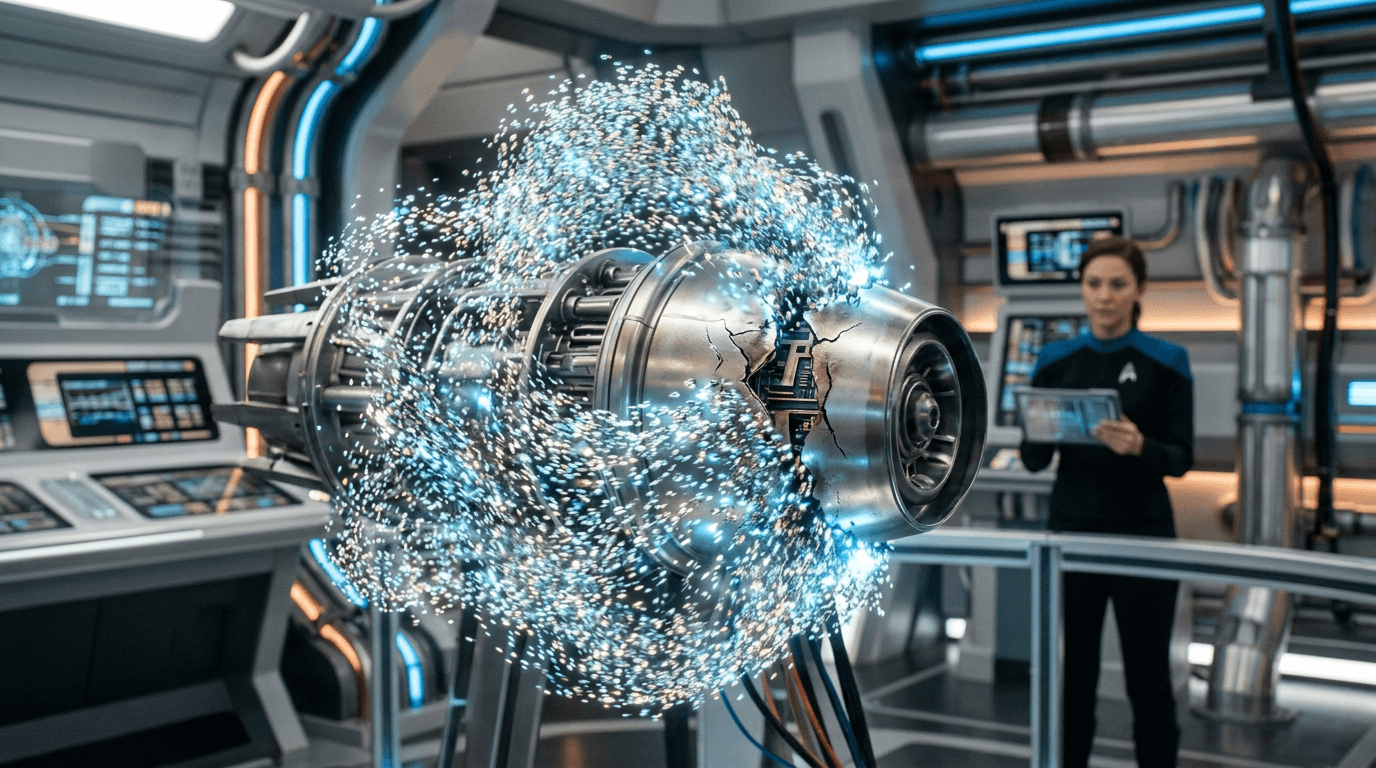
Nanite Swarm
Nanite swarms represent one of science fiction's most compelling explorations of molecular nanotechnology—the concept of programmable machines operating at scales measured in billionths of a meter. The theoretical foundation draws from real nanotechnology research, particularly molecular assembly and microelectromechanical systems (MEMS), but extends these concepts into speculative territory by imagining machines capable of self-replication, collective coordination, and autonomous decision-making. In fictional narratives, nanites function through distributed intelligence protocols, where individual units communicate and coordinate to form emergent behaviors far more sophisticated than any single machine could achieve. This swarm intelligence allows them to adapt to complex environments, repair damage at molecular scales, and even reconfigure themselves for different tasks. The self-replication mechanism typically involves nanites harvesting raw materials from their environment and assembling copies of themselves, a concept inspired by theoretical work on von Neumann probes and molecular manufacturing, though the practical implementation remains firmly in the realm of speculation.
Within science fiction and strategic foresight scenarios, nanite swarms serve as powerful narrative devices for exploring both utopian and catastrophic futures. They appear frequently in discussions about advanced manufacturing, medical intervention at cellular levels, environmental remediation, and space exploration, where self-replicating machines could theoretically construct infrastructure from local materials. The "grey goo" scenario—where unconstrained self-replication leads to nanites consuming all available matter—has become a cultural touchstone for examining existential risks from emerging technologies. This narrative function extends beyond entertainment into serious futures research, where nanite-like systems help explore questions about technological control, autonomous systems governance, and the boundaries between tools and independent agents. Defense and space agencies occasionally reference similar concepts when discussing future capabilities, though always carefully distinguishing between current nanoscale research and speculative swarm systems.
Current nanotechnology has achieved remarkable precision in drug delivery, materials science, and molecular sensing, but remains separated from fictional nanites by several fundamental barriers. Real-world nanodevices lack autonomous mobility, self-replication capabilities, and the energy systems required for independent operation. The physics of molecular-scale machines presents challenges that fiction typically glosses over: Brownian motion dominates at nanoscales, making controlled movement difficult; power sources capable of sustaining autonomous operation don't exist at these dimensions; and the information processing required for swarm coordination would demand computational capabilities far beyond current technology. Self-replication introduces additional complexity around error correction, resource management, and preventing runaway scenarios. For nanite swarms to transition from speculation to plausibility would require breakthroughs in molecular manufacturing, quantum computing for coordination, novel energy harvesting at nanoscales, and robust containment protocols. The concept remains valuable as a thought experiment for exploring the implications of distributed autonomous systems, even as the timeline for practical implementation—if ever achievable—extends well beyond current technological horizons.
Research this in Signals
Signals turns a topic into a sourced research record you can inspect and rerun. Your first scan is free, and this one starts with Nanite Swarm already loaded, so edit it or scan as is.