Space Resource Utilization (ISRU)
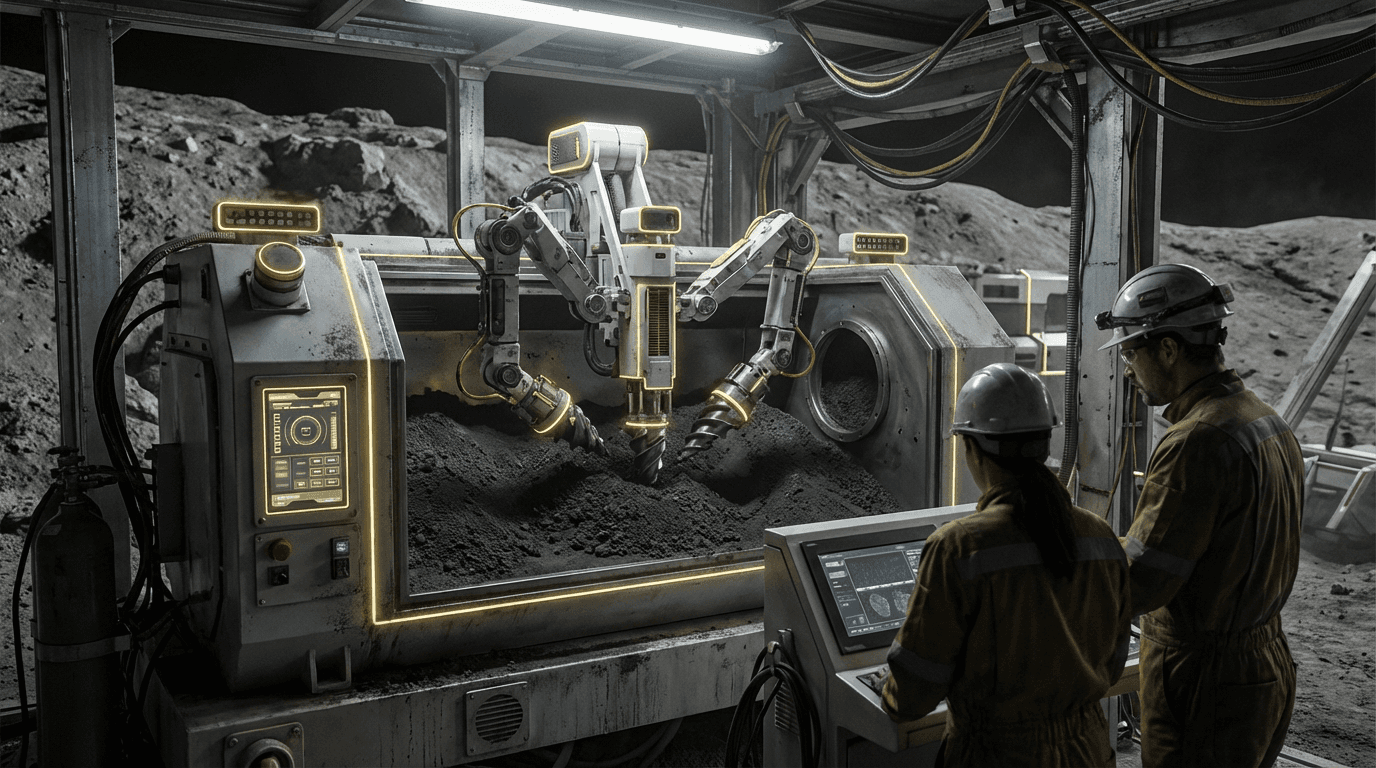
In-Situ Resource Utilization (ISRU) represents a fundamental shift in space exploration strategy, moving away from Earth-dependent supply chains toward self-sustaining operations that extract and process materials directly from celestial bodies. The technology encompasses a range of extraction, processing, and manufacturing techniques adapted to the extreme conditions of space environments. Key processes include thermal extraction of water from permanently shadowed lunar craters, where temperatures can reach -230°C, and regolith processing to separate oxygen from metal oxides that comprise up to 45% of lunar soil by mass. These systems typically employ techniques such as hydrogen reduction, molten regolith electrolysis, or carbothermal reduction, each requiring specialized equipment capable of operating in vacuum conditions with minimal maintenance. The technical challenge lies not only in the extraction itself but in developing autonomous systems that can function reliably in environments where repair and resupply from Earth would be prohibitively expensive or time-delayed by millions of kilometers.
The economic imperative driving ISRU development stems from the astronomical cost of launching materials from Earth's gravity well, currently ranging from $2,000 to $10,000 per kilogram to low Earth orbit and significantly more for deep space destinations. This cost structure makes even basic consumables like water extraordinarily expensive when sourced from Earth, creating a compelling business case for local resource extraction. Water extracted from lunar ice deposits can be electrolyzed into hydrogen and oxygen, providing both life support and rocket propellant that could reduce mission costs by orders of magnitude. Beyond water, the extraction of metals from asteroid bodies addresses the scarcity of platinum group metals on Earth while potentially enabling the construction of large-scale structures in orbit without the need to overcome Earth's gravity. This capability could revolutionize satellite manufacturing, space station construction, and deep space exploration by establishing fuel depots and manufacturing facilities at strategic locations throughout the solar system, fundamentally altering the economics of space operations.
Several space agencies and private companies have begun testing ISRU technologies, with NASA's Artemis program planning to demonstrate water extraction at the lunar south pole within this decade, while experimental payloads have already tested regolith processing techniques in Earth orbit. Early commercial ventures are exploring business models around propellant production and orbital manufacturing, though full-scale operations remain years away. The technology connects to broader trends in space industrialization, including the development of orbital manufacturing facilities, space-based solar power, and permanent lunar bases. As launch costs continue to decline and space activity intensifies, ISRU transitions from a theoretical concept to a practical necessity for sustainable space exploration. The successful implementation of these technologies could catalyze a new era of space development, where the resources of the solar system become accessible for both scientific exploration and economic exploitation, potentially establishing the foundation for humanity's expansion beyond Earth.
Related Organizations

A startup actively launching missions (Brokkr-1, Brokkr-2) to prospect and refine platinum-group metals from asteroids.

Hosts the Center for Space Resources, a leading academic hub for ISRU research and education.

Innovation center focused exclusively on space resources utilization, supported by ESA and Luxembourg.

Honeybee Robotics
United States · Company
Develops advanced robotic systems for planetary exploration, specifically drilling and sampling tools essential for extracting subsurface ice and regolith.

Private lunar exploration company focusing on transportation and resource exploration to establish a lunar economy.
Develops autonomous lunar rovers designed for resource prospecting and environmental monitoring.

National space agency of Luxembourg, specifically focused on the commercial exploration and utilization of space resources.

Developing a swarm of AI-powered industrial robots for mining on Earth, with the explicit goal of expanding to the Moon and Mars.

Construction technology company using 3D printing robotics, software, and advanced materials.

Provides in-space 3D printing and bioprinting capabilities, having acquired Made In Space and Techshot.
Supporting Evidence
Research this in Signals
Signals turns a topic into a sourced research record you can inspect and rerun. Your first scan is free, and this one starts with Space Resource Utilization (ISRU) already loaded, so edit it or scan as is.