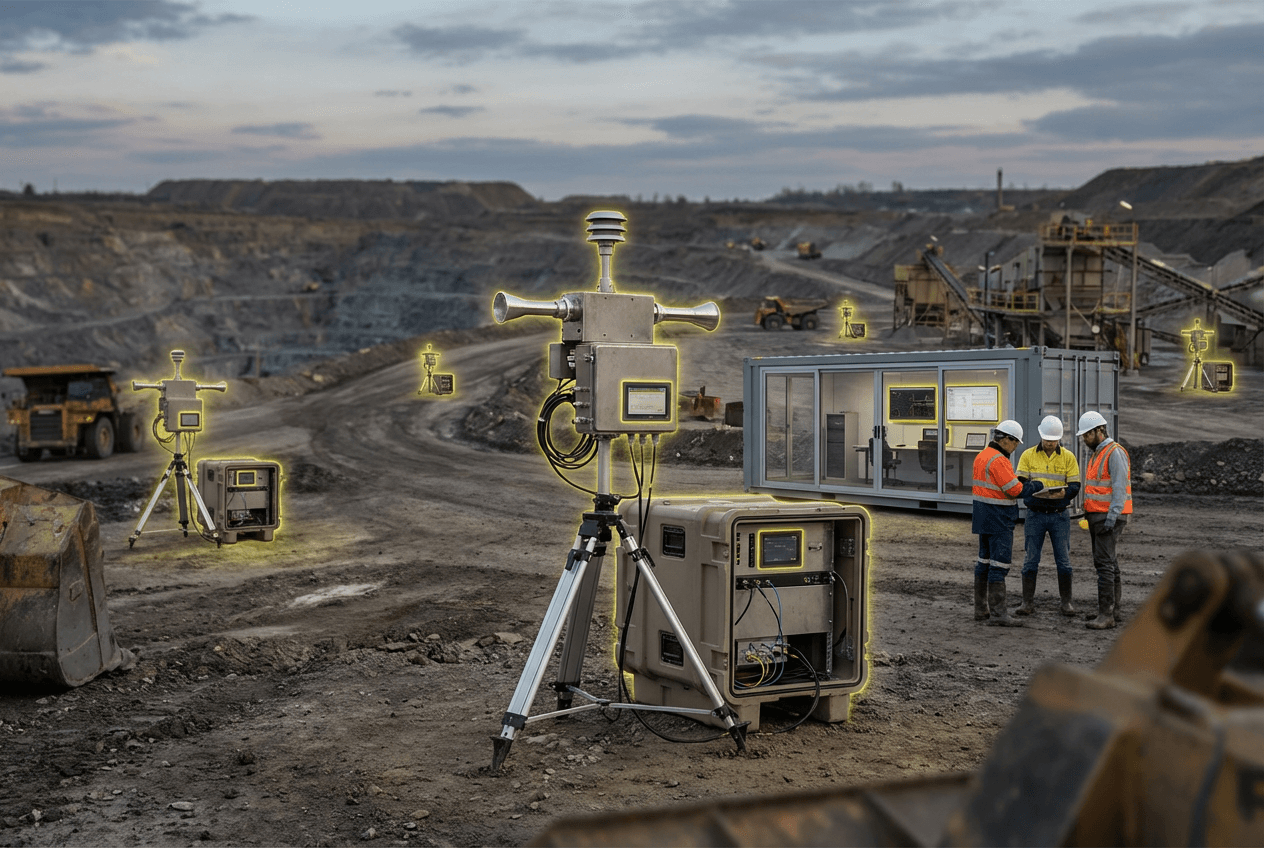
Air Quality Monitoring Networks
Air quality monitoring networks represent a critical evolution in environmental oversight for heavy industry, deploying distributed arrays of sensors to continuously track airborne pollutants around extraction and processing facilities. These systems typically combine multiple sensor types—including particulate matter detectors for PM2.5 and PM10, electrochemical sensors for nitrogen oxides (NOx) and sulfur oxides (SOx), and sometimes additional instruments for volatile organic compounds and heavy metals. The sensors are strategically positioned in fenceline configurations that create a perimeter around industrial sites, with placement informed by prevailing wind patterns, topography, and proximity to residential areas. Modern networks leverage wireless connectivity and edge computing to transmit measurements at intervals ranging from minutes to hours, creating granular temporal and spatial datasets that reveal pollution patterns invisible to traditional periodic sampling methods. The shift toward lower-cost sensor technologies has dramatically reduced deployment barriers, enabling networks with dozens or even hundreds of monitoring points where previously only a handful of expensive reference-grade stations might have been feasible.
The fundamental challenge these networks address is the historical opacity of industrial emissions and their immediate environmental impact on surrounding communities. Traditional regulatory monitoring often relied on infrequent manual sampling or a small number of fixed stations that could miss localized pollution events or fail to capture the full spatial distribution of emissions. This created information asymmetries where operators possessed internal monitoring data while nearby residents had limited visibility into air quality conditions affecting their health. Fugitive emissions from material handling, unexpected releases during process upsets, and cumulative impacts from multiple sources within industrial complexes frequently went undetected or undocumented. Air quality monitoring networks fundamentally alter this dynamic by providing continuous, spatially resolved data that can identify specific emission sources, verify the effectiveness of control technologies like scrubbers and baghouses, and create an evidence base for both compliance verification and community health studies. The transparency enabled by these systems also shifts corporate incentives, as operators face reputational and regulatory consequences when elevated readings become immediately visible to stakeholders.
Current deployments span mining operations in Australia and Chile, petrochemical complexes along the U.S. Gulf Coast, and smelting facilities across multiple continents, with regulatory frameworks in jurisdictions like California and the European Union increasingly mandating fenceline monitoring for certain facility types. The data streams feed into multiple applications: automated alert systems notify operators and regulators when thresholds are exceeded, enabling rapid investigation and corrective action; community portals provide public access to near-real-time air quality information, often visualized through color-coded maps; and longitudinal datasets support epidemiological research linking exposure patterns to health outcomes. Looking forward, these networks are becoming integral components of broader industrial digitalization strategies, with machine learning algorithms identifying emission signatures associated with specific process conditions and predictive models forecasting pollution episodes based on operational schedules and meteorological forecasts. As environmental justice concerns intensify and communities demand greater accountability from neighboring industries, air quality monitoring networks are evolving from optional corporate responsibility initiatives into essential infrastructure for maintaining social license to operate in the extractive and heavy industrial sectors.
Related Organizations

Manufacturer of portable and fixed air quality monitoring systems for industrial and environmental applications.

Provides environmental intelligence software combined with sensor networks to manage noise, vibration, and air quality for mines and industry.

Deploys continuous monitoring units (Canary S) at oil and gas sites to certify responsibly sourced gas.

Manufactures high-precision gas analyzers and systems for measuring greenhouse gases and trace impurities.

Offers a range of environmental monitoring solutions including gas and dust sensors for industrial compliance.

Provides air quality monitoring solutions to cities and businesses.

Specializes in odor monitoring and air quality sensing technology for wastewater, landfill, and petrochemical sites.

A global leader in weather, environmental, and industrial measurements.

German startup providing AI-enabled air quality sensors and cloud platforms for smart buildings and industry.

Manufactures precision air quality monitoring instrumentation used in regulatory networks.
Supporting Evidence
Research this in Signals
Signals turns a topic into a sourced research record you can inspect and rerun. Your first scan is free, and this one starts with Air Quality Monitoring Networks already loaded, so edit it or scan as is.