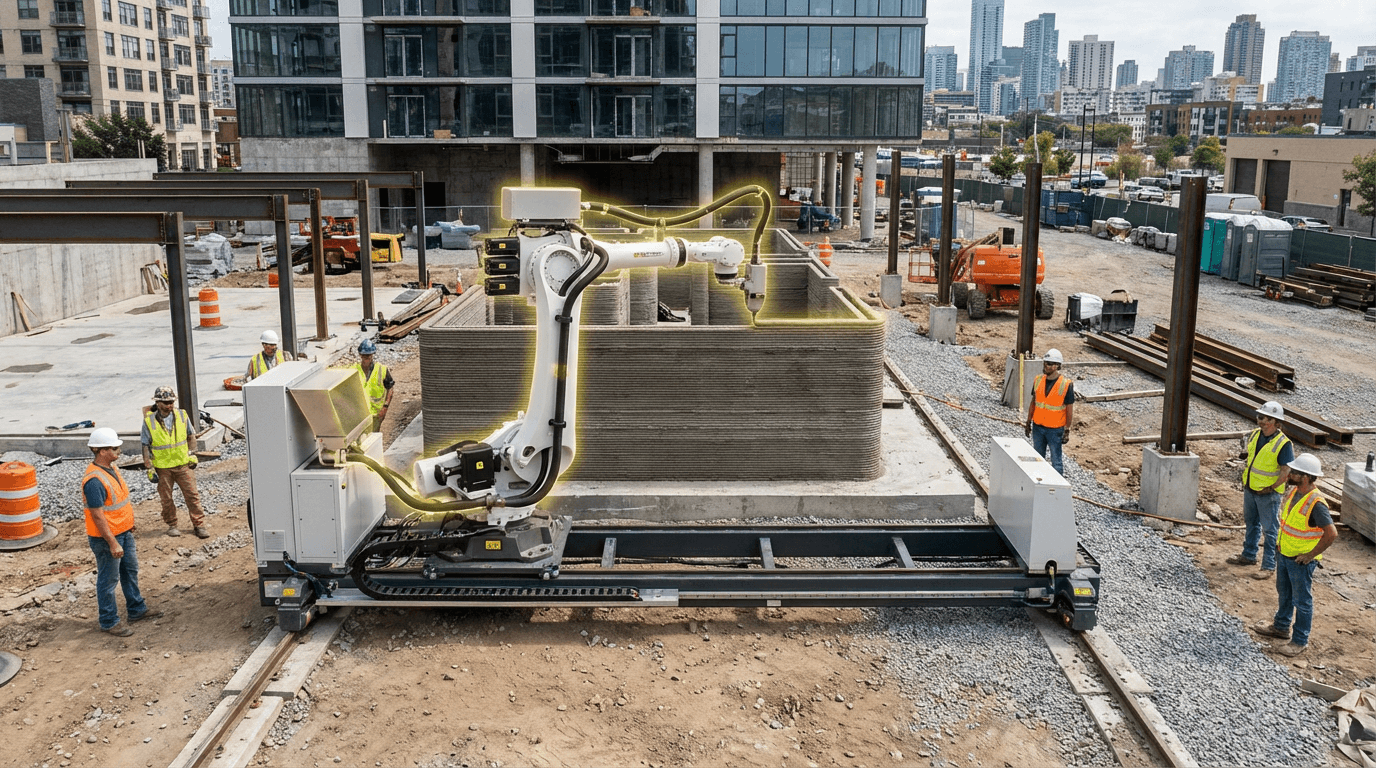
Construction Automation
The construction industry has long grappled with challenges that include labor shortages, safety hazards, inconsistent quality, and extended project timelines. Traditional building methods are labor-intensive, often requiring workers to perform repetitive, physically demanding, and sometimes dangerous tasks in unpredictable environments. Construction automation addresses these fundamental issues by deploying robotic systems and autonomous machinery capable of executing precise building tasks with minimal human intervention. These systems encompass a range of technologies, from robotic arms that lay bricks with millimeter-level accuracy to mobile platforms that perform welding and material handling, as well as large-scale 3D printing systems that can extrude concrete or composite materials to create entire structural components. The underlying mechanisms typically involve computer vision for environmental mapping, advanced sensors for real-time positioning, and sophisticated control algorithms that enable these machines to adapt to varying site conditions while maintaining consistent output quality.
By automating repetitive and hazardous construction tasks, these robotic systems fundamentally transform how buildings and infrastructure are erected. Research suggests that automated construction can significantly reduce project timelines while improving worker safety by removing human operators from high-risk activities such as working at heights or handling heavy materials. The technology enables a shift toward modular construction approaches, where building components are fabricated with precision in controlled environments and then assembled on-site by robotic systems, minimizing weather-related delays and material waste. This precision manufacturing approach also addresses the skilled labor shortage facing many developed economies, as automated systems can maintain productivity levels independent of workforce availability. Furthermore, construction automation facilitates new architectural possibilities, as robotic fabrication can execute complex geometries and customized designs that would be prohibitively expensive or technically challenging using conventional methods.
Early deployments of construction automation have appeared in both controlled factory settings for prefabricated components and on active construction sites for specific tasks. Robotic bricklaying systems have been tested on residential and commercial projects, demonstrating the ability to work continuously with consistent quality. Large-scale 3D printing has been employed to create affordable housing prototypes and emergency shelters, showcasing the technology's potential for rapid deployment in disaster relief scenarios or addressing housing shortages. As the construction industry faces mounting pressure to reduce carbon emissions and improve sustainability, automated systems offer the promise of optimized material usage and reduced waste through precise fabrication techniques. The trajectory of this technology points toward increasingly integrated construction ecosystems where autonomous machines, digital design tools, and project management systems work in concert to deliver buildings faster, safer, and with greater resource efficiency, fundamentally reshaping an industry that has remained largely unchanged for decades.
Related Organizations

Robotics company creating machines that automate drywall finishing.

World leader in 3D construction printing solutions, manufacturing gantry-based printers.

Developer of the Hadrian X, a truck-mounted robot capable of laying bricks autonomously.

Construction technology company using 3D printing robotics, software, and advanced materials.

Develops TyBOT and IronBOT, autonomous robots for rebar tying and placement in bridge construction and maintenance.

Built Robotics
United States · Startup
Creates the Exosystem, an aftermarket kit that transforms heavy construction equipment like excavators into autonomous robots.

Developer of the FieldPrinter, a robot that autonomously prints floor plans and layout lines directly onto concrete slabs.

Conducts advanced research in bioelectronics and the interface between biological systems and electronic circuits.

Dutch startup developing small, electric, autonomous bricklaying robots that work in swarms.

Robotics and automation for rebar fabrication and assembly in pre-cast environments.

Construction giant that acquired 'Concrete Sensors' to integrate IoT structural monitoring into their portfolio.

Provides autonomous vehicle software for mining and construction equipment.
Supporting Evidence
Research this in Signals
Signals turns a topic into a sourced research record you can inspect and rerun. Your first scan is free, and this one starts with Construction Automation already loaded, so edit it or scan as is.