Industrial IoT Middleware
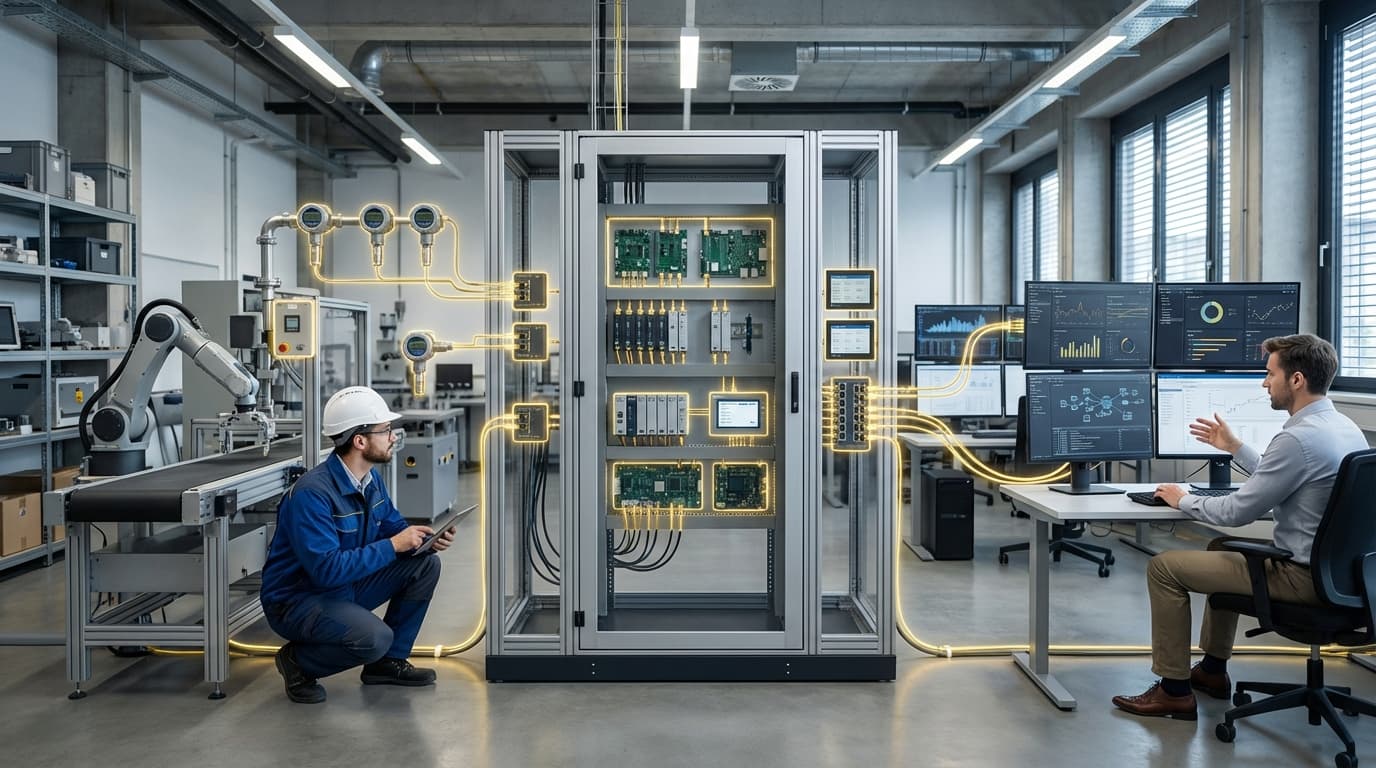
Industrial IoT Middleware represents a critical integration layer that addresses one of the most persistent challenges in modern manufacturing: the disconnect between operational technology (OT) systems on the factory floor and enterprise information technology (IT) infrastructure. At its technical core, this middleware functions as a sophisticated translation and routing system that bridges fundamentally different communication protocols, data formats, and security models. Legacy industrial equipment—programmable logic controllers (PLCs), supervisory control and data acquisition (SCADA) systems, and distributed control systems—typically operate using proprietary protocols like Modbus, OPC, or PROFINET, designed decades ago for isolated, deterministic environments. Industrial IoT middleware employs protocol translators to convert these signals into modern formats compatible with cloud platforms, enterprise resource planning systems, and analytics engines. Message brokers within the middleware handle asynchronous communication, buffering data streams and ensuring reliable delivery even when network conditions fluctuate. Data historians provide time-series storage optimised for industrial telemetry, capturing high-frequency sensor readings while maintaining the contextual metadata necessary for meaningful analysis.
The fundamental problem this technology solves is the operational siloing that has long plagued manufacturing environments. Without effective middleware, production data remains trapped in isolated systems, preventing manufacturers from achieving the visibility and agility demanded by contemporary competitive pressures. Quality issues may go undetected until products reach customers, maintenance occurs on fixed schedules rather than actual equipment condition, and production planning relies on outdated information rather than real-time capacity data. Industrial IoT middleware enables manufacturers to break down these barriers, creating unified data pipelines that feed advanced analytics, machine learning models, and enterprise dashboards. This integration unlocks new operational models such as predictive maintenance, where equipment health data flows seamlessly from sensors through middleware to cloud-based analytics platforms that can forecast failures days or weeks in advance. It also supports digital twin implementations, where virtual replicas of physical assets require continuous synchronisation with real-world conditions.
Early deployments of industrial IoT middleware have demonstrated substantial operational improvements across various manufacturing sectors. Automotive manufacturers have implemented these systems to coordinate robotic assembly lines with supply chain management platforms, reducing inventory costs while maintaining production continuity. Process industries such as chemical manufacturing and oil refining have leveraged middleware to integrate safety systems with operational analytics, enabling faster response to anomalous conditions. As the Fourth Industrial Revolution progresses, the role of industrial IoT middleware continues to expand beyond simple data translation toward more sophisticated functions including edge computing orchestration, where processing decisions are dynamically distributed between factory floor devices and cloud resources based on latency requirements and bandwidth constraints. This evolution positions middleware as the essential nervous system of smart factories, enabling the convergence of physical production and digital intelligence that defines Industry 4.0.
Related Organizations

Industry consortium maintaining the OPC UA standard.

Develops Industrial DataOps software to model and contextualize industrial data.

Industrial Edge Data Platform that collects, analyzes, and manages data at the edge.

Host of major open-source IoT and Smart City projects (like Eclipse Ditto) that enable vendor-neutral infrastructure.

MQTT messaging platform enabling reliable data movement for edge analytics.

Low-code platform for edge analytics and integration in industrial IoT.


Specializes in securing the Extended Internet of Things (XIoT), bridging the gap between IT, OT, and IoT security.
Supporting Evidence
Research this in Signals
Signals turns a topic into a sourced research record you can inspect and rerun. Your first scan is free, and this one starts with Industrial IoT Middleware already loaded, so edit it or scan as is.