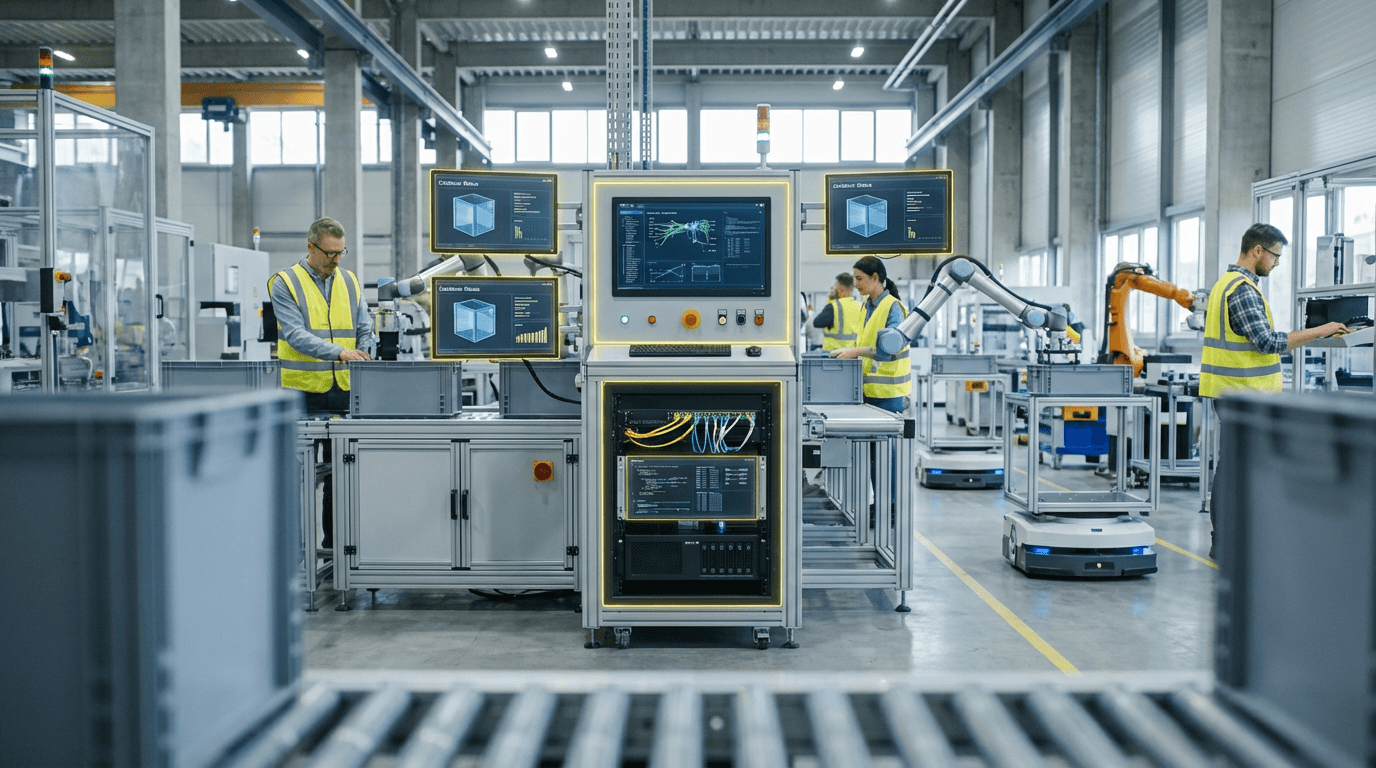
Edge Orchestration Platforms
Edge Orchestration Platforms represent a critical infrastructure layer designed to manage the deployment, operation, and coordination of computational workloads across distributed edge computing environments. Unlike traditional cloud-based systems that centralise processing in remote data centres, these platforms enable organisations to distribute artificial intelligence models, containerised applications, and data processing tasks across networks of edge devices—including industrial gateways, autonomous robots, manufacturing equipment, and IoT sensors. The technical architecture typically employs container orchestration technologies adapted for resource-constrained environments, enabling automated deployment of software updates, model versioning, and workload scheduling across heterogeneous hardware. These systems must account for the unique constraints of edge environments: limited computational resources, variable network connectivity, and the need for autonomous operation during network outages. By maintaining synchronisation protocols and state management across distributed nodes, edge orchestration platforms ensure that critical operations continue even when connectivity to central systems is disrupted.
The industrial landscape faces mounting pressure to process data closer to its source, driven by latency requirements, bandwidth constraints, and data sovereignty concerns. Traditional cloud architectures struggle to meet the real-time demands of manufacturing quality control, autonomous vehicle navigation, or predictive maintenance systems that require millisecond-level response times. Edge orchestration platforms address these challenges by enabling organisations to deploy sophisticated AI inference models and analytics directly onto factory floors, retail locations, or remote infrastructure sites. This distributed approach reduces the volume of data transmitted to central clouds, lowering bandwidth costs while improving system responsiveness. Furthermore, these platforms provide unified management interfaces that allow operators to monitor thousands of edge devices simultaneously, push configuration updates, and troubleshoot issues remotely—capabilities that would be impractical with manual device management. The result is a more resilient operational architecture where local intelligence complements centralised oversight.
Early adopters in manufacturing, logistics, and telecommunications have begun deploying edge orchestration platforms to manage fleets of industrial equipment and autonomous systems. Retail chains use these platforms to coordinate computer vision systems across store locations for inventory management and customer analytics, while energy companies deploy them to manage distributed renewable energy assets and grid infrastructure. The technology has matured beyond pilot programs in several sectors, with industrial automation vendors increasingly offering edge orchestration as a standard component of their smart factory solutions. Looking forward, the convergence of 5G networks, increasingly powerful edge processors, and growing regulatory requirements around data localisation will likely accelerate adoption. As organisations seek to balance the benefits of centralised AI development with the operational advantages of distributed deployment, edge orchestration platforms are positioned to become essential infrastructure for the Fourth Industrial Revolution, enabling the coordination of cyber-physical systems at unprecedented scale while maintaining the autonomy and resilience required for mission-critical operations.
Related Organizations

Umbrella organization under the Linux Foundation establishing open interoperability standards for edge computing.

Edge orchestration solution enabling the deployment of analytics apps to distributed edge nodes.

Develops an edge application orchestration platform designed to manage containerized applications across distributed edge environments.

Provides a complete set of tools for building, deploying, and managing fleets of connected Linux devices and containers.

Offers the Palette platform, which provides full-stack lifecycle management for Kubernetes clusters, including specific capabilities for bare metal edge environments.

The publisher of Ubuntu, offering MicroK8s and Ubuntu Core for secure, transactional updates and orchestration at the edge.

Develops Rancher and K3s, lightweight Kubernetes distributions and management platforms specifically optimized for edge computing.

Delivers hyperconverged infrastructure solutions specifically designed for edge computing, combining servers, storage, and virtualization.

Provides a Kubernetes Operations Platform that automates the lifecycle management of clusters and applications across public clouds, data centers, and the edge.

A cloud computing company that provides a unified platform for running applications and data across clouds and edge locations.
Supporting Evidence
Research this in Signals
Signals turns a topic into a sourced research record you can inspect and rerun. Your first scan is free, and this one starts with Edge Orchestration Platforms already loaded, so edit it or scan as is.