Real-time Ray Tracing
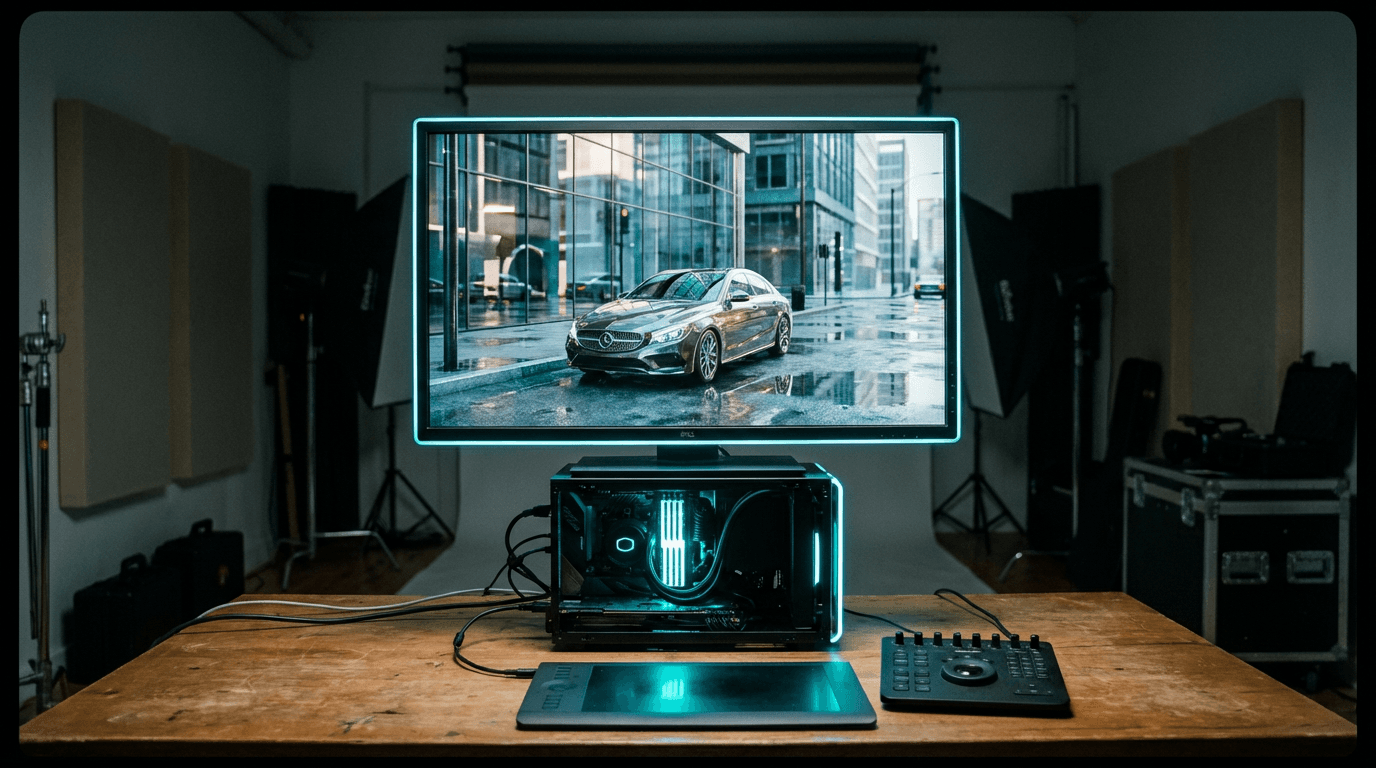
Real-time ray tracing leverages hardware RT cores, BVH acceleration structures, and denoisers to simulate reflections, refractions, soft shadows, and global illumination interactively. Modern engines hybridize rasterization for primary visibility with ray tracing for secondary lighting, keeping frame rates high while delivering physically plausible results. Temporal accumulation and AI denoising smooth noise so even mid-range GPUs can display path-traced lighting in motion.
Games, virtual production stages, and advertising rely on real-time ray tracing to blend CG and live footage seamlessly. Automotive configurators show accurate metal flake reflections, broadcasters render virtual sets that inherit stage lighting, and AR applications ground virtual objects with contact shadows that match reality. The technique also underpins spectral rendering for virtual fashion and product design.
With TRL 9, the focus shifts to workflow integration: artists need intuitive controls for sample budgets and light linking. Khronos Vulkan, DirectX, and Unreal expose ray-tracing APIs, while film pipelines adopt real-time previews to accelerate look dev. Expect continued efficiency gains as GPU vendors add path tracing hardware and cloud render farms offer ray-traced streams on demand.
Related Organizations
Developing foundation models for robotics (Project GR00T) and vision-language models like VILA.

Developers of Unreal Engine 5, which features Lumen, a fully dynamic global illumination and reflection system designed for next-gen consoles and PC.
Develops the RDNA architecture with Ray Accelerators, powering ray tracing on PC and current-gen consoles (PS5, Xbox Series X).
United States · Consortium
Maintains the Vulkan API, which includes cross-platform extensions for hardware-accelerated ray tracing.

Provides the High Definition Render Pipeline (HDRP) which supports real-time ray tracing for gaming and industrial visualization.
United Kingdom · Company
Develops PowerVR architecture with dedicated ray tracing hardware capabilities optimized for mobile devices.

Develops silicon spin qubits using advanced 300mm wafer manufacturing processes.
Germany · Company
Develops CRYENGINE, which introduced 'Neon Noir', a hardware-agnostic ray tracing solution based on sparse voxel octrees.
United States · Company
Cloud graphics company that created the OctaneRender engine and founded the Render Network.
Finland · Company
Game studio known for the Northlight Engine, one of the first to implement comprehensive ray tracing in games like 'Control' and 'Alan Wake 2'.
Supporting Evidence
Research this in Signals
Signals turns a topic into a sourced research record you can inspect and rerun. Your first scan is free, and this one starts with Real-time Ray Tracing already loaded, so edit it or scan as is.