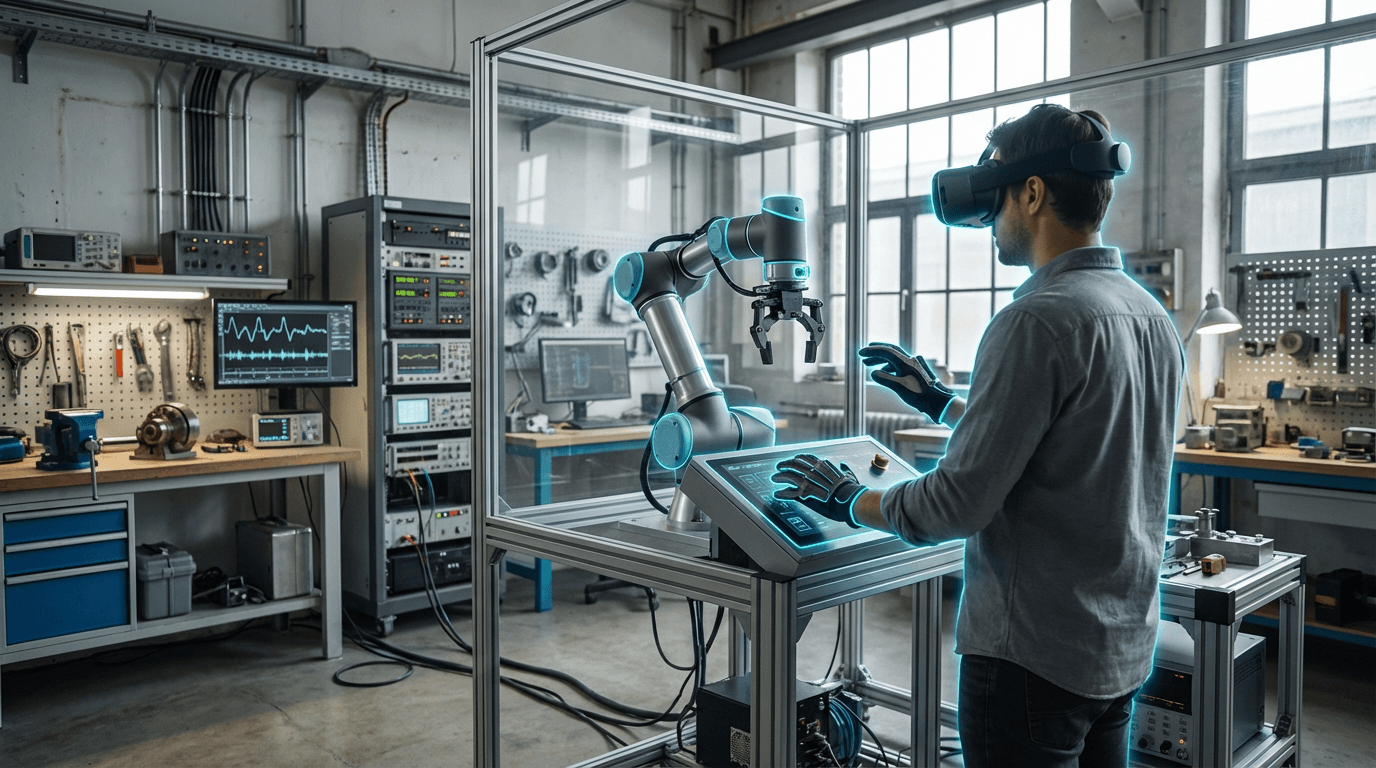
Tactile Internet & Remote Operations
The Tactile Internet represents a fundamental evolution in telecommunications, moving beyond traditional data transmission to enable real-time physical interaction across distances. Unlike conventional internet connections that primarily deliver audio and visual information, this technology creates bidirectional communication channels that transmit tactile sensations and enable precise remote control of physical systems. The architecture relies on ultra-reliable low-latency communication (URLLC) capabilities found in advanced 5G and emerging 6G networks, combined with edge computing infrastructure that processes data as close to the user as possible. Haptic feedback devices translate digital signals into physical sensations, allowing operators to "feel" what remote machines encounter. The system demands end-to-end latency of one millisecond or less—a threshold where human perception cannot detect delays—along with near-perfect reliability rates exceeding 99.999 percent. This stringent performance requirement necessitates sophisticated network slicing, where dedicated virtual networks guarantee bandwidth and processing resources for critical operations.
The telecommunications industry has long grappled with the challenge of extending human capabilities beyond physical presence, particularly in scenarios where distance, danger, or precision requirements make direct human intervention impractical or impossible. Traditional remote control systems suffer from latency issues that create dangerous disconnects between operator actions and machine responses, limiting their application to slow-moving or non-critical tasks. The Tactile Internet addresses this fundamental limitation by creating communication channels responsive enough to match human reaction times and sensitive enough to convey nuanced physical feedback. This breakthrough enables entirely new operational paradigms in sectors where real-time precision is paramount. In healthcare, it allows specialist surgeons to perform delicate procedures on patients thousands of kilometres away, democratising access to expertise. In industrial settings, it permits operators to control machinery in hazardous environments—deep mines, nuclear facilities, or disaster zones—without physical risk. The technology also supports collaborative robotics applications where human workers and machines must coordinate complex tasks with split-second timing.
Early deployments of Tactile Internet systems have emerged in controlled environments, with research institutions and telecommunications providers conducting pilot programs in surgical training, industrial maintenance, and emergency response scenarios. The technology builds upon broader industry momentum toward network densification and edge computing infrastructure, which are essential prerequisites for achieving the required latency and reliability targets. As 5G networks mature and 6G development accelerates, the technical foundation for widespread Tactile Internet deployment continues to strengthen. Current applications focus on high-value, specialised use cases where the substantial infrastructure investment can be justified, but industry analysts note a trajectory toward broader accessibility as network capabilities improve and costs decline. The convergence of this technology with advances in robotics, artificial intelligence, and sensor systems suggests a future where physical distance becomes increasingly irrelevant for skilled work, potentially reshaping labour markets and enabling new forms of human-machine collaboration that were previously confined to science fiction.
Related Organizations

A leading research hub that coined the term 'Tactile Internet' and focuses on low-latency 5G/6G applications.

Produces 'Ethically Aligned Design' standards, addressing the legal and ethical implications of autonomous systems.

Operates a teledriving service where remote drivers in a control center deliver cars to customers or drive them remotely.

Develops industrial-grade haptic gloves using microfluidic technology to simulate realistic touch and resistance.

Provides a human-assisted autonomy platform for yard trucking, integrating teleoperation centers to handle edge cases in logistics hubs.

Developing VR-based teleoperation software for robotic arms.

Mobile technology research and development company that licenses its innovations.

A major research center for 5G/6G and the Internet of Skills, pioneering remote surgery and music demonstrations.

The world leader in mid-air haptics and hand tracking, formed from the merger of Ultrahaptics and Leap Motion.

A technology platform that allows clinicians to virtually 'scrub in' to any operating room.
Supporting Evidence
Research this in Signals
Signals turns a topic into a sourced research record you can inspect and rerun. Your first scan is free, and this one starts with Tactile Internet & Remote Operations already loaded, so edit it or scan as is.