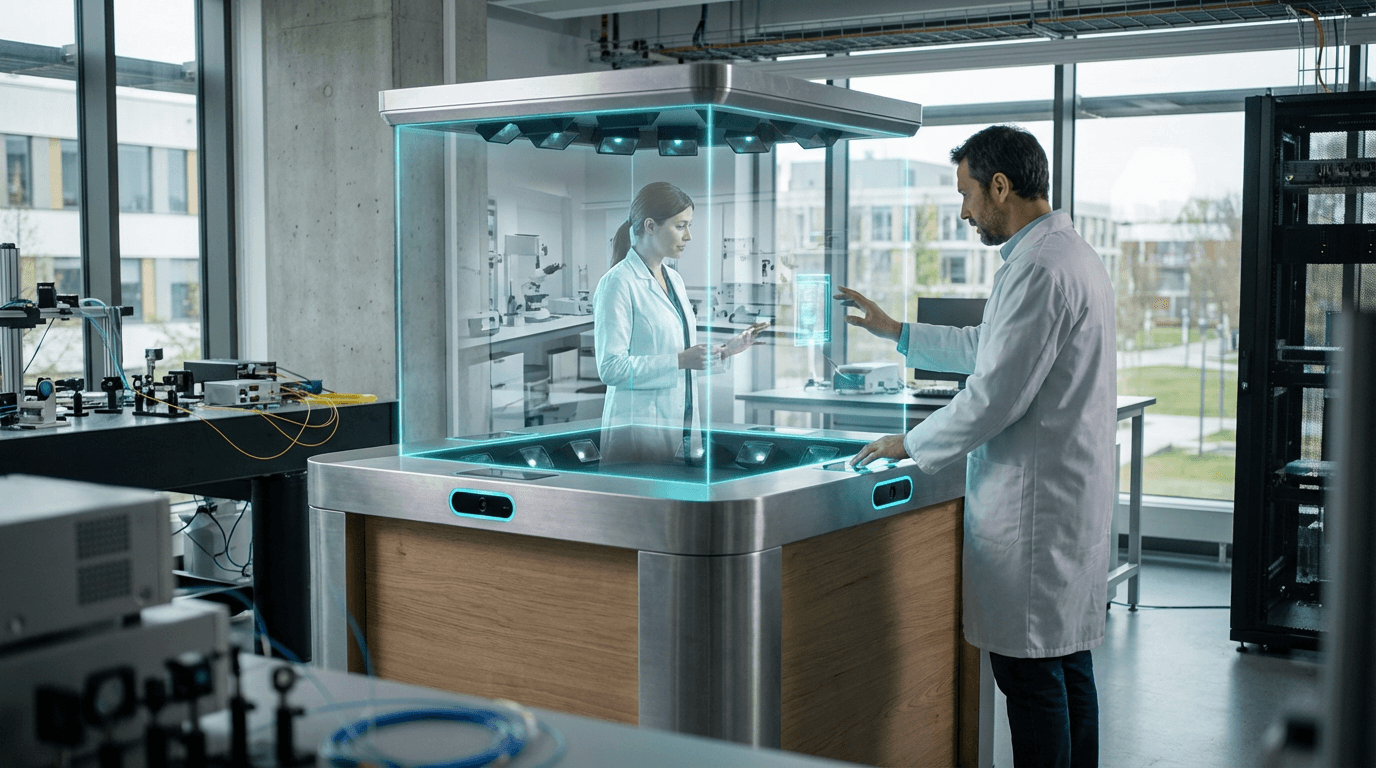
Holographic Telepresence
Holographic telepresence represents a significant evolution in remote communication technology, moving beyond flat video conferencing to create lifelike, three-dimensional representations of people and objects in real-time. Unlike traditional video calls that display participants on two-dimensional screens, this technology captures the full volumetric presence of individuals—their depth, movement, and spatial positioning—and transmits this data to recreate them as interactive holograms at remote locations. The process relies on an array of depth-sensing cameras and sensors that capture multiple angles simultaneously, creating a complete 3D model of the subject. This volumetric data is then compressed, transmitted over ultra-high-bandwidth networks, and reconstructed at the receiving end using specialized display systems such as holographic projectors or light-field displays. The technical challenge lies not only in capturing this immense amount of spatial information but in processing and transmitting it with minimal latency, requiring data rates that far exceed current network capabilities and compression algorithms sophisticated enough to maintain visual fidelity while managing bandwidth constraints.
The telecommunications industry has long sought to bridge the gap between physical presence and remote communication, recognizing that conventional video conferencing fails to capture crucial non-verbal cues, spatial awareness, and the sense of shared presence that characterizes face-to-face interaction. Holographic telepresence addresses these limitations by enabling participants to perceive each other's full body language, make natural eye contact from multiple angles, and interact with shared holographic objects as if occupying the same physical space. This capability has profound implications for sectors where physical presence has traditionally been considered irreplaceable—from medical consultations where doctors need to examine patients from multiple angles, to engineering collaborations where teams must manipulate and inspect 3D prototypes together, to executive meetings where subtle interpersonal dynamics influence critical decisions. The technology also promises to reduce the environmental and economic costs associated with business travel while maintaining the effectiveness of in-person collaboration.
Early demonstrations of holographic telepresence have emerged from research laboratories and telecommunications companies exploring next-generation network applications, though widespread commercial deployment remains contingent on the rollout of advanced wireless infrastructure capable of handling the extraordinary data demands. Pilot programs in specialized fields such as remote surgery consultation, high-stakes business negotiations, and immersive education suggest that the technology could fundamentally transform how professionals collaborate across distances. The development trajectory closely parallels advances in network technology, with industry observers noting that the ultra-low latency and multi-gigabit speeds promised by emerging 6G standards may finally provide the foundation necessary for practical implementation. As display technologies become more sophisticated and affordable, and as compression techniques improve, holographic telepresence is positioned to move from experimental demonstrations to real-world applications, potentially redefining the nature of remote work, telemedicine, and global collaboration in an increasingly connected world.
Related Organizations

Creators of CausalImpact, a package for causal inference using Bayesian structural time-series.

Manufactures self-contained holographic display units (Epic and M) for beaming life-size volumetric avatars for events and communications.

ARHT Media
Canada · Company
Provides holographic telepresence solutions (HoloPresence) for live events, education, and retail.

Develops desktop and large-format holographic displays that generate 45-100 views simultaneously for glasses-free 3D.

Through Copilot and the 'Recall' feature in Windows, Microsoft is integrating persistent memory and agentic capabilities directly into the operating system.

Develops technology for capturing, transforming, and streaming volumetric video of real people.

Offers Webex Hologram, an augmented reality meeting solution that projects photorealistic 3D holograms of participants into the room.

A software company enabling holographic presence using just a single camera (like a smartphone) rather than complex rigs.

Provides lightfield display hardware and software solutions for mobile devices, tablets, and automotive cockpits.

Developed 'Project Ghost', a telepresence booth that uses glass reflection and screen technology to create eye-contact enabled realistic calls.
Supporting Evidence
Research this in Signals
Signals turns a topic into a sourced research record you can inspect and rerun. Your first scan is free, and this one starts with Holographic Telepresence already loaded, so edit it or scan as is.