









The Internet Of Senses
Internet of Senses
Networks that transmit touch, smell, and taste sensations alongside audio and video
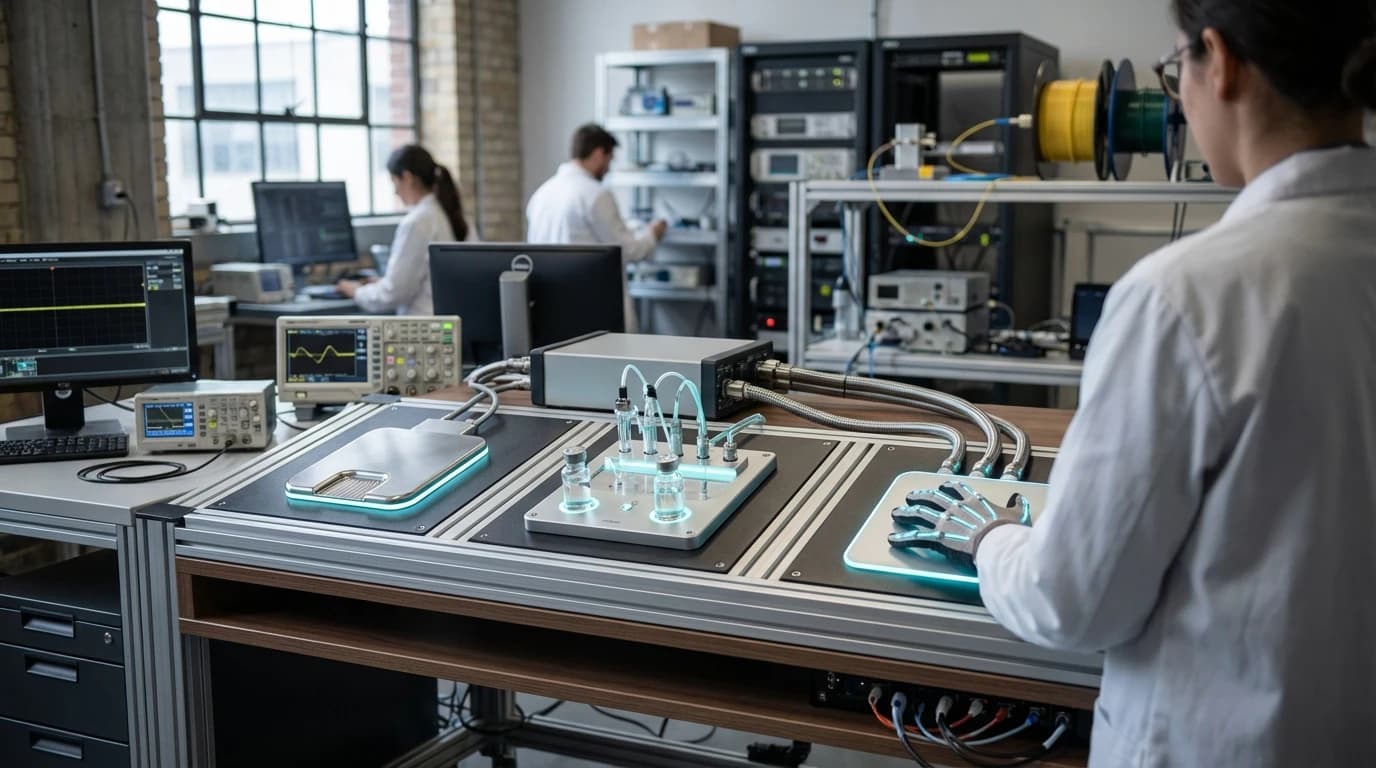
The Internet of Senses represents a fundamental expansion of digital communication infrastructure, moving beyond traditional audio-visual transmission to encompass the full spectrum of human sensory experience. This technology relies on sophisticated sensor arrays and actuator systems that can capture, encode, and reproduce physical sensations across networks. Haptic feedback systems use precise vibration patterns, force feedback, and temperature modulation to simulate touch and texture. Olfactory transmission employs digital scent technology, where chemical compounds are catalogued and reproduced through controlled release mechanisms at the receiving end. Gustatory experiences are recreated through electrical or thermal stimulation of taste receptors, or through precise delivery of flavor compounds. The entire system depends on ultra-low latency networks—often requiring sub-millisecond response times—to maintain the synchronization necessary for convincing sensory experiences. This technical requirement has driven significant advances in edge computing and 5G/6G network architectures, as even slight delays can break the illusion of presence and render applications like remote surgery dangerously impractical.
The telecommunications industry faces mounting pressure to differentiate services beyond simple bandwidth increases, and the Internet of Senses addresses this challenge by creating entirely new categories of networked experiences. Current video conferencing and virtual reality platforms, while visually sophisticated, remain fundamentally limited in their ability to convey physical presence or enable remote manipulation of objects. This technology overcomes these limitations by enabling applications that were previously impossible: surgeons could perform delicate procedures from thousands of miles away with full tactile feedback, engineers could inspect and feel the texture of materials in remote facilities, and quality control specialists could verify product characteristics without physical samples. The solution also enables new business models in entertainment, education, and retail, where sensory-rich experiences can be delivered as services. Museums could offer virtual tours where visitors not only see artifacts but feel their textures and experience associated scents, while culinary schools could transmit the exact taste profiles of dishes for remote instruction.
Early research deployments have demonstrated proof-of-concept systems in controlled environments, particularly in medical training facilities and specialized industrial applications. Telecommunications companies and technology research institutions are actively exploring the infrastructure requirements and standardization challenges necessary for broader deployment. The technology aligns with the broader industry trajectory toward immersive communications and the development of the metaverse, where full sensory engagement is considered essential for creating convincing virtual environments. However, significant technical hurdles remain, including the development of compact, affordable sensory reproduction devices and the establishment of universal standards for encoding sensory data. As network infrastructure continues to evolve toward higher speeds and lower latencies, the Internet of Senses represents a natural progression in connectivity, promising to transform remote collaboration, healthcare delivery, and human connection in ways that fundamentally reshape how distance affects our ability to share experiences.
TRL
2/9Theoretical
Impact
4/5
Investment
3/5
Category
Applications
Related Organizations
Develops industrial-grade haptic gloves using microfluidic technology to simulate realistic touch and resistance.
Developer
Creates wearable scent technology (ION) for VR/AR headsets to deliver precise olfactory experiences.
Developer
Develops the Aroma Shooter, a directional scent delivery device that uses solid-state cartridges.
Developer
Produces the Nova glove, which uses force-feedback tendons to simulate the size and density of virtual objects.
Developer
Produces a full-body haptic suit using electro-muscle stimulation (EMS) and TENS to simulate physical sensations.
Developer
The world leader in mid-air haptics and hand tracking, formed from the merger of Ultrahaptics and Leap Motion.
Developer
The primary IP holder and licensor for haptic technologies globally.
Developer
Home to the Miyashita Lab, which developed 'Taste the TV' (TTTV), a lickable screen that imitates food flavors.
Researcher
Develops surface haptics technology that modulates friction on touchscreens to simulate textures.
Developer
What was expected
Published forecasts about this technology, graded against what happened in Hindsight.
Supporting Evidence
Evidence data is not available for this technology yet.
Research this in Signals
Scan Internet of Senses for yourself.
Signals turns a topic into a sourced research record you can inspect and rerun. Your first scan is free, and this one starts with Internet of Senses already loaded, so edit it or scan as is.