







Drone swarming for defense
This page is broader than it.
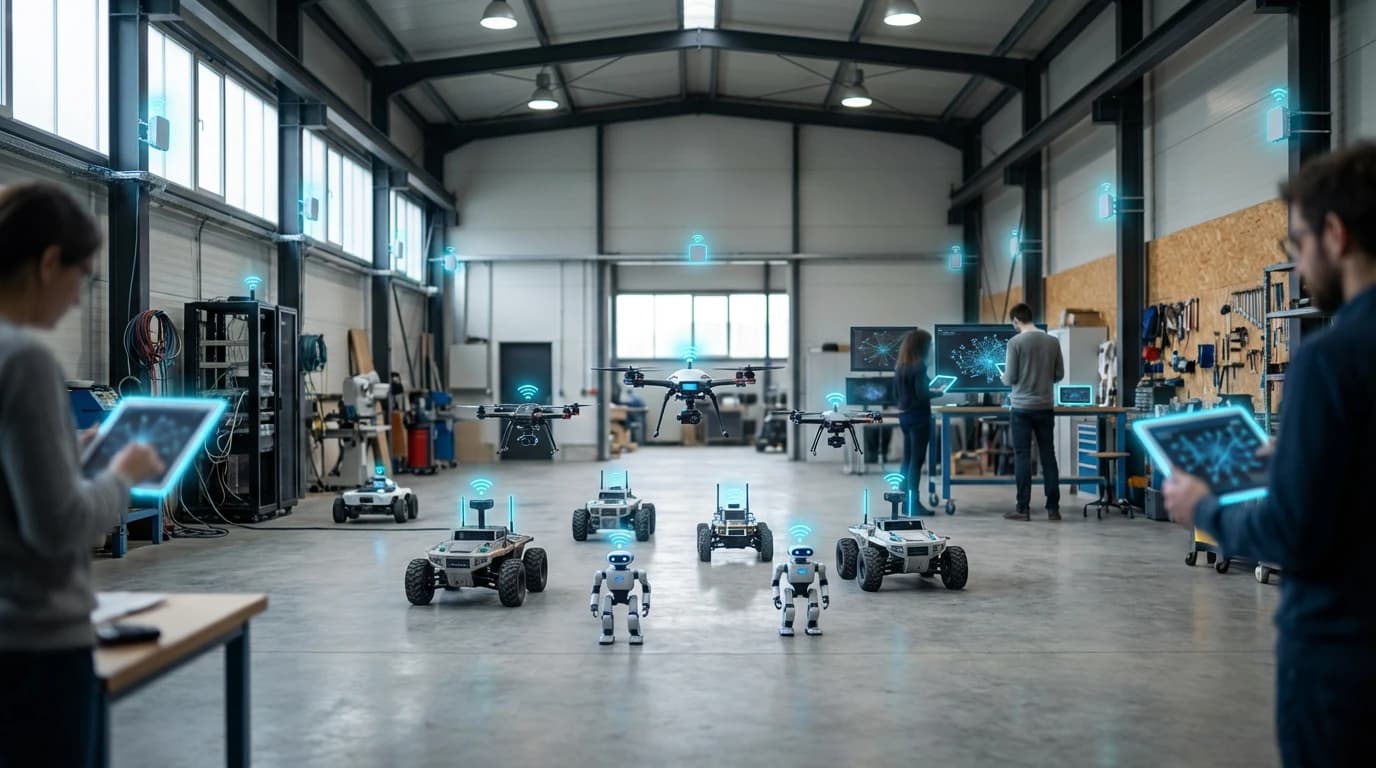
The challenge of coordinating large numbers of autonomous agents—whether drones, ground robots, or autonomous vehicles—has historically relied on centralized control systems that create single points of failure and struggle to scale beyond a few dozen units. Traditional command-and-control architectures face fundamental limitations when managing hundreds or thousands of mobile agents operating in dynamic environments, particularly when communication infrastructure is degraded or absent. Swarm coordination and multi-agent communication addresses these constraints through decentralized protocols that enable autonomous agents to self-organize, share information, and execute complex collective behaviors without requiring constant oversight from a central controller. The technical foundation rests on lightweight consensus algorithms that allow agents to rapidly agree on shared objectives and coordinate actions, mesh networking protocols that create resilient communication pathways by routing data through the swarm itself, and beamforming techniques that focus wireless signals to maintain reliable links even as agents move at high speeds or operate in dense formations.
The practical implications of this technology extend across numerous industries facing coordination challenges at scale. In logistics and warehousing, companies are deploying robot fleets that use swarm protocols to dynamically allocate tasks, avoid collisions, and optimize pathways without requiring a central traffic controller—enabling warehouse operations to scale to hundreds of autonomous units working simultaneously. Emergency response organizations are exploring drone swarms that can rapidly survey disaster areas, with individual units sharing sensor data through mesh networks to build comprehensive situational awareness even when cellular infrastructure has failed. The entertainment industry has adopted swarm coordination for aerial light shows, where hundreds of drones execute precisely synchronized maneuvers to create three-dimensional displays. These systems solve the fundamental problem of achieving sub-second coordination across large agent populations while maintaining resilience to individual unit failures, communication disruptions, and rapidly changing operational requirements.
Current deployments indicate growing maturity, with commercial drone light show providers routinely coordinating 500+ aircraft, and research institutions demonstrating swarms exceeding 1,000 units in controlled environments. The technology is transitioning from laboratory demonstrations to operational systems, though challenges remain in ensuring robust performance across diverse environmental conditions and regulatory frameworks. Industry analysts note particular momentum in agricultural applications, where coordinated robot teams can perform tasks like precision weeding or harvesting more efficiently than individual units. As autonomous systems proliferate across urban environments, transportation networks, and industrial facilities, the ability to coordinate large numbers of agents without centralized infrastructure will become increasingly critical. The trajectory points toward hybrid approaches that combine swarm intelligence with edge computing infrastructure, enabling even larger-scale coordination while maintaining the resilience and scalability advantages of decentralized protocols.
Runs the Semantic Forensics (SemaFor) program to develop technologies for automatically detecting, attributing, and characterizing falsified media.
Defense technology company building Hivemind, an AI pilot for autonomous drone swarms and aircraft operating without GPS or comms.
The General Robotics, Automation, Sensing & Perception Lab is a world leader in researching cooperative multi-robot systems.
Unmanned Life
United Kingdom · Startup
Provides a software platform for the orchestration of autonomous robotics swarms, including drones and ground rovers, over 5G.
A Saab company specializing in unmanned systems and swarm autonomy for defense applications.
Focuses on automating the launch, recovery, and servicing of drone swarms to enable continuous operations.
Creates autonomous indoor drone swarms for inventory management in warehouses and live entertainment shows.
Provides an open-source based operating system for drones that supports fleet management and multi-vehicle coordination.

Swarm Logistics
Germany · Startup
Develops software to coordinate fleets of autonomous trucks and vehicles using swarm intelligence for route optimization.
Creators of the Crazyflie, an open-source nano-drone platform widely used as the standard hardware for swarm research.
Published forecasts about this technology, graded against what happened in Hindsight.
Drone swarming for defense
This page is broader than it.
Signals turns a topic into a sourced research record you can inspect and rerun. Your first scan is free, and this one starts with Swarm Coordination & Multi-Agent Communication already loaded, so edit it or scan as is.