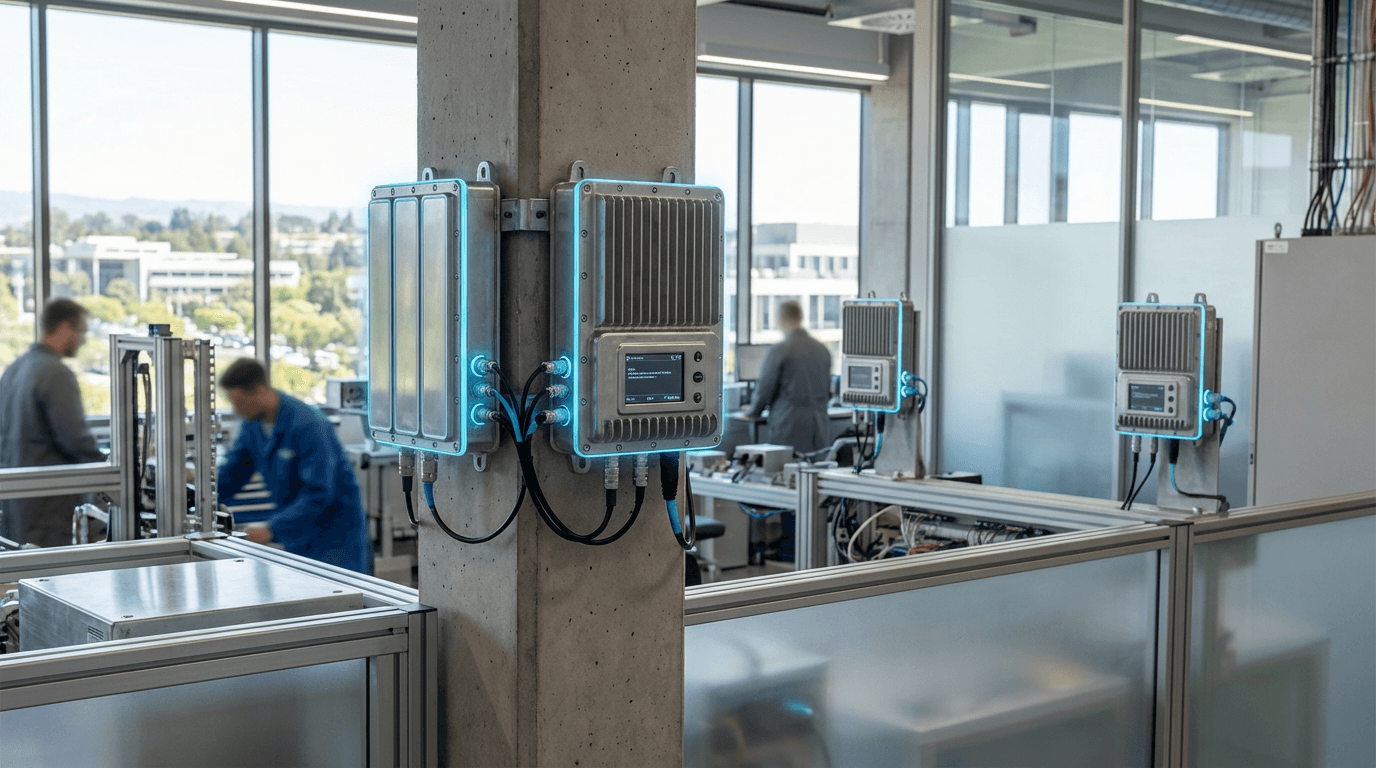
Integrated Access & Backhaul (IAB)
The telecommunications industry faces a persistent infrastructure challenge: extending high-speed network coverage to areas where traditional fiber-optic backhaul is either economically unfeasible or physically impractical to deploy. In dense urban environments, the cost and complexity of trenching fiber through established infrastructure can be prohibitive, while rural and remote regions often lack the population density to justify such capital-intensive investments. Integrated Access and Backhaul (IAB) addresses this fundamental limitation by enabling wireless network nodes to serve dual roles simultaneously. Rather than requiring dedicated fiber connections to link each cell site back to the core network, IAB nodes use the same radio spectrum to both serve end users and relay traffic wirelessly to other nodes in the network. This creates a mesh-like topology where data can hop across multiple wireless links before reaching a fiber-connected anchor point, effectively extending network reach without the need for ubiquitous fiber deployment.
The technical architecture of IAB represents a significant evolution in network design, particularly for 5G and emerging 6G systems. Each IAB node operates as both an access point for user devices and a relay station for backhaul traffic, intelligently managing radio resources to balance these competing demands. Advanced scheduling algorithms and beamforming techniques ensure that user traffic and backhaul data can coexist on the same spectrum without significant performance degradation. This dual functionality transforms the economics of network expansion, enabling operators to deploy coverage more rapidly and cost-effectively in scenarios where fiber installation would require months of permitting, construction, and substantial capital expenditure. For urban densification projects, IAB allows carriers to add capacity-enhancing small cells without the logistical nightmare of connecting each site to fiber. In rural contexts, it enables operators to extend coverage from fiber-connected anchor sites deep into underserved territories, using wireless relay chains that can span several kilometers.
Early commercial deployments of IAB have demonstrated its viability in both urban and rural scenarios, with network operators increasingly incorporating the technology into their 5G rollout strategies. In cities, IAB nodes mounted on streetlights or building facades can quickly fill coverage gaps or add capacity in high-traffic areas without extensive civil works. Rural broadband initiatives are leveraging IAB to reach communities that would otherwise remain unconnected for years due to the prohibitive cost of fiber extension. As the technology matures and 6G development progresses, research suggests that IAB will become even more sophisticated, with enhanced spectral efficiency, lower latency relay mechanisms, and improved resilience through dynamic mesh reconfiguration. This evolution positions IAB as a critical enabler of universal connectivity, helping to bridge the digital divide by making network expansion economically viable in regions that traditional infrastructure models have historically overlooked.
Related Organizations

Multinational telecommunications, information technology, and consumer electronics company.

Offers the AI Stack which includes tools for hardware-aware model efficiency and architecture search.

Provides 5G small cells and Open RAN software tailored for private network densification.

Pioneered Holographic Beam Forming (HBF) technology for 5G mmWave, allowing antennas to shape and steer beams with low power and cost.


Verizon's dedicated network and technology division for first responders.

Kumu Networks
United States · Startup
Specialists in self-interference cancellation technology enabling Full Duplex communication, which significantly enhances IAB spectral efficiency.

Creates 5G mmWave active repeater and beamforming technologies to solve signal propagation challenges.

Academic research center pioneering mmWave and Terahertz beamforming propagation measurements and algorithms.

Wireless backhaul specialist providing microwave and mmWave transport solutions.
Supporting Evidence
Research this in Signals
Signals turns a topic into a sourced research record you can inspect and rerun. Your first scan is free, and this one starts with Integrated Access & Backhaul (IAB) already loaded, so edit it or scan as is.