Envisioning is an emerging technology research institute and advisory.

LinkedInInstagramGitHub

2011 — 2026

research
  • Reports
  • Newsletter
  • Methodology
  • Origins
  • My Collection
services
  • Research Sessions
  • Signals Workspace
  • Bespoke Projects
  • Use Cases
  • Signal Scanfree
  • Readinessfree
impact
  • ANBIMAFuture of Brazilian Capital Markets
  • IEEECharting the Energy Transition
  • Horizon 2045Future of Human and Planetary Security
  • WKOTechnology Scanning for Austria
audiences
  • Innovation
  • Strategy
  • Consultants
  • Foresight
  • Associations
  • Governments
resources
  • Pricing
  • Partners
  • How We Work
  • Data Visualization
  • Multi-Model Method
  • FAQ
  • Security & Privacy
about
  • Manifesto
  • Community
  • Events
  • Support
  • Contact
  • Login
ResearchServicesPricingPartnersAbout
  1. Home
  2. Research
  3. Interface
  4. AI-Based Signal Processing for Hearing

AI-Based Signal Processing for Hearing

AI algorithms that isolate speech from noise in hearing devices and earbuds
Back to InterfaceView interactive version

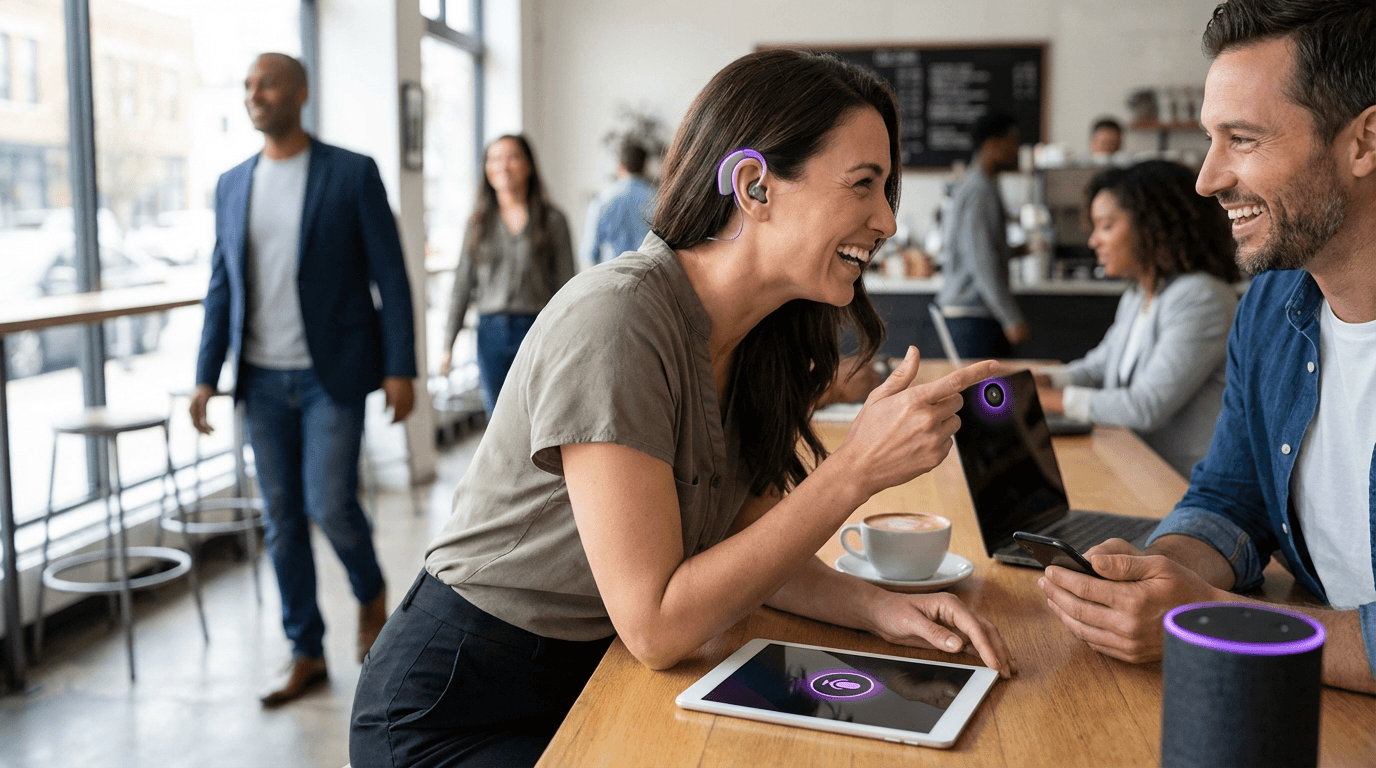
AI-based signal processing for hearing uses advanced algorithms including denoisers, beamformers, echo cancellers, and spatial audio processing to enhance speech clarity in challenging acoustic environments. These technologies work together to isolate target speech from background noise, cancel echoes and reverberation, and focus on voices from specific directions or distances. The Coneformer technology enables voice isolation by angle and distance, allowing hearing devices to focus on a specific speaker even in crowded, noisy environments. The algorithms are optimized for low-latency, low-power digital signal processors (DSPs) and system-on-chips (SoCs) commonly used in hearing aids, earbuds, and audio devices.

The technology dramatically improves speech understanding in noisy restaurants, crowded spaces, phone calls, and other challenging listening situations. The low-latency processing ensures natural sound without noticeable delays, while low-power optimization enables battery-powered devices to run these advanced algorithms continuously. The spatial processing capabilities allow users to focus on specific speakers or conversations, making group conversations and meetings much more accessible. Applications include hearing aids, true wireless earbuds, communication devices, and any audio system where speech clarity is critical. The technology makes hearing devices more effective in real-world conditions, significantly improving the user experience for people with hearing challenges and anyone in noisy environments.

Technology Readiness Level
5/9Validated
Impact
3/5Medium
Investment
3/5Medium
Category
Software

Related Organizations

Qualcomm logo
Qualcomm

United States · Company

95%

Offers the AI Stack which includes tools for hardware-aware model efficiency and architecture search.

Developer
Sonova logo
Sonova

Switzerland · Company

95%

Parent company of Phonak and Sennheiser Consumer, integrating AI denoising and speech enhancement into hearing aids and earbuds.

Deployer
Fraunhofer IIS logo
Fraunhofer IIS

Germany · Research Lab

90%

Develops light-field production tools and Realception software for processing volumetric video.

Researcher
GN Hearing logo
GN Hearing

Denmark · Company

90%

Produces ReSound hearing aids and Jabra audio devices, utilizing 'Organic Hearing' AI for noise filtering and spatial perception.

Deployer
Knowles Electronics logo
Knowles Electronics

United States · Company

90%

Produces Audio Edge Processors and advanced microphones optimized for AI audio processing and voice isolation.

Developer
Mimi Hearing Technologies logo
Mimi Hearing Technologies

Germany · Startup

90%

Provides sound personalization software that adjusts audio based on a user's unique hearing profile using advanced signal processing.

Developer
NXP Semiconductors logo
NXP Semiconductors

Netherlands · Company

90%

Leading manufacturer of Near Field Communication (NFC) and Secure Element chips used in offline payment hardware.

Developer
Starkey logo
Starkey

United States · Company

90%

Develops the Genesis AI hearing aids, which use an on-board Deep Neural Network (DNN) accelerator to process sound.

Deployer
Audiodo logo
Audiodo

Sweden · Startup

85%

Develops 'Personal Sound' technology that optimizes audio output for individual hearing characteristics.

Developer
Bragi logo
Bragi

Germany · Company

85%

Pivoted from hardware to licensing the Bragi OS, an intelligent operating system for hearables that supports AI apps.

Developer

Supporting Evidence

Paper

Wireless Hearables With Programmable Speech AI Accelerators

arXiv · Mar 24, 2025

Presents NeuralAids, a fully on-device speech AI system for wireless hearables that enables real-time speech enhancement and denoising on compact, battery-constrained devices using a programmable speech AI accelerator.

Support 95%Confidence 98%

Paper

TF-MLPNet: Tiny Real-Time Neural Speech Separation

ISCA Archive · Oct 2, 2025

Introduces TF-MLPNet, a speech separation network capable of running in real-time on low-power neural accelerators (like GAP9) for hearables, outperforming existing streaming models.

Support 92%Confidence 95%

News

Cearvol Brings Next-Gen AI Hearing Aids to EUHA 2025, Redefining Clarity and Control

OpenPR · Oct 22, 2025

Cearvol showcases AI 3.0 hearing aids at EUHA 2025, featuring advanced noise reduction, echo control, wind noise management, and scene presets for environments like restaurants and commutes.

Support 90%Confidence 95%

Paper

HyBeam: Hybrid Microphone–Beamforming Array-Agnostic Speech Enhancement for Wearables

arXiv · Oct 22, 2025

Discusses a hybrid microphone-beamforming approach for speech enhancement in wearables, focusing on array-agnostic techniques to improve performance across different device form factors.

Support 88%Confidence 92%

Connections

Applications
Applications
AI Audiologist Platform

Self-administered hearing tests and education through AI-powered smartphone platforms

Technology Readiness Level
6/9
Impact
3/5
Investment
3/5
Software
On-Device AI Bio-Signal Processing

Chips that analyze heart, brain, and muscle signals locally without cloud connectivity

Technology Readiness Level
4/9
Impact
3/5
Investment
3/5
Hardware
Position-Adaptive 3D Spatial Audio

Audio systems that track listener position to maintain optimal 3D sound anywhere in the room

Technology Readiness Level
4/9
Impact
3/5
Investment
3/5
Applications
Applications
AI Sleep Bots

AI systems that monitor sleep patterns and intervene to reduce snoring and improve rest quality

Technology Readiness Level
7/9
Impact
3/5
Investment
3/5
Hardware
Hardware
Advanced Beamforming Technology

Focused radio signals using antenna arrays to target specific devices instead of broadcasting uniformly

Technology Readiness Level
4/9
Impact
3/5
Investment
3/5

Book a research session

Bring this signal into a focused decision sprint with analyst-led framing and synthesis.
Research Sessions