Urban Irrigation
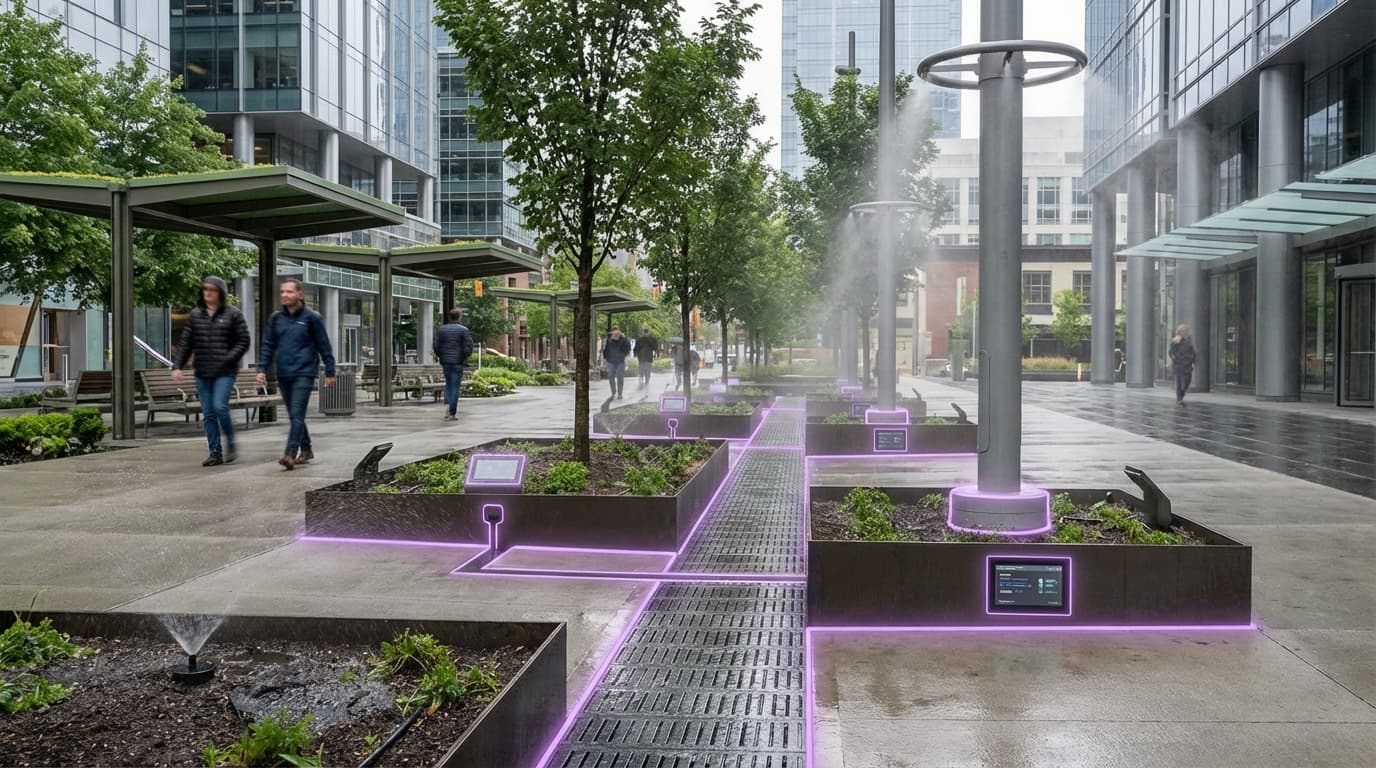
Urban irrigation systems extend traditional agricultural irrigation techniques to city environments, using smart, sensor-controlled sprinkler and misting systems deployed across urban surfaces including parks, rooftops, roads, and building facades. These systems use weather data, temperature sensors, and soil moisture monitors to optimize water application, cooling surfaces through evaporative cooling, suppressing dust, and maintaining vegetation that provides additional cooling and air quality benefits. Advanced systems can respond to real-time conditions, activating during heat events or before predicted rainfall to maximize effectiveness.
The technology addresses multiple interconnected urban challenges: the urban heat island effect where cities are significantly warmer than surrounding areas, air quality problems from dust and pollution, and flood risks from impermeable surfaces. Urban irrigation can reduce local temperatures by several degrees through evaporative cooling, improve air quality by suppressing dust and particulates, and enhance soil permeability to reduce surface runoff. Applications include heat mitigation in vulnerable neighborhoods, air quality improvement near pollution sources, flood risk reduction through enhanced infiltration, and support for urban agriculture and green infrastructure. Cities worldwide are deploying urban irrigation systems as part of climate adaptation strategies.
At TRL 7, urban irrigation systems are commercially deployed in various cities, though optimization and integration with broader urban systems continue to evolve. The technology faces challenges including water availability and cost, ensuring water quality and preventing waste, managing system maintenance, and balancing irrigation with other water needs. However, as cities face increasing heat and air quality challenges, urban irrigation becomes an important adaptation tool. The technology could significantly improve urban livability by reducing heat stress, improving air quality, and enhancing resilience to climate change, potentially making cities more comfortable and healthy while supporting urban ecosystems and reducing flood risks through better water management.
Related Organizations
Israel · Company
The pioneer of drip irrigation, now providing precision irrigation solutions for urban landscapes and green roofs.
A landscape architecture firm led by Kongjian Yu, pioneering the 'Sponge City' concept to manage urban floods.
United States · Company
A leading manufacturer of irrigation equipment, including the Hydrawise smart controller platform.
United States · Company
Develops WeatherTRAK smart irrigation systems used by commercial sites and cities to reduce water waste.

PUB, Singapore's National Water Agency
Singapore · Government Agency
Manages Singapore's water supply and drainage, implementing the 'Active, Beautiful, Clean Waters' (ABC Waters) programme.
United States · Startup
Produces smart sprinkler controllers that use hyper-local weather data to optimize watering schedules.
United States · Company
A global manufacturer of irrigation products, heavily investing in 'IQ4' central control systems for smart city applications.
United States · Company
Provides data-driven water management software for large commercial properties to detect leaks and optimize irrigation.
United States · Company
Specializes in resource management and smart irrigation controllers for government and university campuses.

Designs and manufactures wireless sensor network hardware for IoT applications.

Engineering consultancy famous for 'Blue-Green Infrastructure' projects in Copenhagen and globally to manage cloudbursts.
Supporting Evidence
Research this in Signals
Signals turns a topic into a sourced research record you can inspect and rerun. Your first scan is free, and this one starts with Urban Irrigation already loaded, so edit it or scan as is.