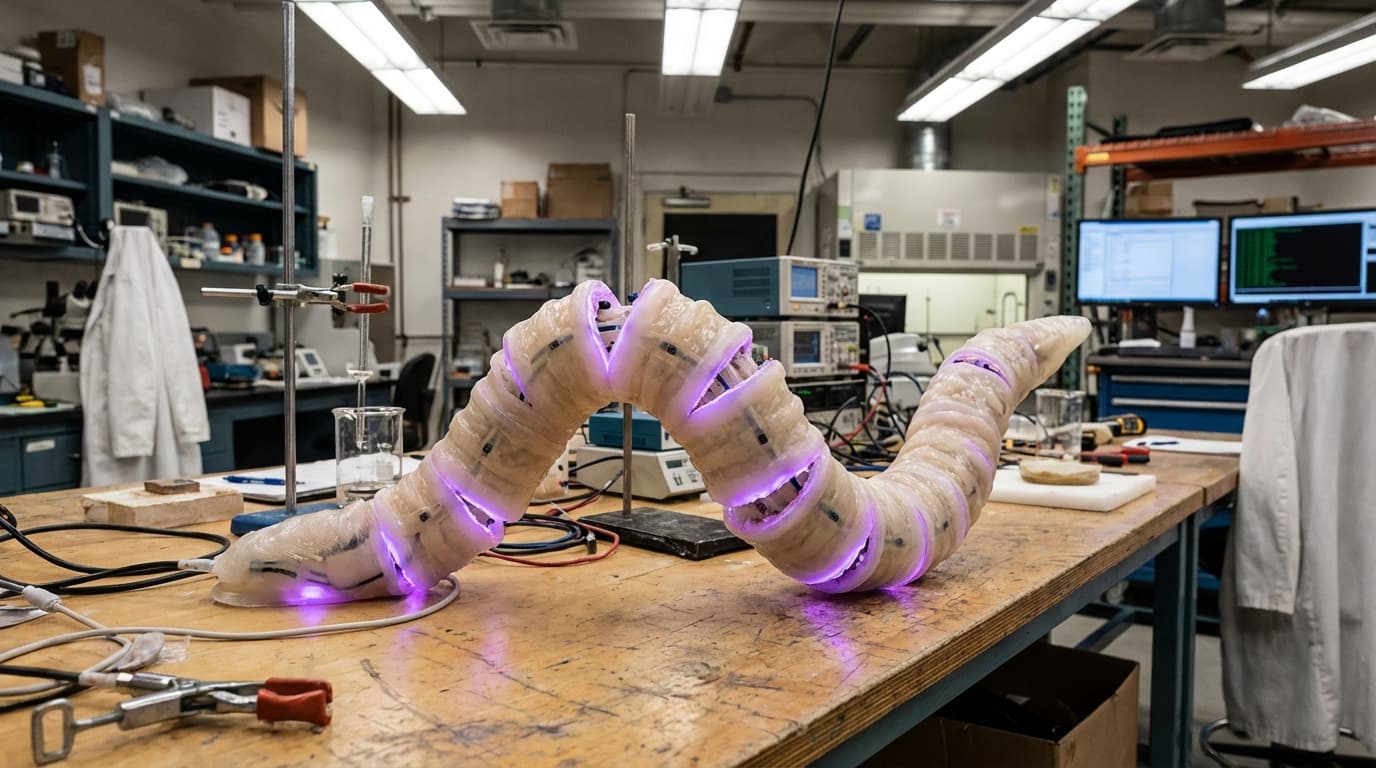
Self-Healing Soft Robot
Self-healing soft robots combine soft robotics—robots made from flexible, compliant materials—with self-healing polymers that can autonomously repair damage. These systems use materials like shape-memory polymers, hydrogels, or polymers with embedded healing agents that can seal cuts, restore functionality after damage, and extend operational lifespan. Integrated sensors detect damage through changes in electrical conductivity, pressure, or structural integrity, triggering healing mechanisms that can repair both microscopic cracks and larger tears.
The technology addresses a fundamental limitation of soft robots: their vulnerability to damage from sharp objects, wear, or environmental stress. Self-healing capabilities enable robots to operate in challenging environments, recover from accidents, and reduce maintenance requirements. Applications include medical robots that can operate safely in the human body, exploration robots for harsh environments, and industrial robots that can continue operating despite wear. Research institutions are developing various self-healing materials and integrating them into soft robotic systems.
At TRL 4, self-healing soft robots are in active research, with laboratory demonstrations showing repair of cuts and restoration of functionality. The technology faces challenges including the speed of healing processes, maintaining functionality during repair, the complexity of integrating sensors and healing mechanisms, and ensuring healed materials retain original properties. However, as soft robotics expands into more applications and self-healing materials improve, these systems could become essential for robots operating in unpredictable or hazardous environments. The technology could enable robots that are more robust, require less maintenance, and can operate autonomously for extended periods, potentially transforming applications from medical devices to space exploration.
Related Organizations

A premier bio-inspired engineering lab developing soft robotics and adaptive materials.

Home to the Brubotics research group, pioneers in self-healing polymers for soft robotics.

The Soft Machines Lab at CMU develops soft multifunctional materials and robots.

Home to the Organic Robotics Lab, focusing on soft robots that can heal and adapt.

Singapore's flagship university.

The Vuckovic Group develops inverse-designed photonics for quantum frequency conversion.

Empa
Switzerland · Research Lab
Swiss Federal Laboratories for Materials Science and Technology, researching self-healing elastomers.

Develops supramolecular polymers that exhibit self-healing properties.
United States · Startup
Commercializes HASEL (Hydraulically Amplified Self-healing Electrostatic) actuator technology for soft motion.
Supporting Evidence
Research this in Signals
Signals turns a topic into a sourced research record you can inspect and rerun. Your first scan is free, and this one starts with Self-Healing Soft Robot already loaded, so edit it or scan as is.