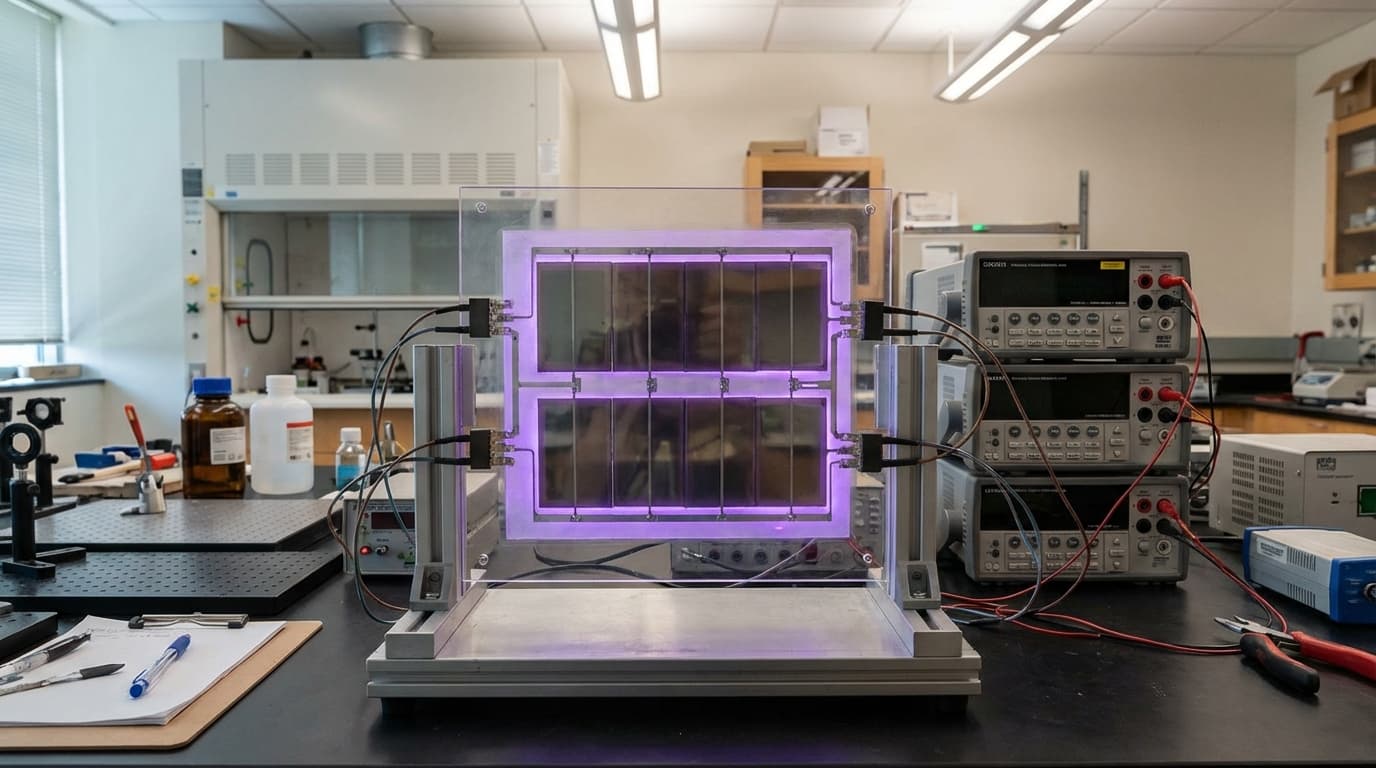
Perovskite Solar Cell
Perovskite solar cells use materials with a perovskite crystal structure—typically hybrid organic-inorganic compounds containing lead or tin halides—that can efficiently convert sunlight into electricity. These materials can be processed from solution at relatively low temperatures, enabling manufacturing using printing, coating, or other low-cost techniques rather than the high-temperature, vacuum-based processes required for silicon cells. Perovskite cells have achieved rapid efficiency improvements, reaching over 25% in laboratory settings, and can be made flexible, semi-transparent, or in various colors, opening new application possibilities.
The technology addresses key limitations of silicon solar cells: manufacturing cost, energy required for production, and limited design flexibility. Perovskite cells can be produced using roll-to-roll printing, potentially reducing manufacturing costs significantly, and can be integrated into building materials, windows, or flexible substrates. The materials also have excellent light absorption properties, working well in low-light conditions and across a broad spectrum. Applications include building-integrated photovoltaics, flexible solar panels, tandem cells that combine with silicon for higher efficiency, and portable or wearable solar devices. Companies and research institutions worldwide are developing perovskite solar technologies.
At TRL 7, perovskite solar cells are being commercialized, though stability and durability remain areas of active development. The technology faces challenges including long-term stability under real-world conditions (moisture, heat, UV light), potential toxicity concerns with lead-based formulations, scaling manufacturing while maintaining quality, and competing with established silicon technology on cost and reliability. However, as stability improves and manufacturing scales, perovskite cells become increasingly viable. The technology could significantly reduce solar energy costs, enable new applications through flexibility and transparency, and accelerate solar adoption by making it more affordable and versatile, potentially transforming how solar energy is integrated into buildings, vehicles, and everyday products.
Related Organizations

A spin-out from the University of Oxford, holding world records for perovskite-on-silicon tandem solar cell efficiency.

Maintains the efficiency charts for solar cells and conducts foundational research on perovskite stability.

Pioneers in inkjet-printed flexible perovskite solar cells for IoT and building-integrated photovoltaics (BIPV).

Formed by the merger of 1366 Technologies and Hunt Perovskite Technologies, focusing on tandem modules.
China · Company
A subsidiary of GCL Tech, developing large-area perovskite modules with significant production capacity targets.

A Chinese leader in perovskite commercialization, having inaugurated a large-scale production line.

Developing lightweight, flexible perovskite tandem solar panels for aerospace and mobile applications.

Uses perovskites to make existing solar modules more powerful by adding a 'perovskite boost' layer.

Acquired Evolar AB to accelerate development of high-efficiency tandem PV technology.
Japan · Company
Developing glass-integrated perovskite solar cells for building facades (BIPV).
Supporting Evidence
Research this in Signals
Signals turns a topic into a sourced research record you can inspect and rerun. Your first scan is free, and this one starts with Perovskite Solar Cell already loaded, so edit it or scan as is.