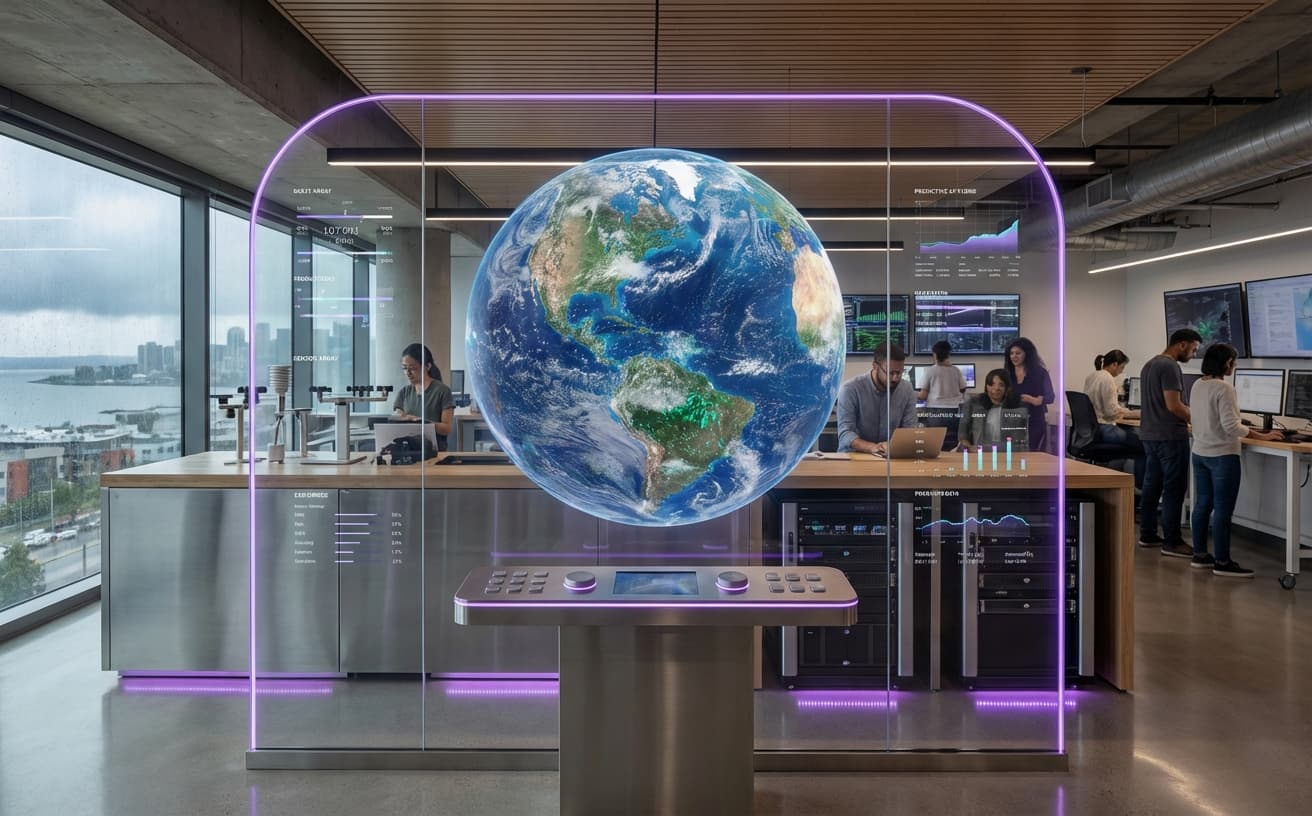
Machine Learning Weather Forecasting
Machine learning weather forecasting uses AI algorithms trained on historical weather data, satellite imagery, radar data, and atmospheric measurements to predict weather conditions with unprecedented accuracy and granularity. Unlike traditional numerical weather prediction models that solve complex physics equations, ML systems learn patterns directly from data, enabling faster predictions, better handling of local variations, and identification of relationships that physical models might miss. These systems can process vast amounts of data simultaneously and continuously improve as they learn from new observations and forecast outcomes.
The technology addresses limitations of traditional forecasting including computational intensity, difficulty modeling local microclimates, and challenges predicting extreme events. ML forecasting can provide hyper-local predictions for specific neighborhoods, generate forecasts much faster than traditional models, and identify patterns that improve prediction of severe weather. Applications include urban planning that accounts for local weather patterns, agriculture that optimizes based on microclimate forecasts, disaster preparedness that predicts extreme events more accurately, and energy management that forecasts renewable generation. Companies like Google (with GraphCast), NVIDIA, and various weather services are developing ML forecasting systems.
At TRL 7, machine learning weather forecasting is being deployed by major weather services and has demonstrated competitive or superior performance to traditional models for certain applications. The technology faces challenges including explainability of ML predictions, handling rare extreme events with limited training data, integration with traditional forecasting systems, and ensuring reliability for critical applications. However, as ML techniques improve and training data expands, these systems become increasingly powerful. The technology could enable more accurate and timely weather predictions that save lives through better disaster warnings, optimize agriculture and energy systems, and enable more precise urban planning, potentially transforming how we understand and respond to weather while improving preparedness for climate change impacts.
Related Organizations

Developers of the Gemini family of models, which are trained from the start to be multimodal across text, images, video, and audio.
China · Company
Developed Pangu-Weather, a 3D high-resolution AI model for global weather forecasting.

Developing foundation models for robotics (Project GR00T) and vision-language models like VILA.

The European Centre for Medium-Range Weather Forecasts, traditionally a numerical modeling hub, now actively integrating ML.

Operates proprietary radar satellites and uses generative AI ('Gale') for weather intelligence.
United States · Startup
Provides AI-meteorology solutions to governments and defense using a proprietary neural network.
United States · Startup
Focuses on sub-seasonal to seasonal (S2S) forecasting using machine learning and ocean data.

Uses a constellation of nanosatellites to collect radio occultation data, fed into ML models for forecasting.
Supporting Evidence
Research this in Signals
Signals turns a topic into a sourced research record you can inspect and rerun. Your first scan is free, and this one starts with Machine Learning Weather Forecasting already loaded, so edit it or scan as is.