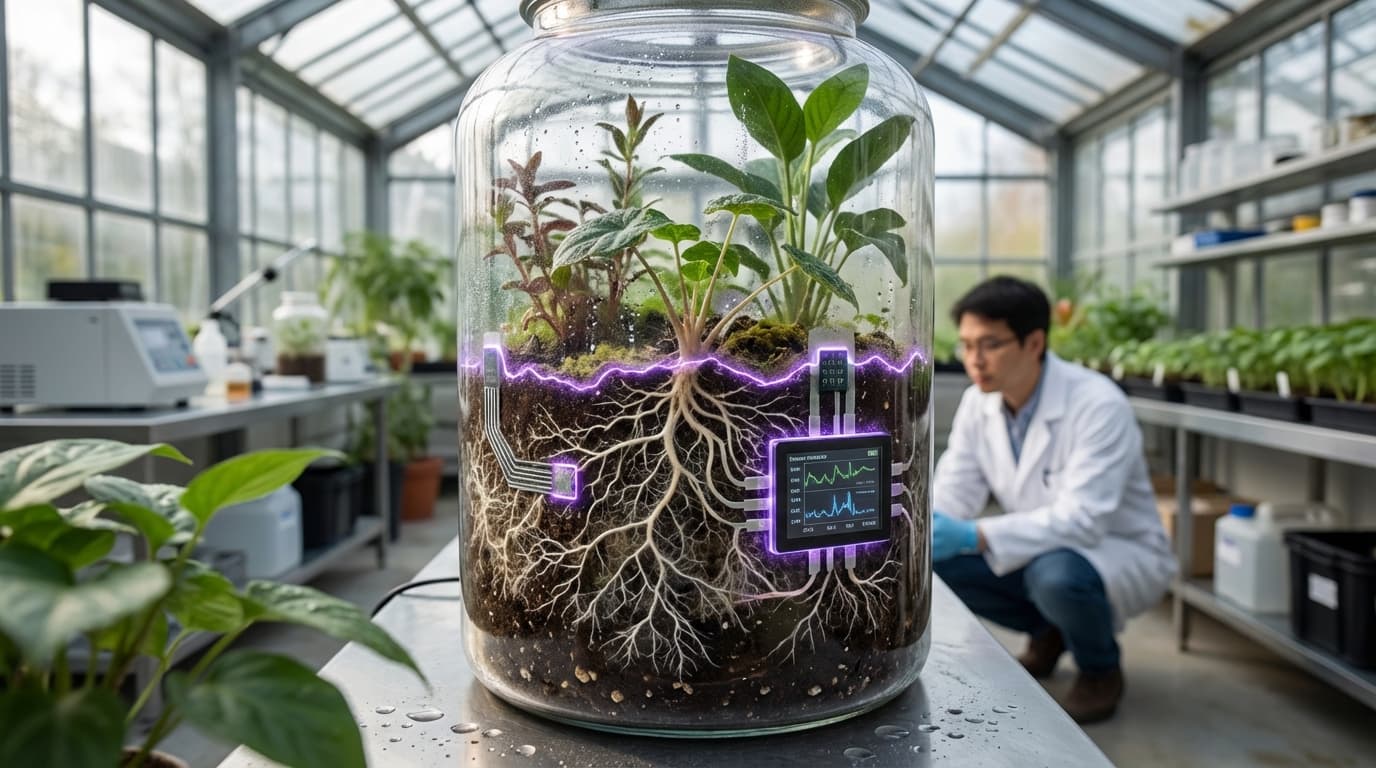
Living Fungal Sensor
Living fungal sensors represent a novel approach to environmental monitoring that leverages the natural sensitivity of fungal mycelium—the root-like network of fungi—to detect and respond to environmental changes. These biohybrid systems integrate living fungal networks with electronic interfaces that translate biological responses into measurable signals. Mycelium naturally responds to various environmental factors including pollutants, humidity, temperature, and chemical changes, making it an ideal biological sensing element.
The technology offers several advantages over traditional electronic sensors: fungi are self-replicating and self-healing, require minimal energy (often just the nutrients in their growth medium), and can detect complex chemical signatures that might require multiple conventional sensors. Research institutions are developing systems where mycelium's electrical conductivity changes in response to environmental conditions, or where fungal growth patterns indicate pollution levels. These sensors could be deployed in soil, water, or air to monitor environmental health continuously.
At TRL 3, living fungal sensors are primarily in laboratory research, with early prototypes demonstrating proof-of-concept for detecting specific pollutants or environmental changes. The technology faces challenges including response time, calibration, integration with existing monitoring infrastructure, and ensuring consistent performance across different environmental conditions. However, as sustainability becomes increasingly important, living sensors offer a unique opportunity to create monitoring systems that are not only environmentally friendly but potentially regenerative. If these challenges can be overcome, fungal sensors could enable widespread, low-cost environmental monitoring that integrates seamlessly with natural ecosystems, providing continuous data on environmental health while requiring minimal resources.
Related Organizations
United Kingdom · Research Lab
Led by Prof. Andrew Adamatzky, this lab pioneers research into fungal computers and mycelium-based sensing networks.
United Kingdom · Research Lab
Research center exploring 'Living Buildings', including the integration of fungal networks for sensing and responsive architecture.

Home to the Organic Robotics Lab, focusing on soft robots that can heal and adapt.

Develops mycelium-based materials for interior design and is researching 'smart' fungal materials that respond to the environment.
Italy · University
Engaged in research on fungal biotechnology and bio-materials, collaborating on projects involving living sensors.

The Centre for Microsystems Technology (CMST) at Ghent is a pioneer in flexible electronics and smart contact lens displays.

Conducts advanced demonstrations like LCRD (Laser Communications Relay Demonstration) and DSOC (Deep Space Optical Comm).

Conducts extensive research on living materials, including fungal mycelium for sensing and responsive surfaces.

A biomanufacturing company using mycelium for construction, researching the thermal and acoustic sensing properties of their materials.

The pioneer of mycelium technology platform (AirMycelium), providing the foundational biology for functional fungal applications.
Supporting Evidence
Research this in Signals
Signals turns a topic into a sourced research record you can inspect and rerun. Your first scan is free, and this one starts with Living Fungal Sensor already loaded, so edit it or scan as is.