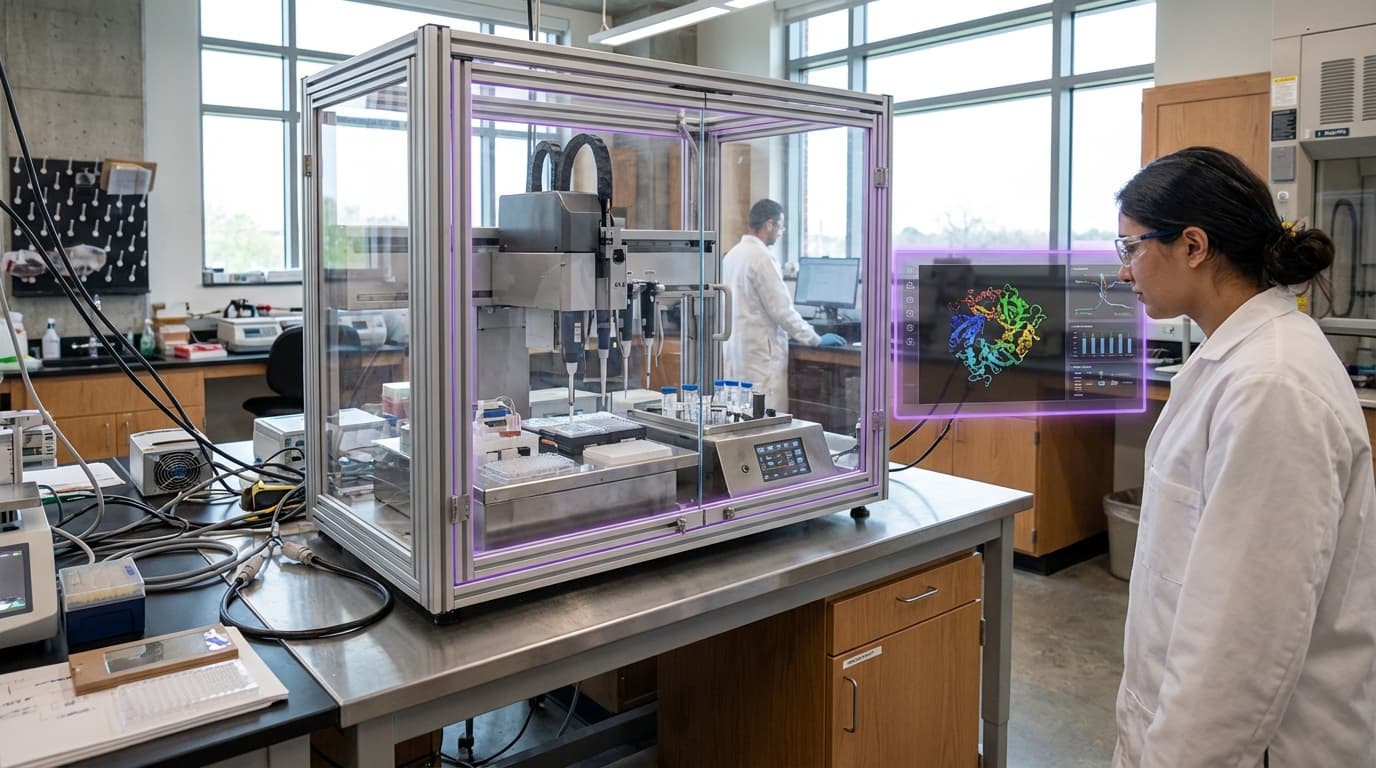
AI-Powered Protein Design
AI-powered protein design uses machine learning algorithms trained on vast databases of protein structures and sequences to predict how amino acid sequences will fold into three-dimensional structures and what properties those structures will have. These AI systems can then design entirely new proteins with specific functions, properties, or binding capabilities, dramatically accelerating a process that traditionally required extensive trial and error. Advanced models like AlphaFold and protein language models have demonstrated remarkable accuracy in predicting protein structures and designing novel sequences.
The technology is transforming protein engineering by enabling rapid design of proteins for specific applications. In medicine, AI-designed proteins can create more effective drugs, vaccines, and therapeutic antibodies. In materials science, designed proteins can create new biomaterials with specific mechanical or chemical properties. In industrial biotechnology, custom enzymes can be designed for specific chemical reactions or processes. Companies like DeepMind, Generate Biomedicines, and Recursion Pharmaceuticals are advancing AI protein design, with some designed proteins already being tested in clinical trials.
At TRL 4, AI-powered protein design has demonstrated the ability to create functional proteins, with some designs being validated experimentally and moving toward applications. The technology faces challenges including ensuring designed proteins fold correctly in real conditions, predicting all relevant properties beyond structure, experimental validation of designs, and understanding the full range of possible protein functions. However, as AI models improve and training data expands, protein design becomes increasingly powerful. The technology could enable rapid development of new therapeutics, materials, and industrial enzymes, potentially transforming multiple industries by making protein engineering as predictable and rapid as software development.
Related Organizations

Academic hub at the University of Washington led by David Baker, creating tools like RosettaFold and RFdiffusion.

A subsidiary of Alphabet applying AI (specifically AlphaFold technology) to reimagine the drug discovery process.

Uses generative AI to create de novo protein therapeutics across multiple modalities.

Developing Large Language Models (LLMs) trained on protein sequences to design functional proteins.

A generative AI drug creation company focused on creating de novo antibodies.

Uses generative AI to help biologists design improved proteins and accelerate R&D pipelines.
United States · Startup
Uses evolutionary deep learning to design novel proteins with enhanced functionality.

Builds a knowledge graph of global biodiversity to train AI models for protein design.

A clinical-stage biotechnology company using generative AI for end-to-end drug discovery and research.

Combines quantum computing and machine learning to design new peptides and proteins.
Supporting Evidence
Research this in Signals
Signals turns a topic into a sourced research record you can inspect and rerun. Your first scan is free, and this one starts with AI-Powered Protein Design already loaded, so edit it or scan as is.